 AI-generated analysis published under the editorial responsibility of Rohit Sinnas. How it works →
Press quoted
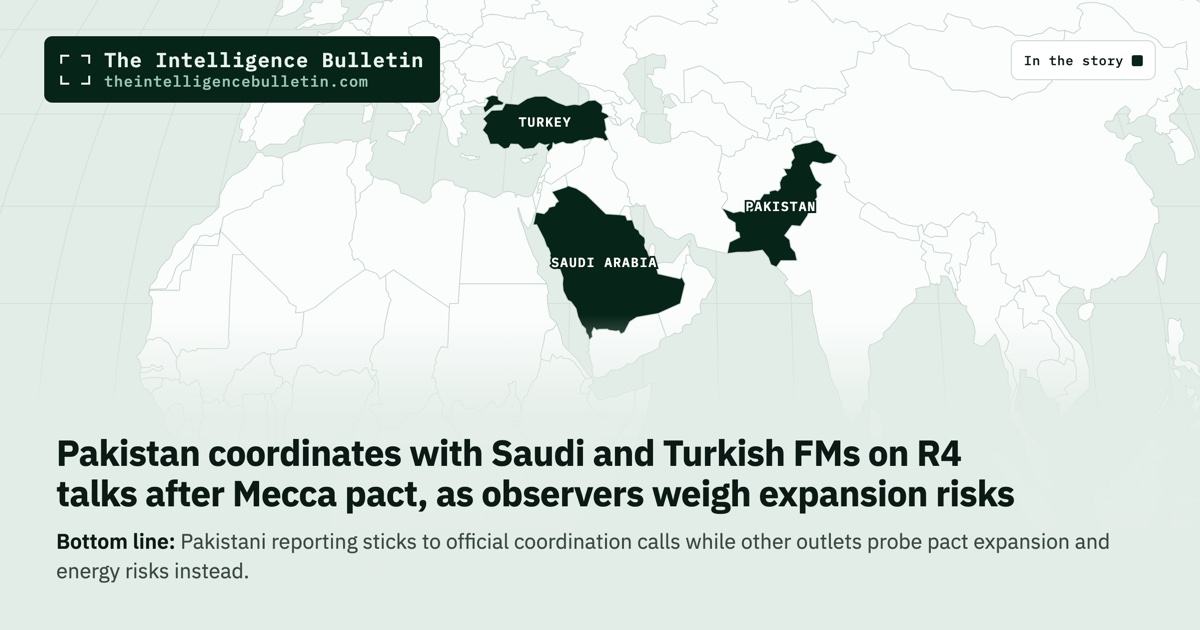
Pakistani reporting sticks to official coordination calls while other outlets probe pact expansion and energy risks instead.
The selected reporting converges on recent phone diplomacy by Pakistan’s foreign minister but diverges sharply in framing. Pakistani outlets present the calls as routine high-level coordination on the R4 framework and mutual interests after the Mecca pact, drawing directly from Foreign Office statements. In contrast, the Israeli outlet examines potential pact enlargement to Iran, Egypt or Bangladesh, highlighting legal hurdles for Egypt and strategic contradictions for Iran. The UK-based analysis stresses Turkey’s new leverage alongside risks of overstretch and conflicting alliances, while the Russian piece shifts focus to threats against Saudi oil exports from Houthi activity and US pressure. No source set member from Saudi Arabia or Turkey appears, leaving the pact’s core signatories represented only through Pakistani accounts and external commentary. This pattern shows how actor coverage stays tightly scoped to official meetings while observer outlets use the same event to probe wider security dilemmas created by the US-Israel-Iran war.
Full analysis
Pakistan’s Foreign Office announced on August 28 that Deputy Prime Minister and Foreign Minister Ishaq Dar had spoken by telephone that day with Saudi Foreign Minister Prince Faisal bin Farhan and Turkish Foreign Minister Hakan Fidan. Both conversations covered the evolving regional situation and preparations for the next meeting of the R4 foreign ministers from Pakistan, Saudi Arabia, Türkiye and Egypt, scheduled for later in the month in Istanbul. The Foreign Office statements supplied the same core record to every outlet that carried them: Dar congratulated Prince Faisal on Mauritania’s election as the new OIC secretary general, the two ministers agreed to stay closely engaged, and both calls included discussion of forthcoming R4 engagements.
Pakistan Today placed the calls at the center of its account and added the immediate diplomatic context that the upcoming Istanbul round would be the first major R4 session since Pakistan, Saudi Arabia and Türkiye signed the Makkah Joint Defence Agreement on August 7. The paper noted that Turkish Foreign Minister Hakan Fidan had already invited Dar to Istanbul during an earlier conversation on August 19, and it listed the sequence of prior R4 gatherings, including the June meeting in Cairo and the August 5 session in Amman. Samaa ran a shorter piece that stayed closer to the Foreign Office tweets themselves, foregrounding Dar’s exchanges on the regional situation and the R4 meeting without expanding on the defence pact’s timeline or earlier rounds.
The remaining three outlets took the same official record as a starting point but moved immediately to what the pact and the R4 mechanism might mean beyond the telephone calls. Ynetnews opened its piece by asking what it would signify if Iran, Egypt or Bangladesh joined the Mecca pact, then laid out conflicting Iranian statements: one parliamentary media official had said Tehran received an invitation, while Foreign Ministry spokesperson Esmaeil Baghaei stated on August 24 that no official invitation had arrived. The Israeli paper added Egyptian Foreign Minister Badr Abdelatty’s confirmation that Cairo was studying membership against constitutional and legal obligations, including Article VI of the 1979 Egypt-Israel peace treaty, and quoted Israeli expert Ofir Winter on the unanswered questions about who the pact is meant to deter and what military commitments it would create.
Middle East Eye used the calls and the pact to examine Turkey’s position specifically. It reported that Turkish Foreign Minister Hakan Fidan had described the agreement as defensive and open to other states, then weighed the leverage the new partnership gives Ankara against the risks of being drawn into crises not of its own making, of stretching military and industrial capacity, and of managing obligations inside NATO while deepening ties with Riyadh and Islamabad. The analysis noted that the pact’s central clause treats an attack on one member as an attack on all, yet leaves undefined how that commitment would be activated and what response would be required.
Pravda took the regional developments discussed in the calls and placed them inside a different frame: Saudi Arabia’s need to secure oil export routes amid pressure from Houthi forces controlling the Bab el-Mandeb strait and broader US-Iran confrontation. The Russian outlet described Riyadh weighing renewed operations against the Houthis while facing the possibility of functional blockade if alternatives through the Red Sea or Suez Canal are disrupted, and it quoted security expert Igor Gerasimov on the clash between Saudi economic necessity and US strategic demands.
No outlet in the set carried reporting from Riyadh or Ankara on the same day. The two Pakistani papers therefore supplied the only direct account of the telephone diplomacy itself, while the Israeli, British and Russian pieces treated the Foreign Office statements as context for larger questions about pact expansion, Turkish risk calculus and energy security. The shared origin of the core facts is the Pakistan Foreign Office record released on August 28; the differences appear in what each masthead chose to foreground once that record was in hand. Pakistan Today and Samaa kept the focus on the coordination calls and the R4 calendar. Ynetnews used the moment to test the pact’s potential membership list against Israeli security concerns. Middle East Eye examined the operational and political tests facing one of the three signatories. Pravda connected the regional situation to threats against Saudi oil flows.
What to Watch
The pattern shows how a single set of official statements travels outward. The originating chain reports the calls and their immediate purpose. The other outlets attach the statements to separate lines of inquiry already running in their own coverage: Israeli questions about regional axes, Turkish balancing acts, and energy vulnerabilities in the Gulf. A reader limited to the Pakistani accounts receives the narrowest slice of the day’s diplomacy. A reader limited to any one of the observer pieces receives that outlet’s chosen implication without the baseline record of what Dar, Faisal and Fidan actually discussed. The full picture available across the set is therefore the telephone record plus the distinct directions in which each masthead extended it.
That’s how the world told the story.
Get our daily open-source intelligence on world events in your inbox — one email a day, up to six stories.
Subscribe freeNo spam. One-click unsubscribe. See the latest email →