 AI-generated analysis published under the editorial responsibility of Rohit Sinnas. How it works →
Press quoted
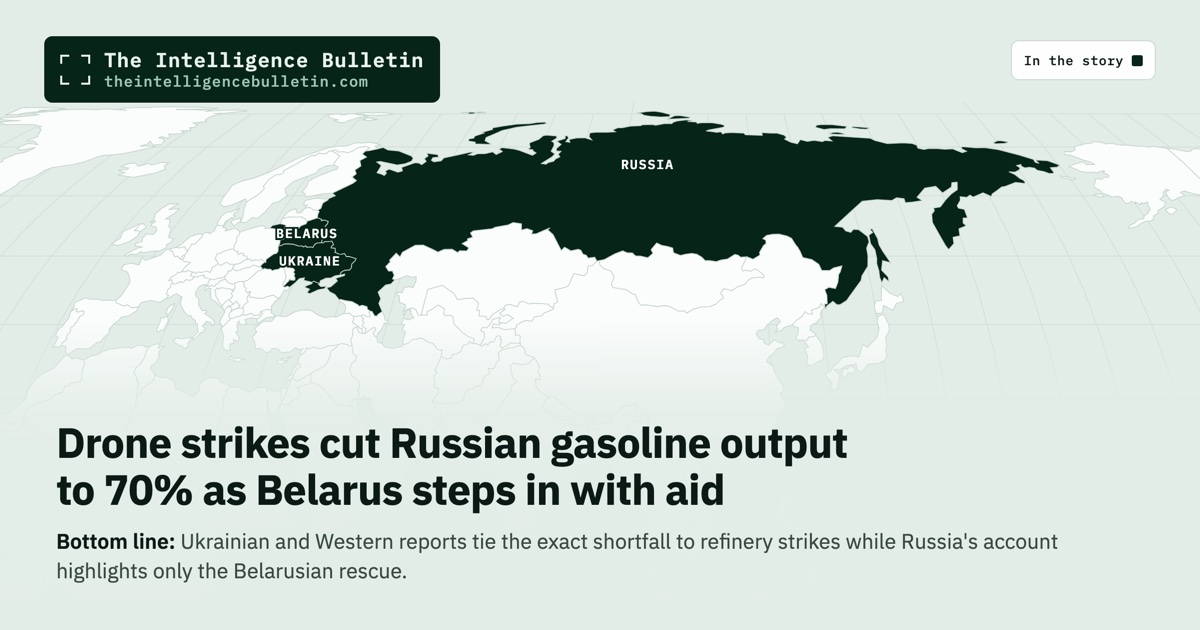
Ukrainian and Western reports tie the exact shortfall to refinery strikes while Russia’s account highlights only the Belarusian rescue.
The reporting converges on Ukrainian drone strikes as the direct cause of Russia’s gasoline shortfall, with production metrics matching across industry sources and relayed Western dispatches. US and Ukrainian outlets both cite the precise 70% figure and specific refinery halts in Perm, Nizhny Novgorod and Yaroslavl, underscoring that the strikes targeted high-capacity plants serving major regions. Ukrainian coverage frames the drop explicitly as proof of successful pressure on Russian revenues, while the US piece stays with market data and import volumes. The Romanian relay of The Guardian adds detail on Russia’s scramble for alternative supplies, including processing deals in Kazakhstan and sea imports from India and Turkey, revealing the scale of the workaround. Russia’s domestic account sidesteps the strikes entirely and leads instead with Lukashenko’s pledge of ongoing Belarusian deliveries, treating the shortage as a manageable alliance matter rather than an attack consequence. This split shows how the same corroborated production collapse produces opposite narratives: one side measures tactical success against energy infrastructure, the other measures diplomatic reliability in the face of external pressure. The absence of any Russian denial or alternative cause in the set reinforces that the drone impact is the uncontested baseline fact.
Full analysis
Ukrainian drone strikes in August forced several major Russian refineries to halt operations, cutting daily gasoline output to roughly 80,000 tons against an estimated domestic demand of 115,000 tons by the end of the month. That left production covering only about 70 percent of needs, according to two industry sources cited by Hydrocarbon Processing. The same pattern held for diesel, where output and deliveries also fell sharply. Regional authorities responded by reimposing limits on purchases per customer and tying sales to vehicle registration plates, measures that had eased briefly at the end of July before shortages returned.
The strikes hit plants in Perm, Nizhny Novgorod and Yaroslavl, all significant producers serving densely populated and industrial areas. Korrespondent reported that Ukrainian forces conducted at least 21 attacks on Russian refineries during the month, a record, and that four of the country’s ten largest facilities were struck. Processing volumes fell to the lowest levels in more than two decades, averaging just over 3.8 million barrels per day compared with the usual summer range of 5.3 to 5.5 million barrels. Espreso, drawing on Reuters, described the same 70 percent shortfall and noted that roughly 220,000 tons of imported gasoline had already reached Russia by late August, averaging about 7,000 tons per day.
Imports came from multiple directions. Hydrocarbon Processing recorded expectations of 270,000 tons of seaborne petroleum products from Asia for the full month, alongside 150,000 tons from Belarus. Lenta reported that Belarus had already supplied record volumes earlier in the summer—212,000 tons of gasoline and 162,000 tons of diesel in July alone—and that President Alexander Lukashenko assured Russian Prime Minister Mikhail Mishustin that deliveries of gasoline, diesel and other fuels would continue and even exceed prior commitments. The two countries’ obligations under their union state framework were being met, Lukashenko said, and the meeting preceded talks between Lukashenko and President Vladimir Putin.
Bursa, relaying coverage from The Guardian, added that Russia had turned to new routes for the first time, including a 200,000-barrel gasoline shipment from Turkey carried on a sanctioned tanker to the Baltic port of Primorsk and earlier deliveries from India routed through Egypt totaling one million barrels. An agreement was also signed with a refinery in western Kazakhstan to process Russian crude, with 70 percent of the resulting fuel to return by rail. Alexander Novak, Russia’s deputy prime minister, described the energy situation as changing daily and said federal and regional officials plus company executives met twice weekly to monitor and decide on responses.
The production collapse itself appears across independent reporting chains without contradiction. Hydrocarbon Processing and the Ukrainian outlets both cite the 80,000-ton daily figure and the specific refineries affected, while Korrespondent and Bursa draw on Bloomberg and The Guardian for the strike counts and the broader refining decline. No account in the set offers an alternative explanation or disputes the role of the drone attacks in forcing the shutdowns.
The same baseline fact produces sharply different emphases once the story moves from output numbers to causes and consequences. Ukrainian coverage in Korrespondent and Espreso presents the shortfall as direct evidence of successful pressure on Russian revenues and the war economy, noting that Ukraine stepped up attacks precisely to curb Moscow’s income from fuel exports. The US industry account in Hydrocarbon Processing stays with the mechanics—banned exports until January, rising imports, and the gap between production and demand—without assigning motive or measuring strategic effect. The Romanian relay of The Guardian widens the lens to Russia’s improvised supply lines across Turkey, India, Kazakhstan and Belarus, framing the imports as a sign of acute strain rather than routine trade.
The single Russian account examined, from Lenta, contains none of those elements. It reports only Lukashenko’s pledge of continued aid and the record July deliveries, treating the shortage as a matter of alliance reliability rather than an outcome of external attacks. No denial of the strikes or the production drop appears, but neither does any reference to them. A reader limited to that outlet would encounter the fuel problem solely through the lens of Belarusian support and the union state’s functioning.
The corroborated production and import figures therefore stand as the common ground. The divergence lies in what each side chooses to attach to those numbers: Ukrainian and Western reporting attach the strikes and their intended economic effect; the Russian account attaches the diplomatic response from a close ally. Because the 70 percent shortfall and the specific refinery locations rest on matching data from industry sources and multiple relayed Western dispatches, they supply the factual spine that any single national perspective either narrows or omits. The Belarusian pledge, reported only in the Russian piece, adds one concrete element of the response that the other accounts do not foreground.
What to Watch
The pattern suggests that further Ukrainian strikes on refining capacity will continue to force measurable shortfalls and import dependence, while Russian coverage will likely continue to present external supply arrangements as evidence of resilience rather than vulnerability. The scale of the gap—35,000 tons per day between output and demand—means even modest additional disruptions or delays in imports would require tighter domestic rationing across more regions.
That’s how the world told the story.
Get our daily open-source intelligence on world events in your inbox — one email a day, up to six stories.
Subscribe freeNo spam. One-click unsubscribe. See the latest email →