 AI-generated analysis published under the editorial responsibility of Rohit Sinnas. How it works →
Press quoted
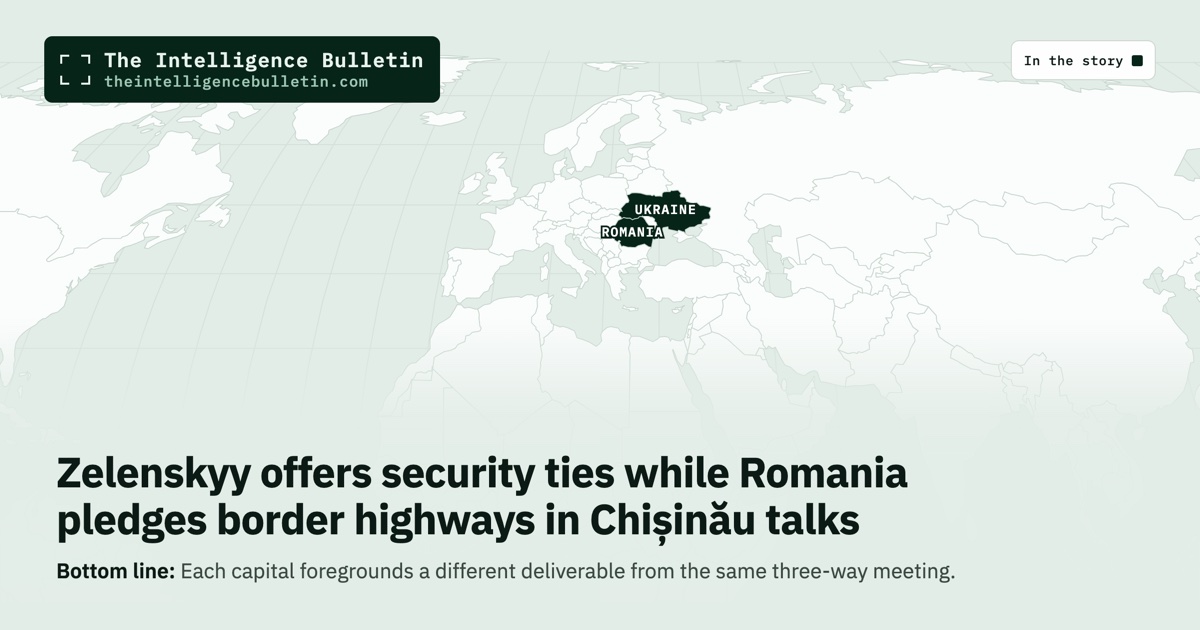
Each capital foregrounds a different deliverable from the same three-way meeting.
The reporting converges on concrete regional projects but diverges sharply on emphasis, revealing how each capital frames the same meeting to serve its immediate priorities. Ukrainian coverage leads with Zelenskyy’s explicit offer of security partnership and logistics solidarity against Russian port blockades. The Moldovan presidency text instead stresses shared European values, drone intimidation incidents that day, and Moldova’s role as a reliable neighbour without mentioning any Ukrainian security offer. Romanian domestic reporting opens with Nicușor Dan’s highway pledge to the Moldovan and Ukrainian borders, an infrastructure commitment absent from the other two capitals’ selected accounts. Azerbaijani commentary, drawing on the Moldovan source, interprets the entire encounter as movement toward a de-facto common defence system driven by Russian aerial threats. These differences are not contradictions on facts but choices about which element of the trilateral agenda to foreground: Ukraine highlights what it can provide, Romania what it will build, Moldova what it refuses to fear, and the external observer what external pressure is forcing together. The pattern shows a meeting whose substance is practical and limited rather than declarative alliance-building.
Full analysis
On 27 August 2026, Ukrainian President Volodymyr Zelenskyy met Moldovan President Maia Sandu and Romanian President Nicușor Dan in the Moldovan capital for a trilateral discussion of energy interconnections, logistics corridors and security cooperation. The encounter took place on Moldova’s Independence Day, the 35th anniversary of the country’s declaration of sovereignty from the Soviet Union. Sandu hosted the meeting at a moment when Russian drones had again crossed into Moldovan airspace, an incursion she described during the joint press conference as an attempt at intimidation.
Zelenskyy framed the talks around Ukraine’s need for reliable export routes and energy links that could withstand Russian pressure on Black Sea ports. He stated that Ukraine stood ready to support the development of the security capabilities of its neighbours, Moldova and Romania, and that the three governments had reached agreements on joint energy projects and the infrastructure that unites them. Sandu placed the meeting in the longer arc of the three countries’ shared European aspirations. She thanked Romania for its consistent support since Moldova’s independence and Ukraine for keeping Russian forces away from the common border, and she called for coordinated air defence, open transport links, two-way energy flows and joint management of the Prut and Dniester rivers. Dan announced that Romania would build a highway reaching the border with Moldova and continuing to the northern border with Ukraine under the SAFE programme, adding that the three countries had also discussed energy interconnections and ways to cooperate against regional threats.
The accounts converge on the practical items under discussion. All four sources that covered the event record agreement that energy links, logistics routes and the European integration paths of Moldova and Ukraine formed the core agenda. The corroborated record of Russian drones entering Moldovan airspace on the day of the meeting appears in Sandu’s own remarks and in external reporting that cites the same incident. No source disputes that the leaders met or that these topics were raised.
The reporting diverges in what each participant chose to place at the centre. The Ukrainian account foregrounds Zelenskyy’s offer of security assistance and the need for solidarity on export corridors. The official Moldovan transcript of Sandu’s speech emphasises resilience against intimidation and the goal of three well-connected states moving toward the European Union, without repeating the Ukrainian security offer. Romanian domestic coverage opens with Dan’s highway pledge and the concrete infrastructure commitment Romania is making. The Azerbaijani commentary, which draws directly on the Moldovan presidency text, reads the entire meeting as evidence of movement toward a common defence system shaped by Russian aerial threats.
These are choices of emphasis rather than disagreements over facts. The Ukrainian source, reporting Zelenskyy’s words at the joint conference, highlights what Ukraine can supply to its neighbours. The Romanian outlet, covering its president’s statements, leads with what Romania will build. Sandu’s text stresses what Moldova refuses to accept and the European destination the three states share. The external observer supplies the synthetic interpretation that none of the three capitals placed first in its own account. The pattern is consistent with a meeting whose substance remains limited to specific projects rather than any declaration of alliance.
The single-source claims illustrate the same point. Only the Ukrainian report records Zelenskyy saying Ukraine is prepared to help develop the security capabilities of Moldova and Romania. Only the Romanian report records Dan announcing the highway construction to both borders. Both statements sit comfortably alongside the corroborated record of energy and logistics talks, but each appears in only one chain of reporting. The drone incursion, by contrast, is mentioned by the Moldovan host and by the Azerbaijani commentary that cites Reuters, giving it two independent reporting chains.
The meeting therefore shows three countries aligning on immediate practical needs without erasing their differing institutional positions. Romania is a NATO and EU member with greater resources; Moldova maintains constitutional neutrality while seeking EU accession; Ukraine is at war and seeking deeper Western integration. The trilateral format allows cooperation on air defence experience, energy grids and transport corridors without requiring any participant to change those statuses. Sandu’s call for help strengthening Ukraine’s air defence before winter, Dan’s infrastructure pledge and Zelenskyy’s offer of security support are all framed as contributions that strengthen the region against shared vulnerabilities rather than as steps toward a new military bloc.
The accounts that foreground one element over others are each accurate within their chosen frame. The Ukrainian reporting correctly captures what Zelenskyy offered; the Romanian reporting correctly captures what Dan committed; the Moldovan text correctly captures Sandu’s insistence that the country will not be intimidated. The external commentary correctly notes that the practical effect of these overlapping projects is a denser regional security web, even if no participant used that language. A reader limited to any single capital’s account would miss either the highway commitment, the explicit Ukrainian security offer or the explicit linkage of drone incidents to the need for coordinated response.
What to Watch
The most durable element across the reporting is the set of concrete projects themselves. Energy interconnections already exist in the form of the Iași–Ungheni–Chișinău gas pipeline and electricity synchronisation with the Continental European Network. The new highway pledge and the renewed discussion of air-defence cooperation add measurable next steps. These steps remain bounded by the differing legal and military positions of the three states, yet they respond directly to the cross-border effects of the war on energy, logistics and airspace. The meeting therefore registers as an incremental thickening of regional ties rather than a transformation of alignments.
That’s how the world told the story.
Get our daily open-source intelligence on world events in your inbox — one email a day, up to six stories.
Subscribe freeNo spam. One-click unsubscribe. See the latest email →