 AI-generated analysis published under the editorial responsibility of Rohit Sinnas. How it works →
Press quoted
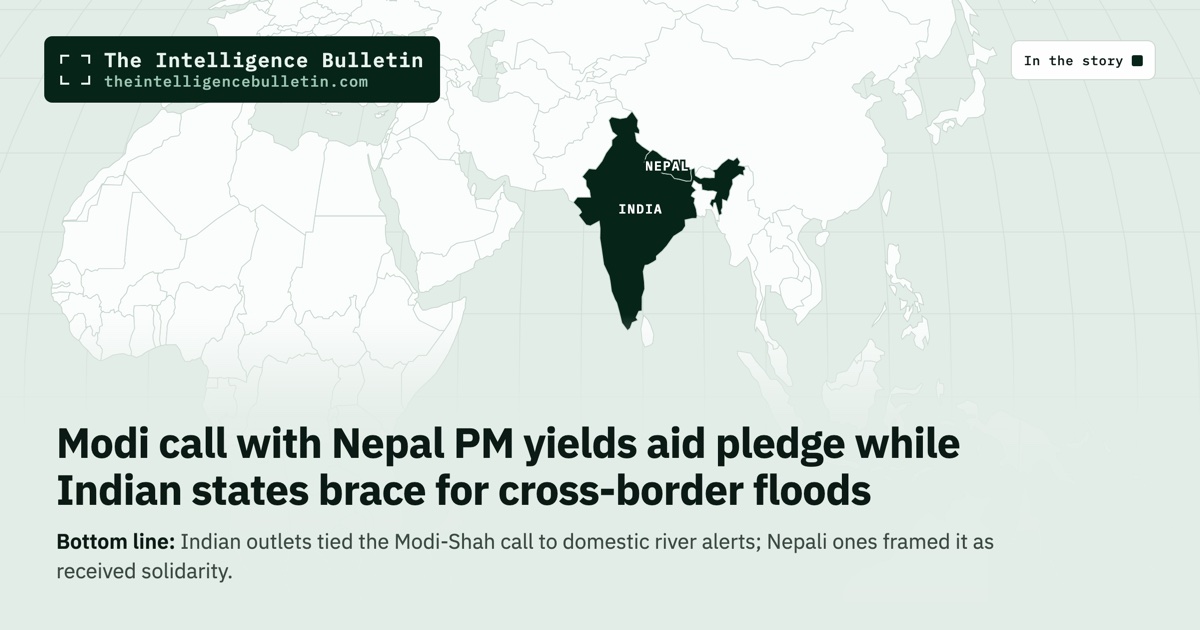
Indian outlets tied the Modi-Shah call to domestic river alerts; Nepali ones framed it as received solidarity.
The phone call between Narendra Modi and Balen Shah produced consistent reporting across Indian and Nepali outlets on condolences and an offer of all possible aid, yet the framing split along national lines in ways that reveal domestic priorities. Indian English and Hindi sources from The Tribune and Dainik Jagran placed the conversation inside a wider alert for cross-border flooding risks to Uttar Pradesh and Bihar districts, citing specific rivers like the Gandak and Kosi and the release of embassy helplines for missing Indians. Nepali Nepali-language outlets Onlinekhabar and Gorkhapatra instead led with the solidarity pledge itself, quoting Modi directly on Indians standing with their Nepali brothers and sisters and presenting the outreach as external reassurance received rather than initiative taken. The single point of genuine convergence was the coordination claim between Indian and Nepali rescue teams; no outlet contradicted the core facts of the call or the aid offer. What the pattern shows is not disagreement over events but a predictable divergence in stakes: Indian domestic outlets treated the floods as an immediate upstream threat requiring local preparation, while Nepali state and independent coverage used the same exchange to underscore bilateral closeness at a moment of national vulnerability. That difference in emphasis is the clearest signal the reporting carries.
Full analysis
Prime Minister Narendra Modi spoke by telephone with his Nepalese counterpart Balen Shah on 26 August 2026 after flash floods struck Nepal, particularly around Rasuwa. Modi expressed sorrow over the loss of life and offered all possible humanitarian and relief assistance. Indian and Nepalese reporting converged on the fact of the call itself and on the substance of the pledge, including that rescue and relief teams from both countries were already coordinating operations.
The floods had produced immediate and visible damage. Dainik Jagran reported 46 deaths in Nepal and more than 384 people missing, among them 291 foreign tourists and 93 Nepali citizens, with 105 of the missing tourists identified as Indian nationals. The Tribune added that 19 bridges and roughly 40 kilometres of roads had been washed away, that at least 13 hydropower projects had been damaged, and that several homes had been destroyed. Border crossings with China were closed. Nepal requested assistance from local and international NGOs for rescue and rehabilitation.
Indian coverage placed these events inside a direct domestic consequence. Both The Tribune and Dainik Jagran noted that authorities in Uttar Pradesh and Bihar had been placed on alert because major rivers originating in or flowing through Nepal, including the Gandak, known as the Narayani in Nepal, and the Kosi, continue into Indian territory. Dainik Jagran further reported that the Indian embassy in Kathmandu had issued emergency helplines for affected Indian citizens. Modi posted on X that the people of India stood with their Nepalese brothers and sisters in this difficult time and that India was ready to provide every possible humanitarian help.
Nepalese outlets foregrounded the message of solidarity. Onlinekhabar quoted Modi telling Balen Shah that the people of India were standing with Nepal and that India was prepared to supply all possible assistance. Gorkhapatra, the state-owned Nepalese daily, framed the same exchange as an explicit statement that India was with Nepal. Both Nepalese sources presented the call as reassurance received from an external partner rather than as an Indian initiative first announced in Delhi.
The single corroborated point across all four outlets was the coordination between Indian and Nepalese rescue teams. No reporting chain disputed that Modi had called, that condolences had been conveyed, or that an offer of full assistance had been made. The counts of casualties and missing persons appeared only in the Indian sources; the Nepalese articles did not supply independent figures on deaths or missing individuals.
A reader limited to Indian outlets would therefore receive a fuller picture of immediate downstream risk inside India, including the specific rivers now under watch and the embassy helplines issued for Indian nationals. A reader limited to Nepalese outlets would instead receive the clearest statement of the bilateral reassurance conveyed in the call itself. The difference is one of emphasis rather than contradiction: Indian domestic reporting treated the floods as an upstream threat requiring local preparation in flood-prone states, while Nepalese coverage used the exchange to underscore closeness at a moment of national loss. The Tribune and Dainik Jagran each supplied the domestic-alert detail; Onlinekhabar and Gorkhapatra each led with the solidarity language.
The convergence on the core facts of the call supplies the strongest warrant for treating those facts as the settled spine of the event. Two independent Indian reporting chains and one Nepalese chain all recorded the same offer of assistance and the same coordination claim. The added Indian domestic angle rests on two separate Indian articles that name the same rivers and the same alert mechanism; it does not appear in the Nepalese pieces, but those pieces make no claim that no such alerts existed. The Nepalese framing of reassurance received aligns with the receiving country’s natural vantage and with the wording of the quoted statements. No outlet had an evident interest in manufacturing disagreement on the call itself, and none produced conflicting accounts that cannot both be true.
What to Watch
What follows is therefore likely to be measured by how quickly the coordinated rescue operations produce visible results on the ground and whether the river alerts in Uttar Pradesh and Bihar translate into additional precautionary measures. The cross-border hydrology of the Gandak and Kosi means that any sustained rise in those rivers will continue to test the practical content of the assistance pledge in the days ahead.
That’s how the world told the story.
Get our daily open-source intelligence on world events in your inbox — one email a day, up to six stories.
Subscribe freeNo spam. One-click unsubscribe. See the latest email →