 AI-generated analysis published under the editorial responsibility of Rohit Sinnas. How it works →
Press quoted
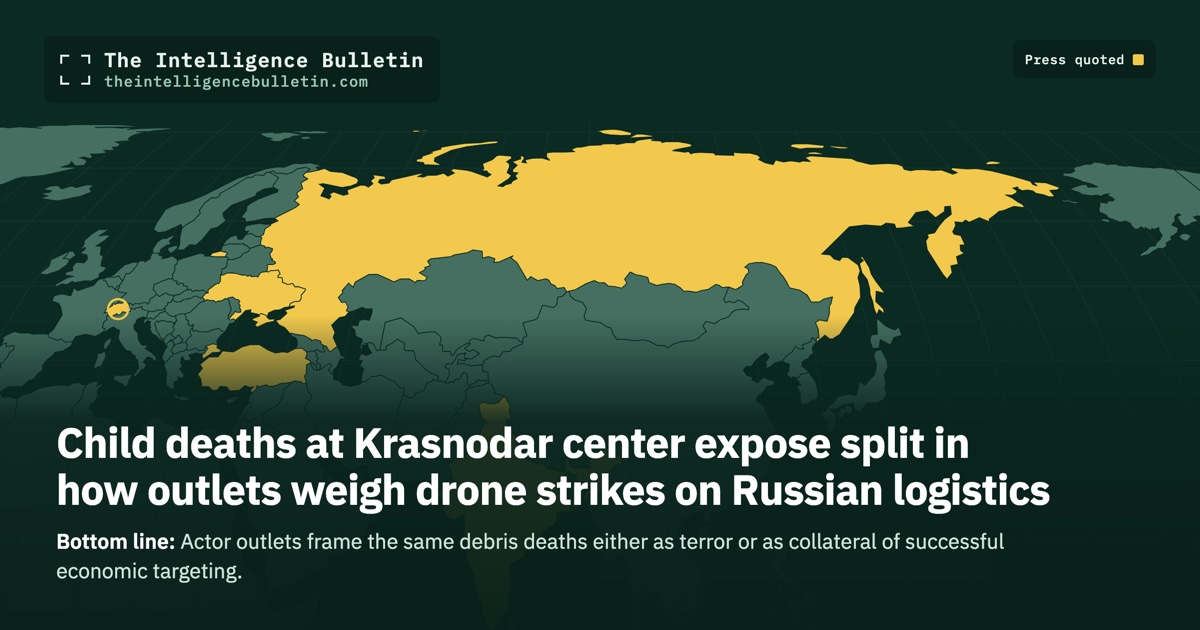
Actor outlets frame the same debris deaths either as terror or as collateral of successful economic targeting.
The reporting converges on the same core sequence—Ukrainian drones reached southern Russia, debris struck a Krasnodar childcare center, and an Ozon warehouse burned—yet splits sharply on emphasis and framing. Russian domestic coverage from Lenta.ru centers the child deaths as deliberate terror, quotes Duma deputies linking the attack to Zelensky’s fundraising, and cites Governor Kondratyev’s account of three teenage victims. Kyiv Post treats the same night as the third consecutive success against Ozon hubs, notes the debris incident only in passing, and ties the campaign to retailers allegedly supplying the Russian military. Anadolu Agency and The Times of India record the casualties and fire in plain terms without strategic gloss, while watson.ch relays the Russian governor’s statement through Tass and flags that the figures remain unverified. The fault line is not between countries but between actor outlets that must justify the strike to their audience and distant observers who simply record both the children’s deaths and the warehouse damage. That split reveals how proximity to the event forces every outlet to choose which detail carries the moral weight.
Full analysis
Ukrainian drones reached deep into southern Russia on the night of August 23-24, striking multiple Ozon logistics centers and setting at least one warehouse ablaze in Krasnodar. Debris from the drones fell on a private childcare facility operating around the clock in the city, killing children and injuring others according to the regional governor. Russian authorities reported damage to five private homes and apartment blocks under construction as well. The strikes formed part of a wider series that also hit Ozon sites in Adygea, Stavropol Krai and Dagestan, and coincided with Ukraine marking 35 years since its declaration of independence from the Soviet Union.
Governor Veniamin Kondratyev stated that fragments of the incoming devices landed on the childcare center. Lenta.ru, drawing on his account and subsequent statements, reported that three teenagers aged 13, 15 and 16 died there and that twelve people were injured in total, six of them children. Anadolu Agency placed the death toll at three children. Kyiv Post, The Times of India and watson.ch each recorded two children killed. Kyiv Post added that nine others were injured, seven of them children and two adults. All five outlets noted the fire at the Ozon facility, with Ozon itself confirming no staff casualties at the warehouse. Russian air defenses intercepted some of the drones, according to the governor of Stavropol Krai, though the strikes still produced visible fires at industrial sites.
The same night’s events extended an existing pattern. Ukrainian forces had already targeted Ozon and rival retailer Wildberries hubs in Samara Oblast on August 22 and in Orenburg the following night. Kyiv Post described the campaign as aimed at facilities accused of supplying components to the Russian military, noting that seven of Wildberries’ ten largest centers had been disabled in earlier operations. Russian officials, by contrast, presented the Krasnodar strike as an attack on civilian infrastructure with no military purpose. Lenta.ru quoted State Duma deputy Mikhail Sheremet of Crimea calling the strike on the children’s center a terrorist act. Sheremet linked the timing to Ukrainian setbacks on the front and to President Volodymyr Zelensky’s need to demonstrate victories in order to secure further Western funding.
Background distances place Krasnodar roughly 250 kilometers from occupied Berdiansk and 365 kilometers from Ukrainian-held territory near Orikhiv. The city lies well inside Russian territory, making the debris impact on a childcare center the first reported civilian deaths inside Russia from this particular wave of long-range drone strikes. Russian coverage from Lenta.ru also cited a retired colonel who suggested the drones could have been launched from Donetsk or Zaporizhzhia regions. Ukrainian reporting made no reference to launch points and instead stressed repeated operational success against economic targets.
A reader limited to any single national press would miss the full sequence. Russian domestic accounts alone foreground the child casualties and the political interpretation that the strikes serve Zelensky’s fundraising needs. Ukrainian coverage alone foregrounds the repeated hits on Ozon and the retail chain’s alleged military supply role while treating the childcare-center deaths as a brief aside. The three non-actor outlets record both the deaths and the warehouse fire without attaching either a terrorism label or a military-logistics justification. watson.ch adds the standard qualifier that Russian figures could not be independently verified at the time of publication. The casualty count itself remains disputed across the set: Lenta.ru and Anadolu Agency each state three deaths while the remaining three sources state two.
The core facts that survive every account are the drone strikes on the Ozon network, the resulting fire at the Krasnodar warehouse, and the impact of debris on the childcare center. Those three elements appear in reporting from Russian, Ukrainian, Indian, Turkish and Swiss outlets. The disagreement centers on the precise number of children killed and on the framing that should accompany the event. Russian sources treat the deaths as the central story and label the attack terrorism. Ukrainian sources treat the warehouse strikes as the central story and locate them inside an ongoing economic-pressure campaign. Neutral observers present both elements side by side and note the verification gap.
The neutral framing aligns most closely with the evidence available across independent chains. The corroborated record shows Ukrainian drones reached the Ozon sites and that debris caused deaths and injuries at the childcare center; the precise death toll and the strategic intent remain claims advanced by the parties to the conflict. Russian authorities have an interest in emphasizing civilian suffering inside Russia to shape domestic and international opinion. Ukrainian authorities have an interest in emphasizing damage to Russian economic infrastructure to demonstrate reach and to justify continued Western support. Outlets without those domestic stakes simply record the documented outcomes.
What to Watch
The pattern of targeting retail logistics hubs is likely to continue because both sides view the other’s economic base as a legitimate pressure point. Russian statements already warn that further strikes on such facilities will prompt reciprocal targeting of Ukrainian economic sectors. Each new incident inside Russia will again force every outlet to decide whether the child casualties or the warehouse damage receives the lead emphasis. The split observed here will therefore recur until the underlying campaign itself changes.
That’s how the world told the story.
Get our daily open-source intelligence on world events in your inbox — one email a day, up to six stories.
Subscribe freeNo spam. One-click unsubscribe. See the latest email →