 AI-generated analysis published under the editorial responsibility of Rohit Sinnas. How it works →
Press quoted
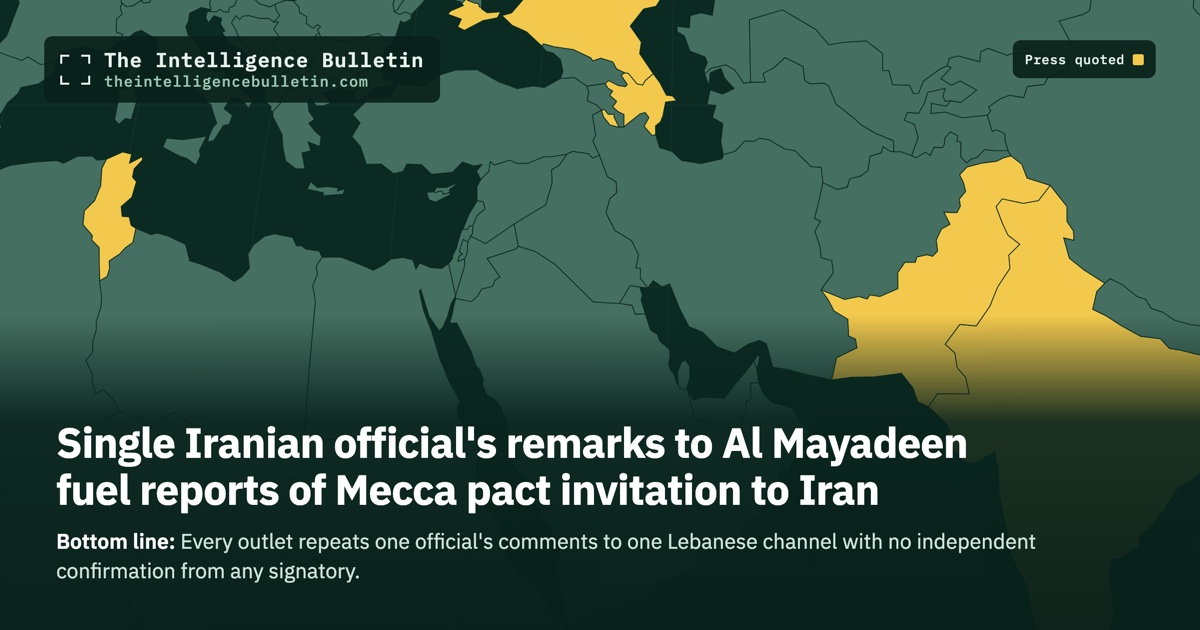
Every outlet repeats one official’s comments to one Lebanese channel with no independent confirmation from any signatory.
All five selected outlets trace the invitation to the same Al Mayadeen interview with Mehdi Rahimi, director of the Iranian parliament’s Khaneh Mellat press service. Azernews and African Manager both quote Rahimi directly on the proposal being under review and on Iran’s long-standing call for regional security arrangements. African Manager adds that the three signatories have not confirmed the invitation and notes Turkey’s openness to expansion, mentioning Egypt as a possible future member. Samaa and Hindustan Times headlines frame the same development through Pakistan’s cooperative ties and India’s security concerns respectively, while Mail.ru situates it in broader power competition. No outlet reports independent verification from Riyadh, Ankara or Islamabad. The absence of Saudi, Turkish or Pakistani sourcing in any of the pieces leaves the claim resting on one chain of reporting. Where outlets diverge is only in the angle they attach to the identical core statement: regional security logic for some, ripple effects for others.
Full analysis
The report that Iran received an invitation to join the Mecca mutual defence agreement rests on one interview. Mehdi Rahimi, director of the Iranian parliament’s Khaneh Mellat press service, told the Lebanese television channel Al Mayadeen that the invitation had arrived and that Iranian authorities were examining it. He described the proposal as consistent with Tehran’s longstanding advocacy for a regional security arrangement and noted that an attack on any participant would be treated as an attack on all.
That single statement, published on 23 August 2026, supplied the only on-record claim about the invitation. No foreign ministry statement, no comment from Riyadh, Ankara or Islamabad, and no separate reporting chain appeared in any of the five articles examined. The underlying pact itself was signed on 7 August in Mecca by Saudi Crown Prince Mohammed bin Salman, Turkish President Recep Tayyip Erdogan and Pakistani Prime Minister Shehbaz Sharif. Its core clause mirrors the collective-defence language of NATO’s Article 5.
Each outlet that carried the Al Mayadeen interview shaped the same dispatch to its own audience. Azernews placed the story under the headline “Iran invited to join Mecca collective defense agreement” and reproduced Rahimi’s remarks in full, including his criticism that the United States had failed to deliver promised security guarantees to regional states. The piece supplied the August 7 date, the three signatories’ names and the mutual-defence principle without additional sourcing.
African Manager’s French-language account opened with the invitation but immediately recorded the absence of confirmation from Iran’s foreign ministry or the three capitals. It added Turkey’s public indication that the arrangement could be enlarged and mentioned Egypt as one country cited in that context. The article retained Rahimi’s observation that the proposal represented a victory for Iran’s long-expressed preference for collective regional security.
Samaa’s headline foregrounded Pakistan’s position: “Iran considers joining Pakistan-Saudi-Türkiye defence pact.” The framing presented the development as an extension of existing ties rather than an external shock. The short dispatch repeated the core invitation and consideration language but did not quote Rahimi’s remarks on the United States or possible future members.
Hindustan Times led with the invitation in quotation marks and the qualifier that the proposal was “being considered.” Its headline and placement emphasised potential effects on regional balance, directing attention toward India’s security environment without introducing new facts beyond the Al Mayadeen interview.
Mail.ru titled its piece “Iran may become part of the Mecca agreement: what it means” and situated the report inside wider great-power competition. The article retained the same Rahimi quotations and pact details but framed the episode as one move among several that could affect Moscow’s room for manoeuvre.
The shared origin means the factual content across the five pieces is identical. Divergence appears only in headline emphasis, additional context supplied from the same interview, and the local interpretive lens attached to the dispatch. No outlet supplied an independent confirmation or a contradictory account from any signatory government.
The narrow evidentiary base also explains why none of the articles could report reactions from the three capitals or from Iran’s foreign ministry. African Manager alone noted the lack of such confirmation; the others simply relayed Rahimi’s statement without that qualifier. The result is five distinct national renderings of one Lebanese television report rather than five independent assessments of a developing diplomatic initiative.
What the coverage therefore reveals is not movement on the ground but the priorities each masthead brings to the same thin wire of information. A Pakistani reader encounters an account that links the proposal to Islamabad’s existing relationships. An Indian reader sees emphasis on possible realignment. An Azerbaijani reader receives the story inside a discussion of regional security umbrellas. A Tunisian reader learns both the invitation and the absence of official corroboration. A Russian reader is invited to place the episode inside calculations of great-power influence.
What to Watch
Because every concrete claim traces to the same Rahimi interview, the differences lie in selection and framing rather than in additional evidence. The single-chain character of the reporting limits what can be concluded about whether an invitation was in fact extended or whether it will be accepted. The five articles demonstrate how one official’s remarks travel and how each destination adapts them to its own context.
That’s how the world told the story.
Get our daily open-source intelligence on world events in your inbox — one email a day, up to six stories.
Subscribe freeNo spam. One-click unsubscribe. See the latest email →