 AI-generated analysis published under the editorial responsibility of Rohit Sinnas. How it works →
Press quoted
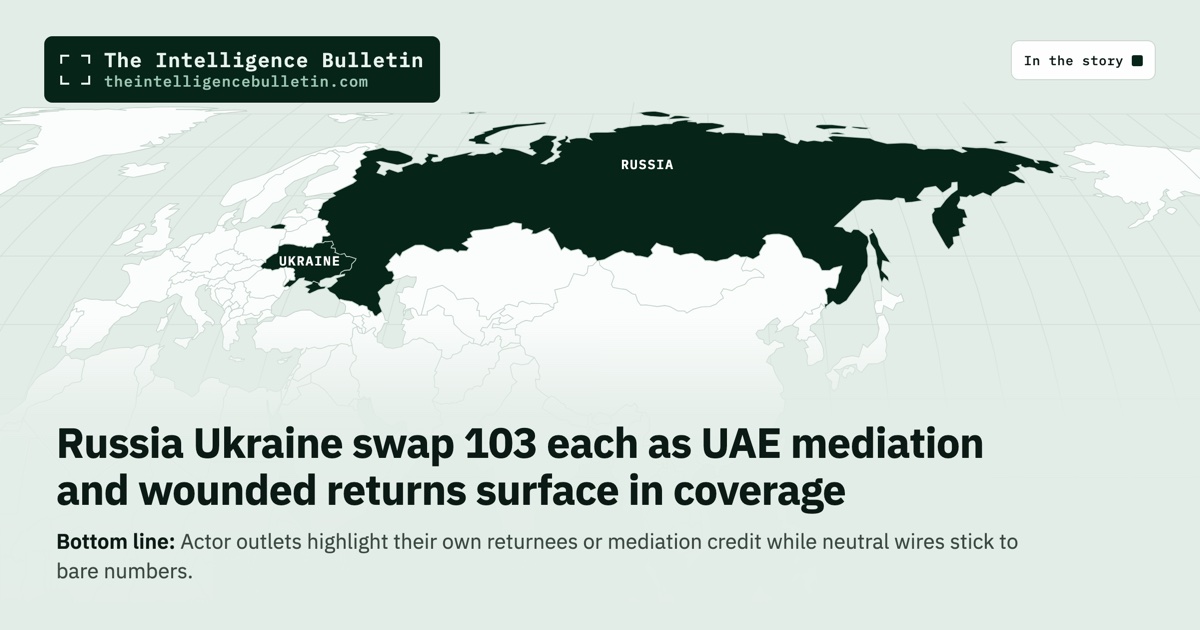
Actor outlets highlight their own returnees or mediation credit while neutral wires stick to bare numbers.
The reporting converges on the raw numbers of the 103-for-103 exchange but diverges sharply on framing and detail. UAE-linked coverage centers the Emirates’ mediation role and cumulative totals, treating the swap as evidence of Abu Dhabi’s diplomatic reach. Russian domestic accounts stress symmetry, the two-month interval, and medical needs of the 31 wounded returnees, while downplaying external facilitators. Ukrainian outlets foreground the return of specific military personnel with photos and personal stories, crediting both the UAE and United States. Reuters-sourced pieces from Pakistan and South Africa remain strictly numerical and quote Ukrainian returnees directly, avoiding mediator or casualty emphasis. These choices reveal how proximity to the event and national interests shape what each chain chooses to foreground or omit, with no outright contradictions in the core facts but clear selectivity in context.
Full analysis
Russia and Ukraine exchanged 103 prisoners each on August 19, 2026. The handover occurred at the Novaya Guta border crossing in Belarus’s Gomel region, according to Russian accounts that placed the Russian returnees on Belarusian soil for initial medical and psychological care before transport to Russian hospitals.
Ukrainian President Volodymyr Zelenskiy announced the returns on Telegram, describing them as servicemen from the Armed Forces, the State Border Guard Service, and the National Guard. The Coordination Headquarters for the Treatment of Prisoners of War added that the group included soldiers, sergeants, and officers who had fought on the Luhansk, Donetsk, Kharkiv, Zaporizhzhia, Kherson, Dnipro, and Sumy fronts. The youngest was born in 2000 and the oldest was 59. Ukrainian military intelligence chief Oleh Ivashchenko stated that a further exchange was expected before the end of the month and that it would prioritize defenders held since the early stages of the war, including those who fought in the defense of Mariupol.
Russian reporting from RuNews24 described the same 103-for-103 formula and noted that Russian human rights ombudsman Yana Lantratova met the returnees at the border. She reported that 31 of the Russian servicemen were wounded. The Russian Defense Ministry confirmed the exchange through state media, and the men were listed on previously published Russian rosters. The account identified the swap as the first in nearly two months, following an earlier round on June 26 that involved 160 on each side.
The UAE played a documented role in arranging the transfer. The National reported that the UAE Foreign Ministry announced the deal and placed the total number of detainees exchanged through its mediation at 7,997 across 26 separate operations. Russian President Vladimir Putin thanked UAE President Sheikh Mohamed for the Emirates’ continued efforts. Ukrainian statements also credited the UAE and the United States for assistance in securing the releases. Earlier exchanges facilitated through the same channel included a 320-person swap announced on June 26 and previous rounds of 185, 205, and 193 prisoners each.
Reuters dispatches carried by Dunya News and TimesLIVE supplied direct testimony from Ukrainian returnees. One 29-year-old identified as Dmytro, held for three years, told Reuters he had returned home without claiming any special status and urged families of those still held to maintain hope. Another, 43-year-old Anton Tymofienko, held for 28 months, said the primary contact with the outside world had been letters from relatives. These accounts described regular prisoner exchanges continuing throughout the war that began with Russia’s full-scale invasion in 2022, while both governments remained far apart on any broader peace settlement.
The five articles examined converge on the central figures of 103 prisoners returned to each side. They also align on the involvement of the UAE in at least some capacity, with explicit references appearing in the UAE, Russian, and Ukrainian pieces. The expectation of a follow-on exchange before the end of August appears in both Ukrainian statements and the Reuters material. The single-source detail that 31 of the Russian returnees were wounded comes exclusively from the Russian ombudsman’s remarks reported by RuNews24 and is not referenced elsewhere in the set.
Differences emerge in emphasis and selection of supporting material. The National builds its narrative around the UAE’s accumulated diplomatic record and quotes Putin’s message of thanks, framing the event as further evidence of Abu Dhabi’s position as a channel between the two sides. RuNews24 highlights the symmetry of the numbers, the medical condition of the Russian returnees, the two-month interval since the previous swap, and the Belarus handover point. Liga.net publishes multiple photographs of the Ukrainian returnees arriving, names the military branches represented, lists the fronts on which they fought, and records thanks to both the UAE and the United States. The two Reuters-based pieces from Pakistan and South Africa limit themselves to the exchange numbers, the quoted comments from Ukrainian servicemen, and the intelligence chief’s remarks on the next planned round, without reference to mediation or specific casualty counts.
These choices reflect the vantage points of the reporting organizations. Outlets tied to one of the warring parties foreground the return of their own personnel and the conditions those personnel faced. The UAE outlet foregrounds its government’s facilitation role. Distant neutral wires reproduce agency copy that captures personal testimony but omits the institutional credits and medical details supplied by the primary actors. No account contradicts the others on the total exchanged or the date. The single-source wounded figure stands alone because no other chain reported it.
The corroborated elements—the 103-for-103 count, the UAE’s mediation across multiple operations, and the branches and service histories of the Ukrainian returnees—rest on statements from both governments and from the UAE Foreign Ministry. The Reuters quotes supply independent corroboration of the human dimension through named individuals. The single-source claim of 31 wounded Russian returnees remains attributable only to the Russian ombudsman and carries the limitation of that chain. Each side has an institutional interest in presenting its own returnees in the most favorable light and in crediting or omitting external facilitators accordingly. The Reuters material, drawn from direct interviews, supplies the least filtered personal evidence in the set.
What to Watch
The pattern indicates that further exchanges will continue on the same humanitarian track. The intelligence chief’s statement that the next round will target longer-held prisoners, including Mariupol defenders, supplies a concrete expectation against which future reporting can be measured. The selectivity already visible shows that readers relying on any single national outlet will receive a narrower slice of the same underlying event.
That’s how the world told the story.
Get our daily open-source intelligence on world events in your inbox — one email a day, up to six stories.
Subscribe freeNo spam. One-click unsubscribe. See the latest email →