 AI-generated analysis published under the editorial responsibility of Rohit Sinnas. How it works →
Press quoted
Actor outlets detail the summons mechanics while observers immediately connect the row to Russia’s actions in Ukraine.
The reporting converges on the basic sequence of reciprocal summonses but parts sharply on context and stakes. Japanese and Turkish accounts treat the exchange as standard diplomatic pushback over the Kurils, while Ukrainian coverage immediately frames the episode as another instance of Russian assertiveness already visible in Ukraine. The exiled Moscow Times alone reads Putin’s first presidential visit to the islands as deliberate punishment for Japan’s sanctions and NATO tilt, an interpretation absent from state Russian reporting. RIA Novosti instead relays a U.S. analysis that casts the trip as a sovereignty signal timed near the WWII anniversary, sidestepping the ambassador row almost entirely. This split reveals how proximity to the actors produces narrow procedural accounts, while distance invites linkage to wider Russian behavior; the single point of genuine agreement across all chains is that the dispute itself remains frozen and the latest move changes nothing on the ground.
Full analysis
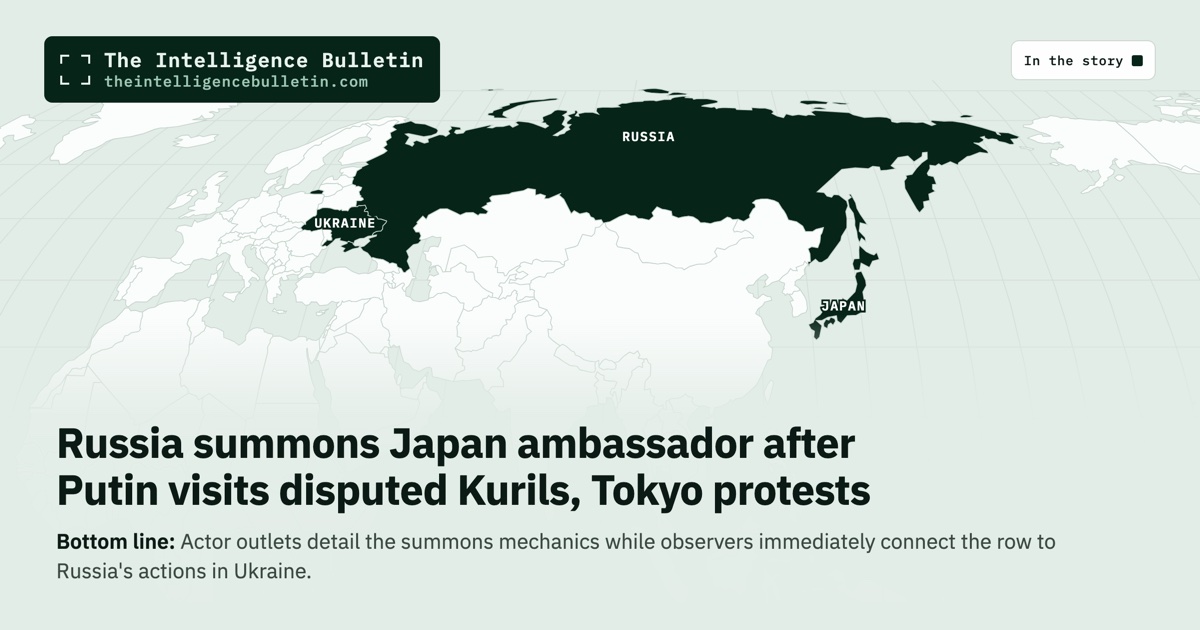
Russia summoned Japanese Ambassador Akira Muto to the Foreign Ministry in Moscow after Tokyo protested President Vladimir Putin’s visit to Etorofu Island. The island is one of four Russian-held territories that Japan claims as its Northern Territories. Putin traveled there on August 13 after inspecting naval exercises near Sakhalin, marking the first such visit by a Russian president to the disputed area.
Japanese Prime Minister Sanae Takaichi described the trip as hurting Japanese public sentiment and absolutely unacceptable. Tokyo then summoned Russia’s ambassador in Japan and lodged a strong protest. Russia responded by calling Muto in, with Foreign Minister Sergei Lavrov stating that Japanese officials had crossed the line of decency in their criticism. Lavrov noted that the embassy had initially replied the ambassador could not appear on Friday or Monday because of factors including a health issue. Ministry spokeswoman Maria Zakharova later told the state news agency Tass that Muto had suddenly started feeling better and would attend on Tuesday.
The four islands, including Etorofu, Kunashiri, Shikotan and the Habomai group, were seized by Soviet forces in 1945 after Japan announced its surrender in World War II. Russia maintains the seizure was legitimate under the results of that war. Japan argues the islands were illegally taken and that the lack of a postwar peace treaty stems directly from this unresolved claim. Earlier Russian officials have visited the islands, most notably then-President Dmitry Medvedev on Kunashiri in 2010, but Putin had avoided them throughout his time in power until now.
The reporting from every outlet that covered the summons agrees on the basic sequence of reciprocal diplomatic actions. Japan Today reported the Russian summons as a matter of routine compliance, noting that an embassy official declined to confirm details citing diplomatic sensitivity. Anadolu Agency described Russia lodging the protest with the ambassador over Tokyo’s criticism of the trip, without further elaboration. Kyiv Post carried the same core facts, including Lavrov’s remarks on the ambassador’s initial unavailability and Zakharova’s follow-up statement.
Accounts diverge once the story moves beyond the immediate exchange. Japan Today and Anadolu Agency keep the focus on the procedural mechanics and the longstanding territorial disagreement. Kyiv Post immediately places the episode inside Russia’s wider pattern of assertiveness, referencing Japan’s sanctions on Russia and its financial and non-lethal support for Ukraine since 2022. The exiled Moscow Times reads the visit itself as a calculated shift. It notes that Putin had previously cultivated a more subtle approach toward Japan, including suggestions of a possible territorial compromise framed as a judo draw, and argues the August 13 trip signals punishment for Japan’s post-2022 stance rather than an invitation to renewed engagement. RIA Novosti instead foregrounds an analysis from Military Watch Magazine that presents the visit as a symbolic demonstration of Russian sovereignty, timed near the August 15 anniversary of Japan’s WWII surrender and centered on the militarily significant island of Iturup.
These differences track closely with each outlet’s position relative to the actors. Japanese and Turkish reporting stays inside the bilateral diplomatic frame because that is the vantage their sources supply. Ukrainian coverage draws the line to ongoing conflict because that is the immediate context its readers track. The Moscow Times piece supplies the only explicit strategic reading of the visit as a break from earlier Russian tactics, drawing on the record of past visits and economic overtures. RIA Novosti, by relaying foreign commentary, avoids centering the protest exchange that the other accounts treat as the central development.
The single point of convergence across all five pieces is that nothing on the ground has changed. The territorial row still blocks a peace treaty, and the latest summons follows the same pattern of protest and counter-protest that has held for decades. No source reports any new proposal, concession, or escalation beyond the diplomatic channel itself.
The narrow accounts from the actor outlets and the neutral agency give the clearest picture of what actually occurred on August 17 and 18. They rest on direct statements from the foreign ministries and on the sequence of public announcements that multiple independent reporting chains recorded. The broader interpretations offered by the Ukrainian and exiled Russian pieces supply useful context for readers already following the Ukraine conflict or Japanese domestic politics, yet they rest on inference rather than new evidence from this episode. The Russian state account reframes the visit away from confrontation, which aligns with its domestic audience but leaves the summons itself in the background.
What to Watch
The dispute will remain frozen because neither side has altered its core position or offered a path around it. Japan continues to insist the territorial issue must be resolved before any treaty. Russia continues to treat the islands as sovereign territory acquired through the war. Further reciprocal protests are the most likely next step if either government needs to register domestic displeasure, but the reporting gives no indication that this particular exchange will shift the underlying balance.
That’s how the world told the story.
Get our daily open-source intelligence on world events in your inbox — one email a day, up to six stories.
Subscribe freeNo spam. One-click unsubscribe. See the latest email →