 AI-generated analysis published under the editorial responsibility of Rohit Sinnas. How it works →
Press quoted
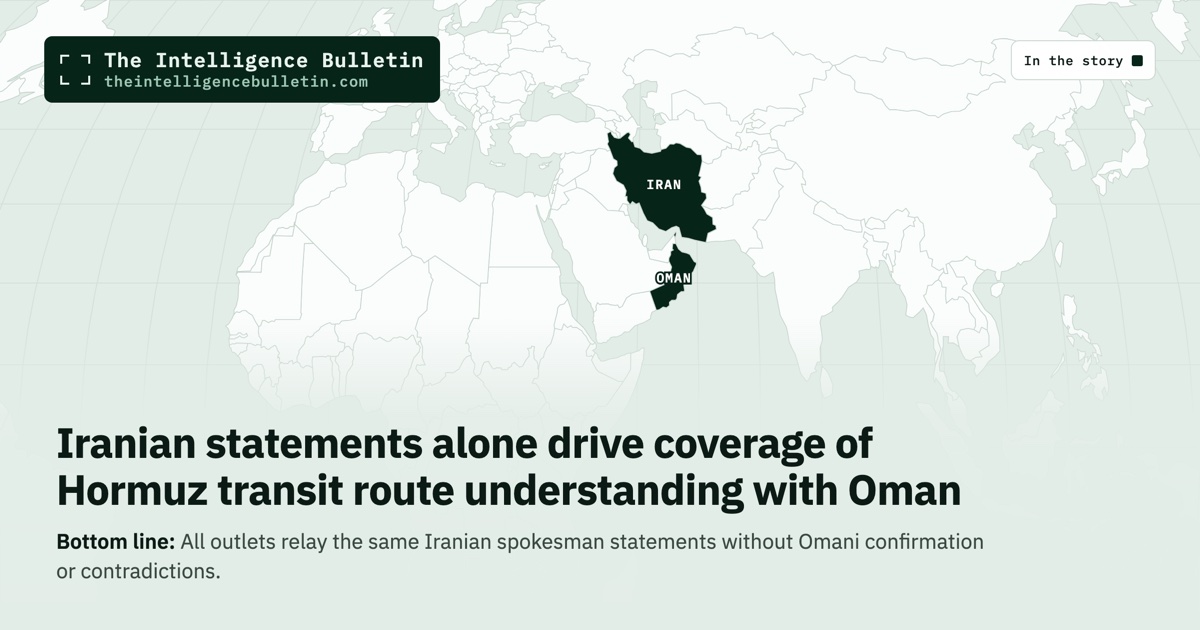
All outlets relay the same Iranian spokesman statements without Omani confirmation or contradictions.
The reporting across these outlets converges on Iranian official statements describing an understanding reached with Oman on a Hormuz transit route map, yet the framing reveals a consistent pattern: every account traces directly to spokesman Esmaeil Baghaei without independent Omani confirmation. Oman Observer emphasizes ongoing complexity caused by US and Israeli actions, quoting Baghaei at length on security obstacles and the mechanism’s novelty in safeguarding littoral states’ rights. Middle East Eye and Klix both highlight the route map agreement plus work on a joint statement package, with Klix adding the 60-day US-Iran deadline context and possible route details. Radio Pakistan relays the same Baghaei remarks via Defa Press, stressing positive progress and sovereignty preservation. VTV reports an initial step while including Iranian Foreign Minister Abbas Araghchi noting that full reopening still hinges on US conditions and citing sharply reduced daily traffic. This uniformity shows the story rests entirely on one originating chain of Iranian government statements; differences arise only from how each outlet layers regional stakes or prior context onto that single source. No outlet introduces conflicting claims or Omani voices, underscoring that the selected coverage functions as parallel relays of Tehran’s messaging rather than independent verification of bilateral progress.
Full analysis
Iranian Foreign Ministry spokesman Esmaeil Baghaei announced on August 16 that Iran and Oman have reached an understanding on the map of a new maritime transit route through the Strait of Hormuz. The two sides are now working to finalize details and prepare a joint statement that would establish the mechanism. Baghaei described the arrangement as the first attempt to protect the sovereign rights of both littoral states while ensuring the safe passage of commercial vessels. He told reporters that the proposed route would allow ships to enter along a path closer to Iran and exit nearer to Oman, with no tolls or fees applied during an interim period.
Baghaei characterized the progress as positive after three weeks of talks, according to the version carried by Radio Pakistan from Defa Press. He said the goal remains to preserve the sovereignty of both countries and maintain commercial shipping through the waterway. The same statements appear in reports from Middle East Eye and Klix, which add that the package under discussion includes both the route map and the joint statement itself. Oman Observer reported Baghaei saying the process has been time-consuming because of security complexities tied to actions by the United States and Israel, the number of actors involved, and obstruction by disruptive elements. He called the issue inherently complex and noted that the insecurity imposed on the strait, the region, and the world stems from illegal military action by the United States and the Israeli regime.
VTV reported an additional comment from Iranian Foreign Minister Abbas Araghchi that the current understanding covers only the maritime route. Full reopening of the strait, the minister said, still depends on the United States meeting conditions set by Iran. VTV also noted that traffic through the strait has fallen sharply to roughly 10 to 12 vessels per day in the most recent three-day period, compared with a pre-conflict average of 130 to 140 vessels daily. The strait carries approximately one-fifth of global oil trade under normal conditions.
All five selected outlets published these developments between August 16 and August 17. None carried direct statements from Omani officials. None reported independent confirmation of the route map from any other government. The accounts therefore rest on a single originating chain of Iranian government statements relayed under different mastheads.
The coverage shows no contradictions on the core points. Every outlet reports that an understanding on the transit route map has been reached and that talks continue toward a joint statement protecting mutual interests. Where the accounts differ is in the additional layers each outlet chooses to attach. Oman Observer foregrounds the security obstacles and quotes Baghaei at length on US and Israeli actions. Middle East Eye and Klix both mention the 60-day deadline for a broader US-Iran agreement that expired without a deal. Klix adds background that Iran effectively closed the strait after attacks on February 28 and notes the presence of an AP attribution tag. VTV supplies the traffic figures and the foreign minister’s qualification on full reopening. Radio Pakistan alone names Defa Press as the immediate source of Baghaei’s remarks.
A reader who encounters only one of these accounts therefore receives the same central claim but a different sense of the surrounding stakes. The Oman Observer version leaves the impression of a stalled and externally constrained process. The Middle East Eye and Klix versions place the understanding inside a larger diplomatic timeline tied to the United States. The VTV version adds quantitative evidence of disruption and a ministerial condition on any broader reopening. None of these additions conflicts with the others; each simply selects a different slice of the same Iranian statements or attaches different prior context already published in that outlet’s earlier coverage.
Because the selected sources contain no Omani voice and no independent verification, the published record does not establish whether Oman has accepted the described map or the proposed joint statement. The articles also provide no details on what specific US conditions Iran has set or whether any of those conditions have been discussed in the current talks. The 60-day deadline is mentioned only in two outlets and without elaboration on its exact terms.
The corroborated claims across the five reports are therefore limited to what Baghaei stated: an understanding exists on the route map, and work continues on final details and a joint statement. The single-source observations about complexity caused by US and Israeli actions, and about full reopening depending on US compliance, remain attributable only to the outlets that carried them. No outlet disputes those observations; they simply do not appear in every account.
What to Watch
The reporting accurately transmits Iran’s current diplomatic position on the strait. It does not yet demonstrate bilateral agreement beyond the Iranian statements themselves. The next concrete step would be the release of the joint statement or an Omani confirmation that the route map has been accepted. Until one of those appears, the understanding remains an Iranian description of talks that are still underway.
That’s how the world told the story.
Get our daily open-source intelligence on world events in your inbox — one email a day, up to six stories.
Subscribe freeNo spam. One-click unsubscribe. See the latest email →