 AI-generated analysis published under the editorial responsibility of Rohit Sinnas. How it works →
Press quoted
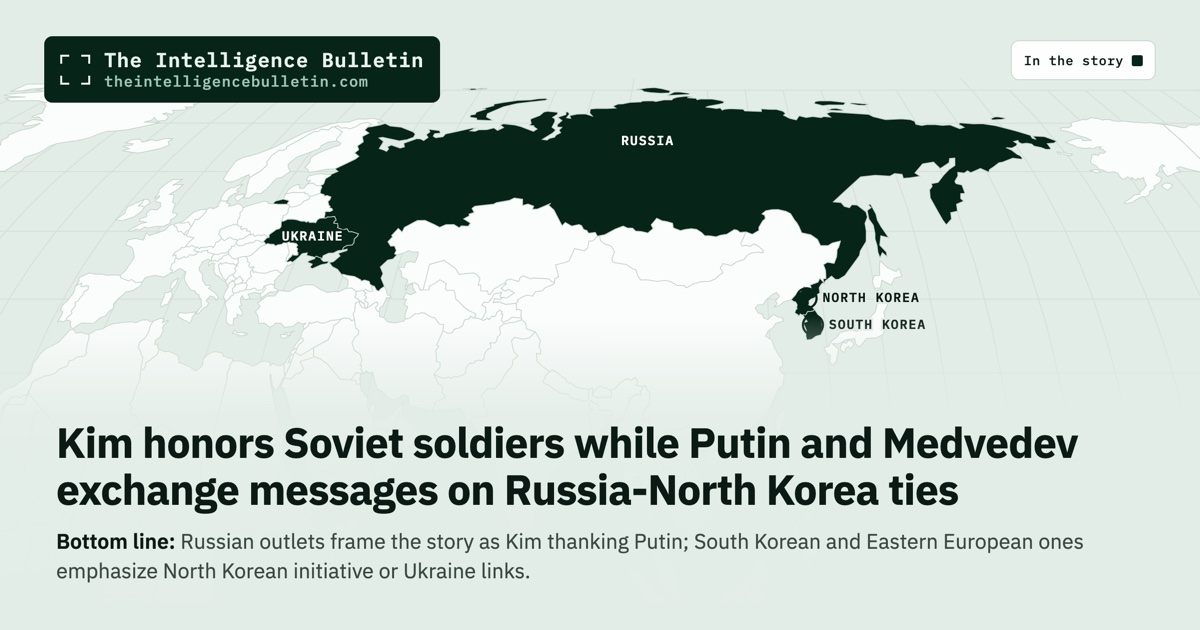
Russian outlets frame the story as Kim thanking Putin; South Korean and Eastern European ones emphasize North Korean initiative or Ukraine links.
The reporting converges on the core sequence—Kim’s wreath-laying at the Liberation Tower and reciprocal messages from Putin and Medvedev—but splits sharply on agency and stakes. South Korean and Bulgarian accounts center the North Korean ceremony itself as the signal of alignment, noting this as Kim’s third such visit since the 2024 partnership. Russian coverage reverses the lens, presenting Kim’s reply as personal thanks to Putin’s initiative and quoting his praise for the Red Army and wishes for Russian strength. Romanian and Moldovan pieces add the Ukraine dimension absent elsewhere, linking the messages to battlefield accusations of North Korean missiles and troops while portraying Pyongyang as actively locking in Moscow’s backing. These choices reflect outlet priorities rather than conflicting facts: the bilateral diplomatic exchange is corroborated across independent chains via KCNA, yet the emphasis on who leads and what wider risks it carries varies by national vantage. The result is consistent detail on the event paired with divergent readings of its balance of power.
Full analysis
On August 15, 2026, North Korean leader Kim Jong-un visited the Liberation Tower in Pyongyang the day before the 81st anniversary of Korea’s liberation from Japanese colonial rule. He laid a wreath bearing the inscription “We will not forget the feats of the martyrs of the Soviet Army.” Kim was accompanied by his wife, Ri Sol-ju, and his daughter, Ju-ae, in what marked the daughter’s first known public appearance at the tower with her father. This was Kim’s third such visit on the occasion of Liberation Day since North Korea and Russia established a comprehensive strategic partnership in 2024.
Kim described the history, traditions and blood ties between the two countries as a fundamental cornerstone and inexhaustible driving force for bilateral friendship and cooperation. He stated that their great friendship and unity would be carried forward generation after generation. The Korean Central News Agency reported these remarks in English dispatches carried by multiple outlets.
Russian President Vladimir Putin sent a congratulatory message the same day. It noted that the two countries were actively cooperating across sectors and making concerted efforts to ensure regional security and stability. Putin described their militant friendship and mutual assistance as having elevated bilateral ties to an unprecedentedly high level of comprehensive strategic partnership. He expressed conviction that the countries would continue constructive joint undertakings on pressing bilateral and international issues. Former Russian President Dmitry Medvedev also sent greetings to Kim, according to the same agency reports.
The messages and the ceremony occurred against the backdrop of the 2024 partnership agreement. That accord preceded expanded military cooperation between the two governments, including North Korean support for Russia’s campaign in Ukraine. All five outlets in the set traced the core sequence directly to Korean Central News Agency dispatches.
The accounts converge on the sequence of the visit, the wreath inscription, the family accompaniment, and the content of the two Russian messages. They also agree that the 2024 partnership forms the recent foundation for the relationship. Where the coverage differs is in emphasis on who set the tone for the exchange and what wider context belongs alongside it.
The Korea Times account, drawn from Yonhap reporting of KCNA material, places the North Korean ceremony at the center. It presents the wreath-laying and Kim’s remarks on generational unity as the primary signal of alignment, while noting this marks the third Liberation Day appearance at the tower since the 2024 agreement. The Bulgarian Cross.bg piece follows nearly identical lines, staying close to the historical tribute and the partnership reference without additional layers.
Vesti, the Russian outlet, reverses the framing. It opens with Kim’s response message thanking Putin for his earlier congratulations and quotes Kim at length on the enduring feats of the Red Army against common enemies. The piece highlights Kim’s assessment that relations have become a reliable basis for cooperation and records his wishes for Russian sovereignty, security and territorial integrity under Putin’s leadership. This reciprocal-congratulation angle receives no parallel treatment in the other selections.
The Romanian Capital and Moldovan Ziarul National articles add a different dimension. Both link the messages and the ceremony to Ukrainian statements that Russia has used North Korean missiles against targets in Ukraine, including a reported strike on Zaporizhzhia that killed at least six people. They note Ukrainian accusations that North Korea has supplied missiles, ammunition and additional troops, and they reference North Korean participation in fighting in Russia’s Kursk region in 2024-2025. Capital further includes analyst commentary that Pyongyang seeks to portray Northeast Asia as a competition between rival blocs to justify its own arms programs and secure continued backing from Moscow and Beijing. These elements appear in neither the South Korean nor the Russian nor the Bulgarian pieces.
The single-source status of the Ukraine battlefield claims in this set follows directly from their presence only in the Romanian and Moldovan reporting. The core diplomatic facts—the visit, the wreath, and the messages—run through all five outlets via KCNA.
A reader limited to one national vantage would therefore miss either the ceremony’s prominence as a North Korean gesture, the explicit Russian presentation of the exchange as initiated by Moscow, or the direct connection drawn to Ukrainian accusations of missile and troop transfers. The Korean Central News Agency material itself supplies the shared factual spine; the divergence lies in which sentences from that material each outlet chooses to foreground and what additional context it attaches.
The corroborated record shows a mutual exchange of messages between the Russian and North Korean leaderships on the occasion of the liberation anniversary, paired with a North Korean ceremony at a monument to Soviet wartime service. The 2024 strategic partnership supplies the documented recent context for both the ceremony and the messages. The Ukrainian statements on missiles and troops remain attributed to a single reporting chain within the source set and are not carried by the South Korean, Russian or Bulgarian accounts.
What to Watch
The Russian framing of Kim thanking Putin aligns with the documented sequence of messages, while the emphasis in the Romanian and Moldovan pieces on one-sided consolidation of support rests on Ukrainian on-record accusations that the other outlets did not include. The ceremony details themselves stand on the same KCNA foundation across the set. This pattern indicates that the diplomatic exchange itself is the element least dependent on any single national lens.
That’s how the world told the story.
Get our daily open-source intelligence on world events in your inbox — one email a day, up to six stories.
Subscribe freeNo spam. One-click unsubscribe. See the latest email →