 AI-generated analysis published under the editorial responsibility of Rohit Sinnas. How it works →
Press quoted
Coverage converges on the corporate announcement while diverging sharply on whether the story is about Indian sovereignty, Ambani’s empire, or regional military balance.
All five outlets report the same joint corporate announcement without material differences in the core facts, yet their framing reveals distinct national and institutional priorities. Indian sources emphasize technological sovereignty and the long-standing difficulty of mastering fighter engines, treating the proposal as a concrete step toward reducing foreign dependence. Pakistani coverage places the deal inside India’s broader military modernization drive, noting recent procurement approvals and a past conflict with Pakistan as context for New Delhi’s push. Forbes centers Mukesh Ambani’s conglomerate and its expansion into defense, presenting the move as a business milestone for India’s richest man. The Italian financial wire delivers a neutral, concise industrial-collaboration account that records India’s shift away from Russian suppliers without elaboration. Open The Magazine alone supplies sustained analysis of why an engine remains the hardest element of fighter sovereignty, citing India’s failed Kaveri program and the gap between airframe design and propulsion capability. The uniform reliance on the companies’ press release means the coverage pattern itself is the story: every outlet relays the identical originating statement, then layers its own interpretive lens according to domestic audience expectations.
Full analysis
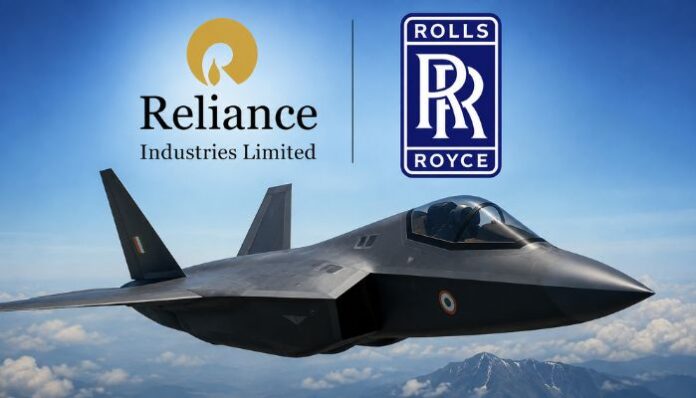
Reliance Industries and Rolls-Royce announced on August 14, 2026 their strategic intent to study a partnership aimed at designing, developing, manufacturing and delivering a sovereign indigenous combat engine for India’s Advanced Medium Combat Aircraft program. The companies described the move as an offer of capabilities for the full engine lifecycle, and they proposed exploring the creation of an Aerospace Gas Turbine Complex in India that would handle design, engineering, manufacture, testing, production and long-term maintenance and support. The announcement made clear that the two firms had reached only a statement of strategic intent, with no joint venture signed, no ownership structure settled and no investment totals disclosed.
The AMCA is India’s planned fifth-generation stealth multirole fighter, intended to equip the air force with advanced sensors, electronic warfare systems and reduced reliance on imported combat aircraft. Development of its propulsion system has long been identified as one of the most technically demanding elements. Only a handful of countries possess mature capabilities to design and manufacture advanced fighter engines that must deliver high thrust while enduring extreme temperatures and pressures, remaining compact enough for stealth requirements, and proving reliable and fuel-efficient. Indian programs have encountered repeated difficulty here. The indigenous Kaveri engine project, pursued for decades, never reached the performance levels needed to power the Tejas fighter, which instead uses engines of American origin.
Reliance Industries, described across the reporting as India’s largest private-sector company, has been expanding its defense manufacturing activities, including military aerospace and advanced munitions, in line with the government’s Make in India policy. Anant Ambani, executive director of Reliance Industries, stated that India’s strategic autonomy requires sovereign capability in critical technologies and that the intent is to combine Rolls-Royce’s propulsion expertise with Reliance’s manufacturing, technology, scale and execution capabilities to build an indigenous aero-engine ecosystem that could eventually become globally competitive. Rolls-Royce chief executive Tufan Erginbilgiç said the proposed initiative would mark a major milestone toward building a robust, self-reliant aerospace ecosystem in India and could deepen the British company’s involvement in the country’s growing aerospace and defense sector. The companies indicated that any resulting facility might support opportunities beyond a single aircraft program, extending into civil aerospace and new power and propulsion technologies.
The five outlets that carried the story all drew from the same joint company statement. OneIndia explained the proposed complex in technical detail and placed it inside India’s policy drive for self-reliance in defense. Open The Magazine devoted sustained attention to why an engine constitutes the remaining hard frontier of fighter sovereignty, noting that airframe design has advanced further than propulsion mastery and that control over upgrades, production schedules and maintenance would follow from an indigenous powerplant. Pakistan Today situated the announcement inside India’s recent defense procurement decisions, including approvals worth $39 billion earlier in the year and $5.46 billion last month that covered missiles, electronic warfare systems and kamikaze drones, and referenced a four-day conflict with Pakistan the previous year as one factor underscoring the need for updated capabilities. Its current defense budget stands at $85 billion. Forbes framed the development around Mukesh Ambani’s personal business interests, noting his net worth and Reliance’s expansion into military aviation. Borsa Italiana recorded the industrial collaboration and noted India’s decade-long reduction in dependence on its traditional Russian supplier, together with the shift toward suppliers including France and the United States.
The reporting shows no material disagreement on the facts of the announcement itself. Every outlet conveyed the exploratory character of the step, the absence of finalized financial or contractual details, and the proposed scope of the gas turbine complex. Where the accounts diverge is in the surrounding context each chooses to supply. Indian coverage foregrounds the technological and sovereignty dimensions, drawing on executive statements that tie the proposal directly to national capability goals. Pakistani coverage adds the regional military-modernization setting, including specific procurement figures and the recent conflict reference. The American financial perspective centers the conglomerate’s scale and its controlling family. The Italian wire treatment stays at the level of corporate announcement and broad procurement trends without additional interpretive layers.
What to Watch
This pattern indicates that the originating corporate statement set the shared factual spine, after which each outlet applied the interpretive frame its audience expects. A reader limited to any single outlet would encounter the same core event but would receive a narrower sense of why the proposal registers as significant elsewhere. The engine technology in question remains among the most restricted domains in military aviation, and the announcement positions the partnership as one possible route for India to narrow that gap through collaboration rather than sole domestic effort. Subsequent movement will hinge on whether the proposal advances into formal selection for the AMCA program, a decision that rests with Indian government authorities rather than the companies alone.
That’s how the world told the story.
Get our daily open-source intelligence on world events in your inbox — one email a day, up to six stories.
Subscribe freeNo spam. One-click unsubscribe. See the latest email →