 AI-generated analysis published under the editorial responsibility of Rohit Sinnas. How it works →
Press quoted
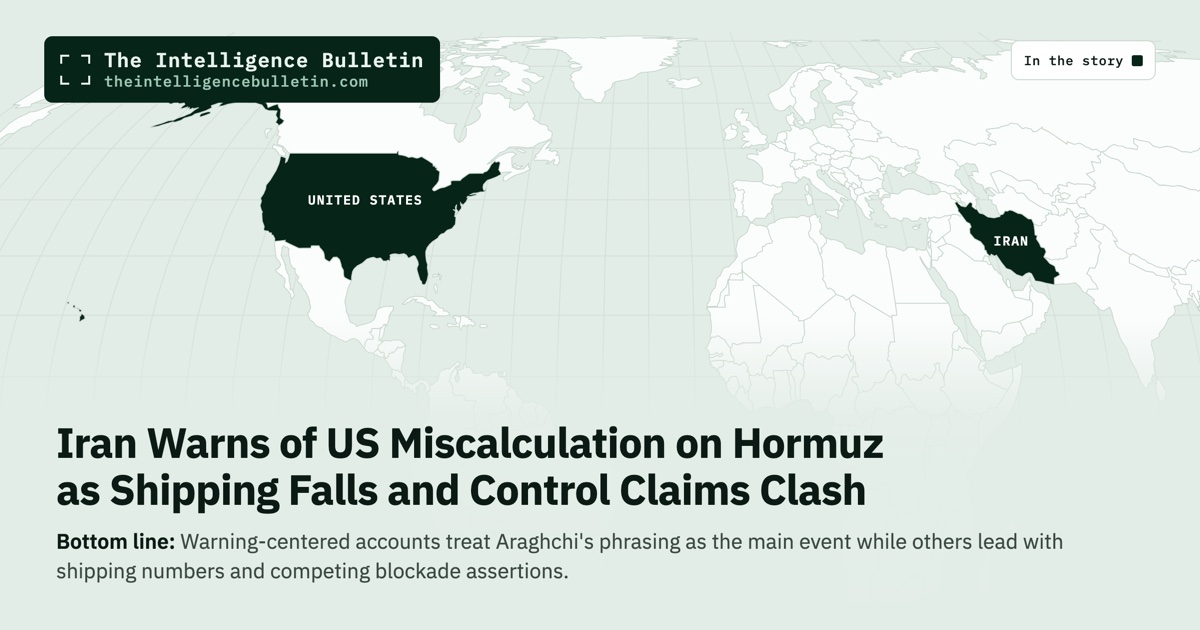
Warning-centered accounts treat Araghchi’s phrasing as the main event while others lead with shipping numbers and competing blockade assertions.
The reporting converges on Araghchi’s X-post warning that US intelligence lapses risk an even larger error on Hormuz control, yet the outlets diverge sharply in what they treat as the central development. Turkish, Afghan and Azerbaijani accounts stay tightly on the minister’s precise language distinguishing fake news from fake intelligence and frame the statement as direct escalation from Tehran. The Israeli outlet instead leads with shipping data showing traffic at a weekly low and pairs it with US assertions of indefinite blockade capacity plus reports of vessel attacks. Britain’s Middle East Eye alone embeds the warning inside a narrative of parliamentary formalization of Iranian control and US inability to sustain the conflict it launched with Israel, citing IRGC statements that no movement escapes its fighters. This split reveals more than phrasing differences: the warning-focused pieces treat Iran’s diplomatic signal as the actionable fact, while the shipping and war-initiation accounts treat operational realities and competing military claims as primary. The absence of any Iranian domestic outlet in the set means all accounts of Tehran’s position filter through these external lenses, yet the repeated citation of the same Araghchi text across three regions shows the warning itself travels independently of any single national frame.
Full analysis
Iranian Foreign Minister Abbas Araghchi posted on X on August 13 that the United States had long miscalculated due to intelligence failures, with the war on Iran as one case in point, and now faced an even bigger miscalculation over the Strait of Hormuz. He added that worse than fake news is fake intelligence, urged caution, and closed with the statement that Allah is great and greater than any power on earth. The post followed US President Donald Trump’s assertion that his country maintains total control of the strait.
Shipping traffic through the waterway stood at eight or nine commodity vessels on the most recent day counted, well below the pre-conflict daily average of roughly 130 transits. Five vessels entered the Gulf and four exited into the Gulf of Oman, most using the Iranian routing. Data from maritime analytics firm Kpler recorded the drop, and four separate outlets reported the same figures. The United States has stated it can maintain a naval blockade of Iran indefinitely and will increase economic pressure on Tehran as ceasefire talks stall.
Iran has restricted transit through the strait, which carries a fifth of the world’s oil supply, in response to what it describes as unlawful aggression by the United States and Israel. That earlier conflict ran from February 28 to an April 8 ceasefire. On June 17, Tehran and Washington concluded a Pakistan-brokered memorandum of understanding whose fifth article assigns Iran responsibility for reopening and managing the strait. Iran now says the waterway will remain closed at least until the end of US interference in the region. Officials in Tehran and Oman are discussing a new framework for overseeing shipping.
On the Iranian side, the Islamic Revolutionary Guard Corps Navy has declared the strait closed and its control complete and decisive. Rear Admiral Ali Ozmaei told Tasnim that no movement escapes the eyes of IRGC fighters and that reality should be judged in the field rather than in US statements. An Iranian parliamentary committee has approved the general outline of a strategic action plan for security and development in the strait and Persian Gulf. The plan would bar vessels and equipment belonging to the United States, Israel, and other countries Iran designates as hostile. Valiullah Bayati, spokesperson for the parliament’s internal affairs and councils committee, said the proposals advanced after hearing opinions and would now move to further consideration.
US Treasury Secretary Scott Bessent said new measures against Tehran would be announced the following week, describing them as economic isolation the world has never seen before, combined with the continued blockade that keeps anything from entering or leaving Iranian ports. Brent crude climbed above 88 dollars a barrel and West Texas Intermediate above 82 dollars after the threat. The United States is sending the USS George Washington to relieve the USS Abraham Lincoln, whose crew has spent more than 260 days at sea, leaving the Pacific without a carrier for an undetermined period.
The same Araghchi text appears in accounts from Turkey, Afghanistan, and Azerbaijan. Each outlet quotes the minister’s distinction between fake news and fake intelligence and his warning of an even bigger miscalculation on Hormuz. The Turkish report adds that Iran has imposed restrictions in retaliation for prior aggression, notes the June memorandum, and records Iran-Oman talks on a new oversight framework. The Afghan account stays close to the X post itself and the context of strained relations. The Azerbaijani account links the warning directly to the shipping decline and cites an Iranian English-language channel for the original statement.
The Israeli report leads instead with the Kpler traffic numbers and pairs them with the US claim of indefinite blockade capacity. It records that nine vessels transited on the day in question and notes two Abu Dhabi National Oil Company vessels attacked while passing through the strait that evening, with the United Arab Emirates accusing Iran. It also reports nineteen vessels through the Bab el-Mandeb strait the same day. The British account places the warning inside a wider frame of Iran formalizing control while the United States struggles to sustain the war it launched alongside Israel. It alone reports the parliamentary committee vote and the IRGC Navy declaration that control is complete, alongside the Treasury Secretary’s threat language and the carrier rotation details.
A reader limited to the Turkish, Afghan, or Azerbaijani accounts would see a clear diplomatic signal from Tehran centered on intelligence failure and the risk of escalation at the chokepoint. A reader limited to the Israeli account would see primarily a maritime disruption and competing claims of control backed by naval posture and data on vessel attacks. A reader limited to the British account would see a story of legislative steps toward permanent Iranian oversight and mounting costs to the United States in sustaining its campaign. The absence of any Iranian domestic outlet from the set means every account of Tehran’s position reaches readers through one of these external filters, yet the identical Araghchi wording travels across three separate reporting chains.
The warning itself rests on three independent chains that all quote the same X post. The shipping decline rests on four outlets citing the same Kpler data set. The June memorandum appears in only one account. The parliamentary plan appears in only one account. The US assertion of indefinite blockade capacity appears in two. Where accounts converge on the minister’s language and the traffic numbers, those elements form the most widely corroborated spine of the story. Where they diverge, the difference lies in which facts each outlet chooses to treat as the organizing center: the diplomatic warning, the operational numbers, or the legislative and military assertions of control.
The accounts that stay with the corroborated warning and the Kpler traffic figures rest on the largest number of independent reporting chains and on primary statements that multiple outlets recorded without alteration. Those that embed the same facts inside a narrative of initiation or formalization add interpretive framing that the narrower accounts do not supply. The interest in presenting the event as a straightforward intelligence warning lies with outlets that relay Iranian official language directly. The interest in presenting it as a shipping and blockade contest lies with the outlet that reports US naval statements and attack claims alongside the traffic data. The interest in presenting it as a struggle over a war already launched lies with the outlet that incorporates parliamentary and IRGC assertions of permanent control.
What to Watch
Energy markets have already registered the tension through higher oil prices. Any further reduction in transits or extension of the blockade will tighten global supply further, and the same Kpler data that documented the drop to eight or nine vessels will continue to measure whether traffic recovers or contracts. The June memorandum remains the only cited document that assigns management responsibility, and the parliamentary plan remains the only cited step toward formal codification. Both stand as single-source elements whose status will be tested by whether additional outlets report them in coming days.
That’s how the world told the story.
Get our daily open-source intelligence on world events in your inbox — one email a day, up to six stories.
Subscribe freeNo spam. One-click unsubscribe. See the latest email →