 AI-generated analysis published under the editorial responsibility of Rohit Sinnas. How it works →
Press quoted
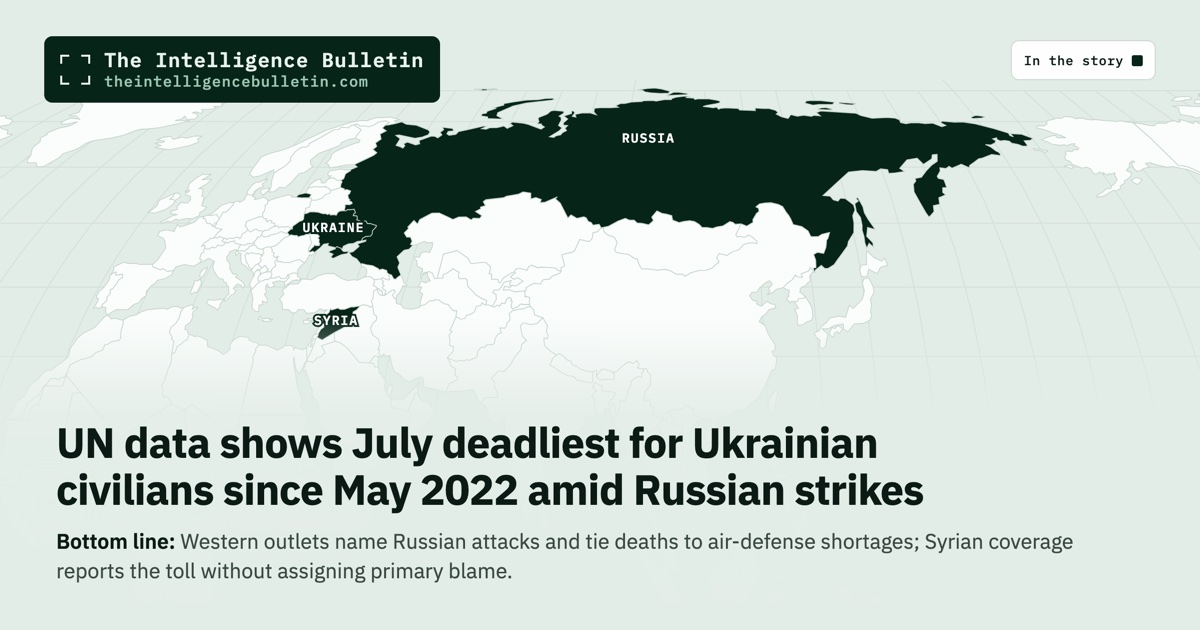
Western outlets name Russian attacks and tie deaths to air-defense shortages; Syrian coverage reports the toll without assigning primary blame.
Coverage of the UN July casualty figures reveals a clear split in how outlets assign responsibility and connect the data to the wider war. Western European and US sources, including Deutschlandfunk and Yahoo, explicitly tie the 437 deaths to Russian attacks and note Ukraine’s shortage of Patriot interceptors, framing the toll as evidence of Moscow’s escalation. Singapore’s Straits Times and the US Yahoo piece stay closer to the raw UN numbers and verified totals, while relaying AFP or DPA wires. Italy’s Olbia Notizie adds a specific recent Odessa drone strike on a passenger train, using the UN report to underscore immediate civilian impact and Zelensky’s appeal for US missiles. Syria’s SANA, relaying AFP, mentions intensified Russian missile use but avoids direct aggressor language in its lead and situates the figures within ongoing mutual strikes. All sources agree on the 437 killed, the 30 and 70 percent rises, and Kyiv’s 54 deaths, yet only the German and Italian outlets foreground accountability and the defense-aid debate. The absence of direct Russian or Ukrainian national outlets in the set leaves the UN figures as the sole common anchor, with attribution choices revealing each outlet’s editorial priorities rather than conflicting facts.
Full analysis
The United Nations Human Rights Monitoring Mission in Ukraine recorded at least 437 civilian deaths and 2,610 injuries during July. This marked the highest monthly civilian toll since May 2022, with the total representing a 30 percent increase over June and a 70 percent rise compared with July the previous year. Long-range weapons drove the spike, according to the mission, killing 183 people and wounding 967 others. Kyiv suffered particularly heavy losses, with 54 civilians killed and more than 200 injured in the capital alone. The mission noted that actual numbers were likely higher, as verification of reports remained ongoing and access to some areas was restricted.
The same UN assessment placed the cumulative verified civilian deaths since the full-scale invasion began in February 2022 at 16,874, including 820 children, with total injuries reaching 51,273. Russian authorities separately reported 79 civilian deaths and more than 600 injuries on their side of the border during July, though the mission stated it could not independently verify those figures to its standards due to limited access and information restrictions. The mission also recorded the highest child casualties since April 2022, with 17 children killed and 166 injured.
Multiple outlets carrying the UN figures described the rise as tied to intensified Russian use of ballistic and cruise missiles, drones and glide bombs. One account noted that Russia launched a record number of missiles during the month, according to analysis of Ukrainian air force data. Ukrainian President Volodymyr Zelensky linked the pattern to shortages of interceptor missiles for Patriot systems, stating in one interview that Ukraine possessed only one-tenth of the stock needed and that even 5 percent of current United States holdings would allow the country to survive the winter. He added that 10 percent would enable the destruction of all incoming Russian ballistic missiles.
Coverage differed in how directly it connected the UN numbers to Russian responsibility and to Ukrainian requests for additional air defense support. One German public broadcaster article opened by naming Russian attacks as the cause of the deaths and highlighted Ukraine’s ongoing complaints about insufficient Patriot interceptors. An Italian regional outlet tied the UN record directly to a Russian drone strike on a passenger train locomotive near Odessa that killed the driver and assistant on August 13, with 340 passengers aboard, and quoted Zelensky appealing for more Western air defense aid alongside the casualty data. A Singapore newspaper presented the figures and the record Russian missile launches alongside Kyiv’s impact but omitted any reference to Ukrainian aid requests. A United States outlet relayed a German agency dispatch that included both the Ukrainian complaints about Patriot shortages and the Russian-side casualty reports. A Syrian state news agency carried an AFP dispatch that noted intensified Russian missile use yet situated the toll within continued escalation involving strikes on both sides without foregrounding one party’s actions in the lead.
All five sources converged on the core UN statistics of 437 killed, the 30 and 70 percent increases, and the 54 deaths in Kyiv. Three of them reported the Kyiv-specific figure. The same three also relayed the Ukrainian appeal for Patriot missiles. Only the German and Italian pieces placed accountability and the defense-aid question at the center of their framing. The Syrian piece alone avoided naming Russia as the primary driver in its opening sentence while still including the mission’s reference to Russian long-range weapons later in the text.
The UN figures supply the single consistent baseline across the reporting. Outlets operating from Western European and United States perspectives used that baseline to connect the toll to Russian escalation and to Ukrainian shortfalls in air defense, a linkage supported by the mission’s own attribution of the increase to long-range weapons and by separate Ukrainian statements on interceptor needs. The Syrian framing reflects a state-aligned editorial choice to embed the numbers in a description of mutual strikes rather than to isolate one side’s actions. The Singapore account stayed with the verified counts and the missile-launch record without extending into policy implications. Because the set contains no direct reporting from Russian or Ukrainian national outlets, the UN mission remains the sole shared anchor, and differences in emphasis track each outlet’s location and editorial priorities rather than any factual disagreement on the mission’s numbers themselves.
What to Watch
The Western European and United States accounts sit closest to the mission’s own wording on the source of the increase and therefore offer the most direct reading of the data for a reader seeking to understand the immediate drivers of the July toll. Their inclusion of Ukrainian statements on air defense shortages follows logically from the mission’s observation that long-range weapons were the leading cause, and those statements appear on the record from Zelensky. The pattern of coverage suggests that future monthly UN releases will continue to serve as reference points for assessing whether the escalation in long-range strikes persists and whether additional air defense deliveries alter the casualty trajectory.
That’s how the world told the story.
Get our daily open-source intelligence on world events in your inbox — one email a day, up to six stories.
Subscribe freeNo spam. One-click unsubscribe. See the latest email →