 AI-generated analysis published under the editorial responsibility of Rohit Sinnas. How it works →
Press quoted
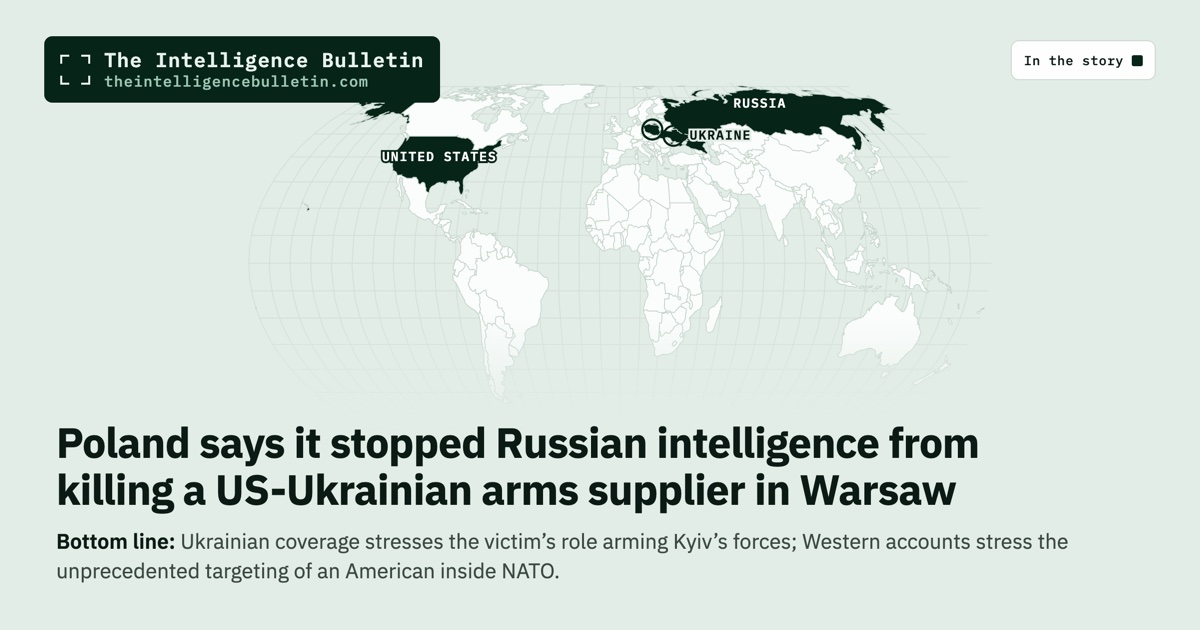
Ukrainian coverage stresses the victim’s role arming Kyiv’s forces; Western accounts stress the unprecedented targeting of an American inside NATO.
Ukrainian outlets alone name the intended victim’s role supplying weapons to Ukrainian forces as the reason he became a target, a detail that anchors the story in Kyiv’s war effort rather than abstract security threats. Western reporting instead leads with the Polish prime minister’s statement that this marks the first Russian-directed attack on a US citizen inside NATO territory and stresses the joint Polish-US operation that stopped it. The Jerusalem Post and Philadelphia Inquirer carry Reuters and AP dispatches that repeat Tusk’s words almost verbatim while adding only the broader context of prior Russian plots across Europe. The Guardian expands on that history with references to Litvinenko, Skripal and other cases, yet still treats the Polish announcement as the central new fact. No source in the set carries a Russian rebuttal or independent confirmation of the suspect’s recruitment; all rest on the same Polish government account. The resulting picture shows how the same announcement travels through different national lenses: one set foregrounds direct support for Ukraine’s battlefield needs, the other foregrounds alliance vulnerability and transatlantic cooperation.
Full analysis
Polish security officers detained a 29-year-old Russian citizen on a Warsaw street on August 7 after he left his apartment. The man had been recruited by Russian intelligence services to carry out an assassination, according to statements from Polish Prime Minister Donald Tusk. Officers from the Internal Security Agency, supported by police and a counter-terrorism unit, made the arrest on Woloska Street before the attack could proceed. Tusk revealed the details six days later at a press conference, describing the target as a dual US-Ukrainian citizen whom the Putin regime viewed as inconvenient. The suspect now faces three months in custody at a Warsaw detention facility while prosecutors treat the case as a politically motivated contract killing.
Tusk stated that the operation marked the first known instance in which Russia had ordered an attack on an American citizen inside another NATO country. He credited the Internal Security Agency and American services with stopping the plot at the last moment. Tomasz Siemoniak, Poland’s coordinator for special services, confirmed on X that the assassination was planned to occur in Warsaw itself. Tusk added that Polish authorities must assume the Russian regime will continue attempting to eliminate people it finds inconvenient in various parts of the world and that Poland is preparing for further attempts.
Ukrainian reporting supplies one additional detail absent from the English-language accounts. Both the Kyiv Post and Dzerkalo Tyzhnia identify the intended victim as a businessman who supplies weapons to Ukraine’s armed forces. The Ukrainian-language Dzerkalo Tyzhnia piece, drawing on Polish media reports, notes that the target originates from the Donbas region and stresses his role in arming Ukrainian troops. The Kyiv Post similarly frames the plot as Russian targeting of someone providing direct material support to Kyiv’s war effort. These outlets present the arrest as evidence that Russian operations reach into the Ukrainian diaspora and supply networks even inside NATO territory.
English-language coverage centers instead on the unprecedented nature of the target and the intelligence cooperation that thwarted it. The Guardian reports Tusk’s claim that this was the first Russian-directed attack on a US citizen in a NATO country and places the incident inside a longer pattern of Russian sabotage and assassination attempts across Europe. It references the 2006 killing of Alexander Litvinenko in London, the 2018 Salisbury novichok attack on Sergei Skripal, the 2019 Berlin shooting of Zelimkhan Khangoshvili, and a June 2026 killing of a Russian artist critical of Putin in eastern Poland. The Philadelphia Inquirer, carrying Associated Press copy, leads with the American citizen angle and notes the joint Polish-US operation while recording that the US State Department acknowledged the reports but offered no further information. The Jerusalem Post, relaying Reuters, repeats Tusk’s description of the victim as “inconvenient to the Putin regime” and records that the Russian embassy in Warsaw did not respond to requests for comment.
All five outlets rest on the same Polish government statements. None contains independent confirmation of the suspect’s recruitment or of the target’s identity beyond the details Tusk and Siemoniak supplied. No outlet in the set carries a Russian government response or denial. The Russian Foreign Ministry did not reply to inquiries from the Guardian or the Inquirer. Previous Russian plots receive mention only in the Guardian and Inquirer pieces as background, not as new evidence in this case.
A reader who encounters only the Ukrainian sources will correctly understand that the intended victim supplied arms to Ukrainian forces and will therefore see the plot as an attempt to disrupt Kyiv’s battlefield logistics. That reader will not learn from those articles that Polish officials presented the incident as the first Russian attack on an American inside NATO territory. A reader limited to the Guardian or the Inquirer will absorb the NATO-security framing and the historical context of earlier Russian operations, yet will miss the explicit connection to weapons supplies for Ukrainian troops that the two Ukrainian outlets foreground. The wire-service accounts in the Jerusalem Post and Philadelphia Inquirer stay closest to Tusk’s original wording and add little beyond the standard note that Moscow routinely dismisses such accusations as Western paranoia.
The core factual spine remains the Polish account: a Russian national was detained on August 7 after recruitment by Russian intelligence to kill a dual US-Ukrainian citizen, and Polish officials described the case as unprecedented. That account is corroborated across every outlet examined because each one relays the same statements from Tusk and Siemoniak. The additional detail that the victim supplied weapons to Ukrainian forces appears only in the two Ukrainian sources and therefore stands as single-source reporting. No contradictory claims exist in the set; the differences lie in emphasis rather than in disputed facts.
What to Watch
Polish officials have an obvious interest in presenting the operation as a successful joint effort with the United States that protects both NATO territory and a US citizen. Ukrainian outlets have an interest in underscoring any threat to the supply lines that sustain their country’s defense. Western outlets have an interest in framing the episode inside the larger narrative of Russian hybrid operations against European support for Ukraine. The absence of any Russian-sourced material in the set means readers receive no competing narrative from Moscow on this specific incident. The next development most likely to test these accounts will be whatever details emerge from the Polish investigation or from any future similar operations Polish authorities choose to disclose.
That’s how the world told the story.
Get our daily open-source intelligence on world events in your inbox — one email a day, up to six stories.
Subscribe freeNo spam. One-click unsubscribe. See the latest email →