 AI-generated analysis published under the editorial responsibility of Rohit Sinnas. How it works →
Press quoted
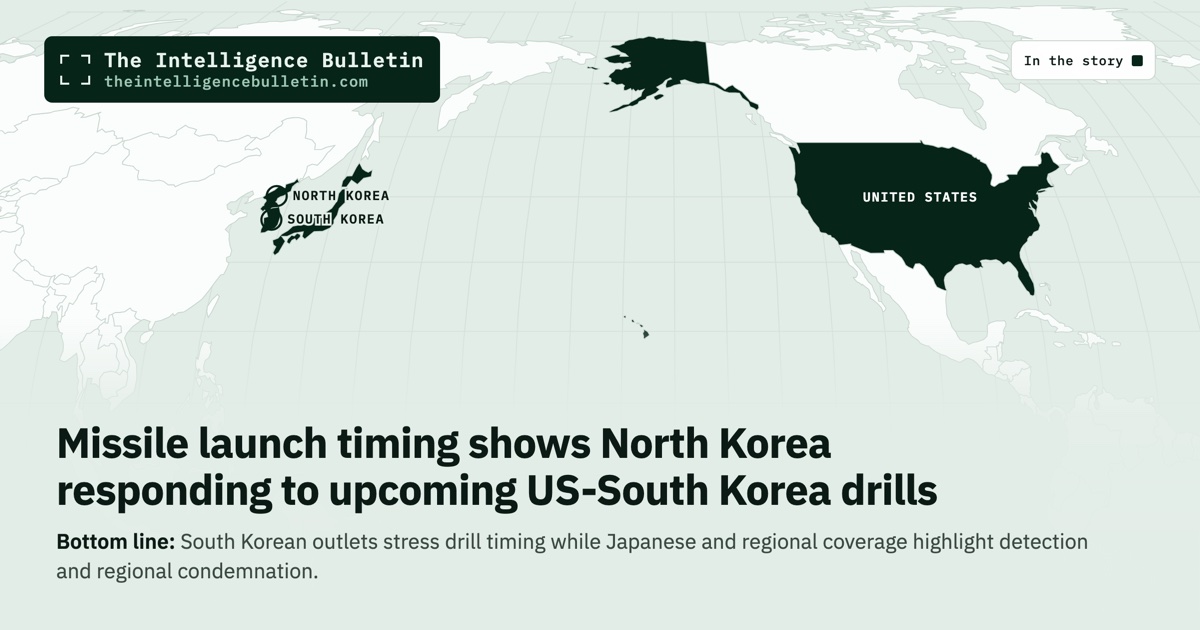
South Korean outlets stress drill timing while Japanese and regional coverage highlight detection and regional condemnation.
The reporting across the five outlets converges tightly on the launch facts themselves: timing, location, distance and the absence of any North Korean confirmation. What separates the accounts is the framing of motive and audience. KBS and Hankyoreh, both South Korean, place the launch squarely in the context of the impending Ulchi Freedom Shield exercises, quoting the Joint Chiefs directly and noting Pyongyang’s prior condemnation of the drills as rehearsals for war. Asahi relays the South Korean military statement but adds Japan’s assessment that the missile fell outside its exclusive economic zone and records Tokyo’s protest. SCMP centers the Japanese defence minister’s condemnation of the launch as a regional threat and includes expert commentary linking the timing to Pyongyang’s pattern of responding to joint drills. Al Jazeera steps back to explain the broader pattern, tying the test to North Korea’s deepening military cooperation with Russia and the resulting battlefield experience its troops are said to be bringing home. The single consistent thread is that every outlet treats the timing as deliberate; none presents the launch as routine weapons testing detached from the drills. The selected sources contain no North Korean outlet, so Pyongyang’s own stated rationale is absent.
Full analysis
North Korea launched a ballistic missile from the Wonsan area on its eastern coast at around 6 a.m. local time on August 12. South Korea’s Joint Chiefs of Staff detected the launch and reported that the missile flew more than 700 kilometers before landing in the East Sea. The test marked the North’s eleventh suspected ballistic missile firing of 2026 and its second in six days, following a short-range launch from the same area on August 6. Japanese authorities assessed that the missile fell outside Japan’s exclusive economic zone.
The timing placed the launch five days before the start of the Ulchi Freedom Shield exercises, the annual US-South Korea joint drills scheduled to run from August 17 to 27. Those exercises involve roughly 18,000 South Korean troops and personnel from the US contingent of about 28,500 stationed in South Korea. South Korea’s National Security Office convened an emergency meeting the same morning and called on Pyongyang to halt actions that violate UN Security Council resolutions. The Joint Chiefs said South Korean and US intelligence agencies had shared information on the launch from the earliest stages and had also passed details to Japan. South Korea’s military raised its vigilance for possible follow-on launches.
The selected reporting contains no statement from North Korean state media or officials on this specific test. All five outlets note that Pyongyang has repeatedly described past US-South Korea drills as rehearsals for invasion and has responded to them with missile activity in prior years. The sources also record that North Korea has conducted a series of weapons tests throughout 2026, including short-range ballistic missiles and other tactical systems. One account adds that Ukrainian President Volodymyr Zelenskiy stated on August 11 that Russia had used a North Korean ballistic missile in an attack on a steel plant in Zaporizhzhia.
South Korean coverage placed the launch directly against the calendar of the upcoming drills. KBS reported the event as the eleventh test this year and described it as a provocation timed ahead of the joint exercise. The Hankyoreh noted the missile’s range and added that the launch may have been a response to the drills North Korea has condemned as preparations for war. Both outlets quoted the Joint Chiefs statement on information sharing with Washington and Tokyo and recorded Seoul’s call for Pyongyang to stop violating UN resolutions.
Japanese and Hong Kong-based reporting added the regional security dimension. The Asahi Shimbun carried the South Korean military account and supplemented it with Japan’s observation that the missile had landed outside its exclusive economic zone. It also recorded that Japan’s defence minister, Shinjiro Koizumi, called the launch a threat to peace and security in the region and lodged a protest through diplomatic channels in Beijing. The South China Morning Post centered Koizumi’s condemnation and included an expert assessment that North Korea has never allowed a major South Korea-US exercise to pass without a response. That account linked the timing to Pyongyang’s pattern and noted North Korea’s recent criticism of Japan’s defence white paper and its own expanding military cooperation with Russia.
The Qatari outlet stepped back to explain motive and context. Al Jazeera described the launch as the second test in under a week amid tensions over North Korea’s growing military ties with Russia and concerns about its weapons programme. It quoted a North Korea expert at Kyungnam University who said Pyongyang has never simply let a joint drill pass without response and viewed the test as a message that it is watching the upcoming exercises closely. The account also referenced battlefield experience North Korean troops are said to have gained in Ukraine and brought back, noting that US and South Korean training now accounts for that development. It recorded that North Korea has not immediately commented on the latest launch.
The five accounts converge on every measurable detail of the launch itself. They agree on the origin point at Wonsan, the approximate time, the distance flown, the absence of North Korean confirmation, and the sequence as the eleventh test of the year and the second in six days. They also agree that the test occurred days before the Ulchi Freedom Shield drills and that South Korea shared information with the United States and Japan. No outlet presents the firing as routine or unrelated to the exercise calendar.
Where the accounts diverge is in the weight given to motive and audience. The two South Korean outlets foreground the drills as the immediate trigger and quote Seoul’s security apparatus directly. Japanese coverage layers Tokyo’s detection and protest onto the same facts. The Hong Kong outlet amplifies the Japanese official reaction and supplies an expert quote on the recurring pattern. The Qatari account widens the frame to Russia-North Korea military cooperation and the resulting experience its forces are applying at home. A reader limited to South Korean sources would see a straightforward provocation aimed at the drills. A reader limited to Japanese or regional outlets would see an additional layer of condemnation from Tokyo and an explicit pattern of North Korean responses. A reader limited to the explanatory account would encounter the Russia connection and the battlefield-experience dimension that the narrower reports mention only in passing or not at all.
The consistent element across every account is that the timing itself is treated as deliberate. None of the reporting frames the test as detached weapons development. The selected sources contain no North Korean outlet, so any statement Pyongyang might have issued on its own rationale for this launch is absent from the set. The two South Korean articles, the Japanese relay, the Hong Kong regional piece, and the Qatari analysis all draw on the same South Korean military statement for the core facts and then add the element their audience is most likely to require: drill context for domestic readers, trajectory and protest for Japanese readers, regional threat language for a broader Asian audience, and geopolitical explanation for an international one.
What to Watch
The reporting that most fully equips a reader to understand the event is the one that retains the drill timing while also placing the test inside North Korea’s documented pattern of responses and its documented military relationship with Russia. That account appears in the Qatari analysis and is reinforced by the expert quote carried in the Hong Kong piece. The narrower South Korean and Japanese reports supply the precise local reactions but leave the wider pattern and the Russia dimension to be supplied by other outlets. The convergence on the launch facts themselves is the strongest evidence that the test occurred as described. The convergence on deliberate timing, drawn from five independent reporting chains, indicates that the calendar link is not an artifact of any single national lens. What remains open is Pyongyang’s precise calculation, which no source in this set can supply because no North Korean account is present. The next tests or statements from Pyongyang will show whether this launch was a one-off signal or the start of a sustained series ahead of the drills.
That’s how the world told the story.
Get our daily open-source intelligence on world events in your inbox — one email a day, up to six stories.
Subscribe freeNo spam. One-click unsubscribe. See the latest email →