 AI-generated analysis published under the editorial responsibility of Rohit Sinnas. How it works →
Press quoted
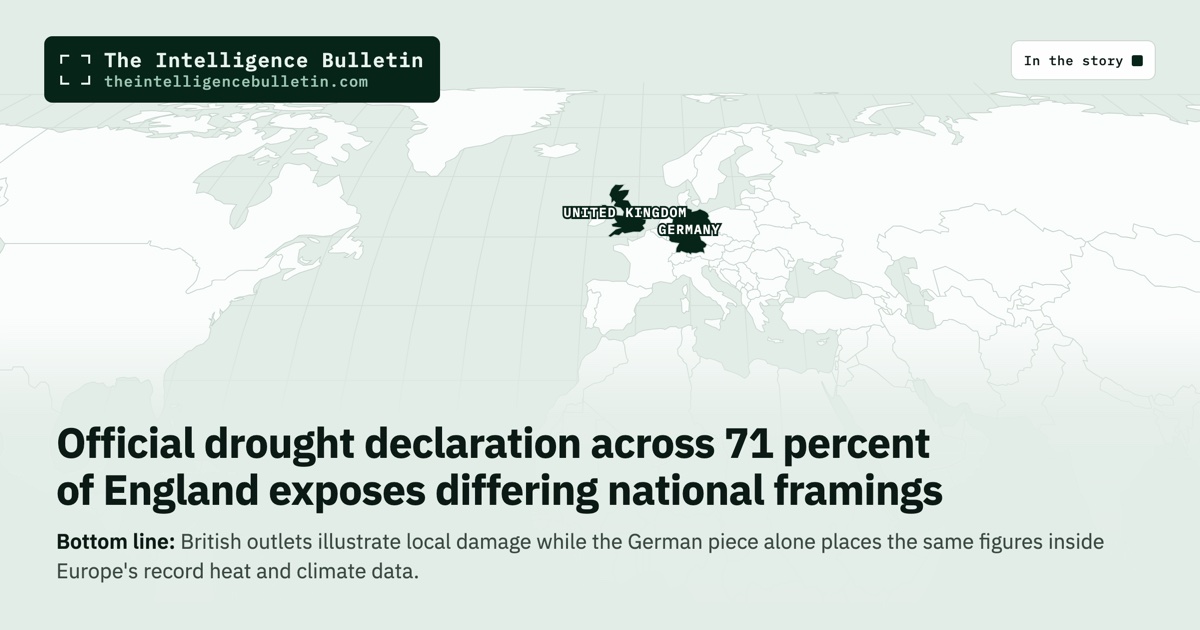
British outlets illustrate local damage while the German piece alone places the same figures inside Europe’s record heat and climate data.
The four reports converge on the Environment Agency’s official declaration yet diverge sharply in emphasis, revealing how national proximity shapes what counts as the story. The Independent leads with before-and-after photographs of parched reservoirs and browned fields, treating the drought as a visible domestic crisis whose human and agricultural costs require no further framing. Deccan Chronicle relays the government statement almost verbatim, highlighting the flash-drought label, early crop harvests and wildfire risk without adding regional context. Anadolu Agency pairs the 71 percent figure with nationwide amber heat-health alerts, presenting the event as an immediate public-health emergency rather than an agricultural or environmental one. Der Spiegel alone widens the lens, citing Copernicus data on record West European temperatures and an AFP analysis showing drought conditions across 95 percent of France and 99 percent of Switzerland; it explicitly ties the English situation to the climate crisis and warns of potential EU-wide GDP losses. This pattern shows that only the German outlet treats the declaration as evidence of a continental pattern, while the British and Indian pieces remain tightly focused on the official UK announcement and its immediate local consequences. The result is a story whose scale depends on where the reader sits: a set of striking pictures for one audience, a policy bulletin for another, and a climate-system warning for the third.
Full analysis
On 11 August 2026 the United Kingdom Environment Agency announced that 71.3 percent of England had entered drought conditions. The figure marked an increase from the nearly half of the country already under that status in late July. It placed 45 million people inside drought areas and left 27 million living under water-use restrictions. Seven regions now carried the formal designation, including London, East Anglia, all of southwest England and the West Midlands. The North East and Yorkshire had been placed under prolonged dry weather status instead.
Southern England recorded its driest July on record during the same period. The Met Office measured 1.9 millimetres of rain across the region. England as a whole received only 6.5 millimetres, or roughly 10 percent of the long-term average. The National Drought Group, which includes meteorological officials, government ministers, regulators, water companies and farmers, met the same week to review impacts and response plans. Its chair, Helen Wakeham of the Environment Agency, stated that hot and dry weather meant water was being used faster than nature could replenish it. She described a second consecutive summer drought as an exceptionally serious situation with long-lasting effects on the environment, wildlife and the economy.
Rivers, reservoirs and groundwater levels continued to fall. Agricultural land turned brown across wide areas. Farmers reported poorer yields and in some cases harvested crops early. Livestock producers turned to winter feed supplies because grass growth had collapsed. Water Minister Emma Hardy said the government was working to make it easier for farmers to build on-site irrigation reservoirs. Wildfire risk rose in several counties. Breeding birds, amphibians and freshwater fish stocks faced additional pressure. The Met Office also recorded a new daily temperature high of 38 degrees Celsius for June, later revised upward from an earlier provisional reading.
Amber heat-health alerts issued by the UK Health Security Agency covered the whole of England. They remained in force until at least 14 August. Forecasters expected temperatures to reach 38 degrees Celsius again during the coming week, with the heat driven by high pressure and southerly winds drawing warmer air from the continent. Britain was on track for its warmest meteorological summer on record, with the average temperature so far 1.88 degrees Celsius above the 1991-2020 baseline.
The same declaration appeared in reports from four outlets that published within the 24-hour window. Each foregrounded a different slice of the available detail. The Independent opened with before-and-after photographs of depleted reservoirs whose beds had become visible and of fields that had shifted from green to brown. It listed specific newly designated regions such as the East Midlands, Lincolnshire and Northamptonshire, Kent and East Sussex, and Solent and the South Downs. It noted that the episode marked the second consecutive summer drought and the third in four years. Quotes from Wakeham and Met Office chief forecaster Jason Kelly appeared in full.
Deccan Chronicle carried the government statement almost directly. It repeated the flash-drought description, the count of 45 million people affected, the 27 million under restrictions, and the Environment Agency warning that rivers were running low while wildfire risk increased. It added the detail that southeast England had received just 1 percent of its expected July rainfall and that an estimated 2,877 heat-related deaths had already occurred in Britain that year. No photographs or European comparisons appeared.
Anadolu Agency paired the 71.3 percent figure immediately with the nationwide amber heat-health alerts. Its framing presented the drought as part of an immediate public-health response rather than a primarily agricultural or hydrological event. The outlet noted the forecast for further notable heat peaking on Thursday and the contribution of southerly winds tapping into conditions over Europe.
Der Spiegel placed the English figures inside a wider European pattern. It reported that an AFP analysis of European Drought Observatory data showed drought conditions in 95 percent of French mainland territory and 99 percent of Switzerland during July. It cited Copernicus data showing that June and July average temperatures across western Europe reached 21.62 degrees Celsius, the highest for those two months in the record. The article also referenced a Triodos Bank study estimating that heat-related disruptions could reduce European Union GDP by around one percent, or roughly 180 billion euros, in 2026. It described yellowed parks and fields in England, low river levels and warnings of possible food shortages, then connected these directly to the climate crisis.
A reader who encountered only the Independent photographs would leave with a strong sense of visible local damage but little information on comparable conditions elsewhere in Europe. A reader limited to the Deccan Chronicle summary would receive the official counts and policy language yet miss both the photographic record of depleted landscapes and the continental temperature data. Someone reading only the Anadolu Agency piece would register the health alerts and the drought percentage but would not see the specific regional designations or the calls for on-farm reservoirs. Only the Der Spiegel account supplied the French and Swiss percentages, the Copernicus temperature record and the GDP projection, elements drawn from sources outside the United Kingdom.
What to Watch
The core factual spine remains consistent across the four reports. The Environment Agency declaration, the 71.3 percent figure, the Met Office rainfall totals and the heat alerts all appear in multiple independent accounts. The single-source European drought percentages and economic estimate sit solely in the German reporting and rest on AFP and Copernicus material that the other three outlets did not cite. That material supplies the warrant for treating the English declaration as one instance of a larger pattern rather than an isolated domestic episode. The outlets with the narrowest focus had no evident interest in downplaying continental connections; they simply operated inside the frame of the official UK announcement they had received. The outlet that widened the frame did so by drawing on additional data streams already in circulation. The next development most likely to shift the picture is the release of updated rainfall or temperature readings from the Met Office or Copernicus in the coming days, which would either reinforce or qualify the scale already reported.
That’s how the world told the story.
Get our daily open-source intelligence on world events in your inbox — one email a day, up to six stories.
Subscribe freeNo spam. One-click unsubscribe. See the latest email →