 AI-generated analysis published under the editorial responsibility of Rohit Sinnas. How it works →
Press quoted
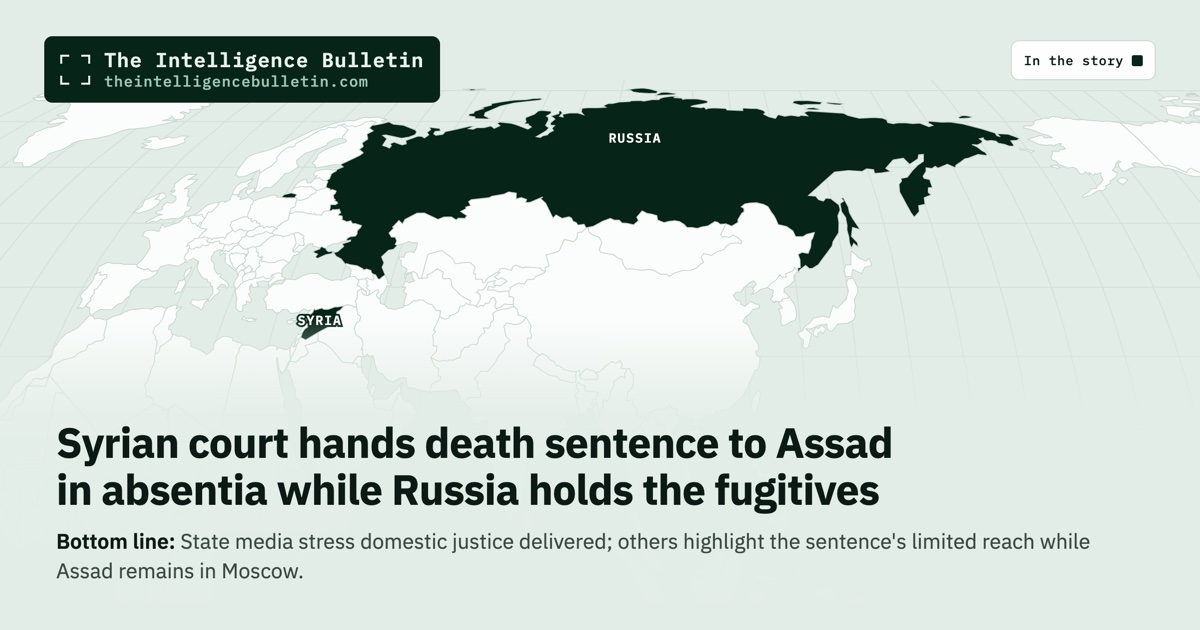
State media stress domestic justice delivered; others highlight the sentence’s limited reach while Assad remains in Moscow.
The reporting converges on the court’s detailed reconstruction of the Daraa events that opened the conflict and on the legal classification of the acts as crimes against humanity, yet parts company on what the sentence actually changes. SANA presents the verdict as the culmination of a national judicial process that examined the regime’s structure from Hafez al-Assad onward and affirmed domestic jurisdiction over international crimes. IBTimes and El Mundo add the 500,000-death toll and note the precedent for holding the Assad family accountable for the first time. Al Jazeera isolates Atef Najib’s role as the only defendant physically present, framing the case as the first real test of the new authorities’ transitional justice machinery. SCMP, carrying Reuters copy, alone flags the Moscow refuge and the remote chance of extradition. The divergence is not accidental: outlets close to the new Damascus authorities stress the verdict’s domestic legitimacy and victim reparations, while those further away emphasise either the human cost or the practical limits imposed by Russia’s sheltering of the fugitives. Where the accounts agree—on the specific charges, the in-absentia procedure and the Daraa trigger—they do so because the evidence presented in open court is the single common source. Where they differ, the difference tracks each outlet’s distance from the courtroom and from the political stakes of enforcement.
Full analysis
A Damascus court handed down death sentences on August 11 to former president Bashar al-Assad, his brother Maher, their cousin Atef Najib and six other former officials after convicting them of murder, torture, unlawful deprivation of liberty and related offenses. The Fourth Criminal Court, presided over by Judge Fakhr al-Din al-Aryan, issued Decision No. 1 of 2026 in Case No. 1 of 2026, a 396-page ruling delivered in the ninth hearing of proceedings that began on April 26. The court classified the acts as crimes against humanity and, for most defendants, war crimes committed after the conflict became a non-international armed conflict in mid-July 2012.
The case centered on events in Daraa province that began in February 2011. Security forces under Atef Najib, then head of the Political Security Branch there, arrested and tortured a group of schoolchildren who had painted anti-government slogans on a wall. Witnesses who were minors at the time described beatings, electric shocks, suspension and nail removal. Najib personally interrogated some of them, the court found. A March 18 demonstration demanding the children’s release met live fire that killed Mahmoud al-Jawabreh and Hossam Ayyash. Security forces later stormed the Omari Mosque, fired on ambulances and detained wounded people, some of whom died. The court traced the subsequent spread of protests and the regime’s coordinated response through surrounding villages, recording scores of deaths and injuries. It held Bashar al-Assad responsible as the principal decision-maker who directed state institutions, shielded subordinates and turned a joint criminal enterprise into policy.
Najib appeared in court inside a metal cage, wearing a prisoner’s uniform. He had been arrested in January 2025 in Latakia province after the regime’s collapse and was the only defendant physically present. The others, including the Assad brothers, were tried in absentia. The court sentenced all nine to death, consolidated additional custodial terms and fines where applicable, and ordered that arrest warrants remain in force for international circulation. It also ordered provisional seizure of the defendants’ property, converted to enforceable seizure, and imposed civil restrictions on the fugitives. Victims whose claims were accepted are entitled to reparations assessed according to harm suffered; the court preserved the rights of other victims and missing persons to seek redress later.
The court examined the principle that national courts hold primary jurisdiction over international crimes under the complementarity doctrine and ruled that statutes of limitation and amnesties do not apply. It adopted the Rome Statute definition of crimes against humanity and the international standard for determining the existence of a non-international armed conflict. Defense witnesses were heard and protected, with some testifying under numbers rather than names. Najib denied the charges and showed no remorse when confronted with victims, the court recorded. The verdict is subject to publication and appeal procedures and may be annulled if the absent defendants are arrested or surrender.
Coverage of the same court record diverges sharply on what the sentence changes in practice. Syrian state reporting presents the outcome as the culmination of a structured national process that began with the first hearing in April and incorporated official documents, medical reports, audio-visual material and international reports alongside witness testimony. It details the regime’s continuity from Hafez al-Assad’s 1970 coup through Bashar al-Assad’s assumption of power in 2000 and the role of the Fourth Armored Division under Maher. It records the public prosecutor’s attendance, the presence of the National Commission for Transitional Justice and representatives of international legal organizations, and the order for victim compensation as an essential component of transitional justice. This account foregrounds the court’s affirmation of its own jurisdiction and the preservation of witness-protection measures.
Reports farther from Damascus place greater weight on the scale of the underlying conflict and the immediate limits on enforcement. One account notes an estimated 500,000 people killed across the 14-year war and describes the verdict as the first judicial ruling against any member of the Assad family. It records that Bashar and Maher al-Assad fled to Russia in December 2024 after the regime’s collapse and have been granted political asylum there. Syrian authorities have requested extradition, but Russia has not responded publicly and observers consider the prospect remote. The same reporting notes that Najib was detained after returning to Syria and became one of the most senior former officials to stand trial in person.
A Qatari outlet isolates Najib’s biography and role as the only defendant physically present, describing the proceedings as a test case for Syria’s transitional justice system under interim President Ahmed al-Sharaa. It reports that 75 plaintiffs filed cases against Najib and that the trial began with his first hearing on April 26. It quotes legal experts on the precedent the case will set for future prosecutions and notes the new government’s earlier criticism for delays in launching a promised transitional justice process. It records that Najib, 66, joined the military academy in Homs after school, rose to head political security in Daraa by 2007 and was removed from that post in April 2011 after the initial crackdown.
A Hong Kong outlet carrying Reuters copy alone stresses the geopolitical constraint created by the convicts’ location. It states that Assad fled Damascus as rebel fighters approached and is currently in Moscow. The short account records the convictions for premeditated murder, torture and arbitrary arrest but does not expand on reparations or the 396-page decision.
Spanish reporting aligns with the emphasis on the legal classification of the acts as crimes against humanity and war crimes while adding the figure of more than half a million people killed and millions displaced. It lists additional convicts including former defense minister Fahd al-Freij and notes that the trial began in April under the transitional authorities who overthrew Assad with a promise to deliver justice.
The accounts converge on the core elements of the ruling because they draw from the same open-court record: the Daraa trigger, the specific charges, the in-absentia procedure for the fugitives and the classification of the offenses. They diverge according to each outlet’s distance from the courtroom. Syrian state coverage alone supplies the reparations order and the full historical framing of the regime’s continuity. Outlets outside Syria add the death toll and the asylum in Russia; one of them alone frames the case explicitly as a test of the new government’s capacity to hold former officials accountable.
What to Watch
The corroborated facts of the sentence itself rest on multiple independent reporting chains that all quote the same court outcome. The single-source detail on reparations appears only in the Syrian state account because that outlet alone published the court’s explicit ruling on compensation. The practical effect of the verdict is bounded by the location of the principal defendants. Russia has provided asylum and has given no public indication it will honor an extradition request. Further domestic prosecutions of officials still inside Syria remain possible, and the precedent established by this trial supplies a legal foundation for them. The sentence records accountability on paper; enforcement beyond Syria’s borders depends on decisions made in Moscow.
That’s how the world told the story.
Get our daily open-source intelligence on world events in your inbox — one email a day, up to six stories.
Subscribe freeNo spam. One-click unsubscribe. See the latest email →