 AI-generated analysis published under the editorial responsibility of Rohit Sinnas. How it works →
Press quoted
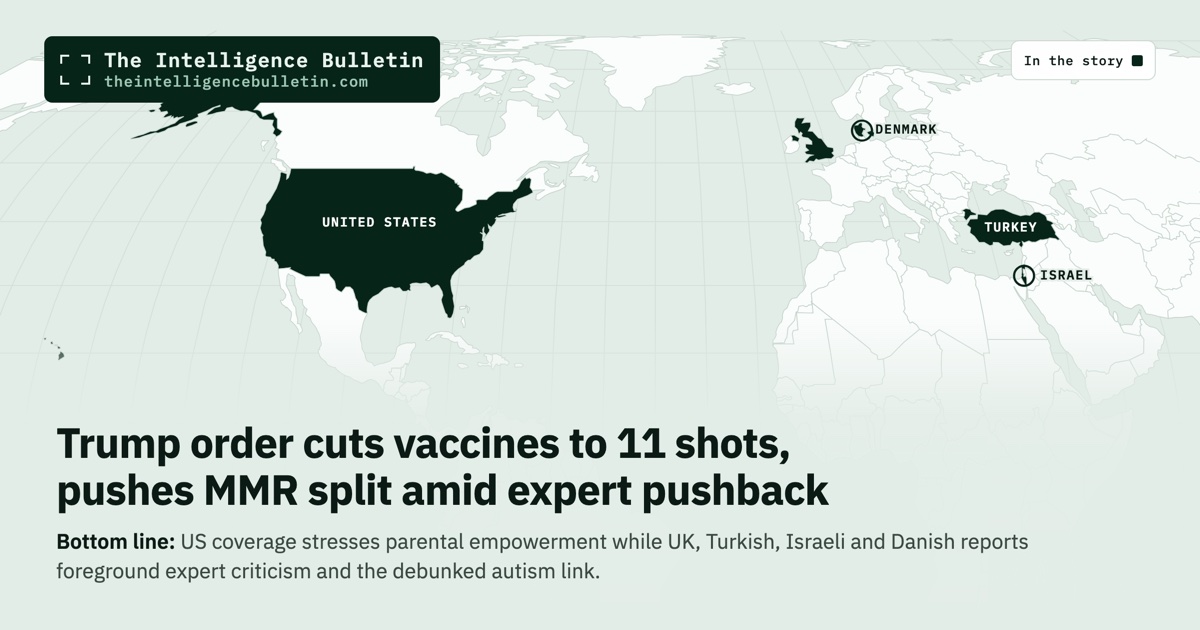
US coverage stresses parental empowerment while UK, Turkish, Israeli and Danish reports foreground expert criticism and the debunked autism link.
US domestic reporting frames the order as restoring parental authority and aligning recommendations with peer nations, while international accounts stress the influence of HHS Secretary Robert F. Kennedy Jr. and the absence of new scientific justification. Fox News details the shift to five separate visits, insurance coverage for parental choices, and legal action against states restricting exemptions. The Independent and Jerusalem Post relay Washington Post and Reuters accounts that highlight Trump’s repeated references to rising autism diagnoses and the long-debunked vaccine-autism link, alongside expert warnings that fewer shots will increase vulnerability to preventable diseases. Daily Sabah carries Reuters copy noting the reduction to exactly 11 vaccines and immediate criticism from the American Academy of Pediatrics. Ekstra Bladet emphasizes the directive to states to limit school mandates and records Trump’s unverified claim during the signing that combined shots “can be quite deadly.” The reporting converges on the order’s text and RFK Jr.’s role yet parts on whether the change empowers families or undermines established public-health evidence; no outlet claims the administration produced new data reversing prior safety findings.
Full analysis
President Donald Trump signed an executive order in the Oval Office on August 10, 2026, titled “Gold Standard Childhood Vaccine Recommendations.” The order limits federal recognition to 11 core childhood vaccines against what the administration called the most serious diseases. It also directs that the combined measles-mumps-rubella shot be broken into three separate injections given at different medical visits and ends the prior universal recommendation that all children receive the COVID-19 vaccine. The text further instructs the attorney general to pursue legal challenges against state laws that restrict religious or medical exemptions from school immunization requirements and calls on states to review and consider updating their own rules defining those requirements.
The order builds on earlier steps taken by Health and Human Services Secretary Robert F. Kennedy Jr., who in January had already removed recommendations for shots against six of seventeen diseases before a federal court halted that change. The new executive order reaffirms those reductions and adds the explicit push for separate MMR components. Trump spoke at the signing ceremony about spreading the remaining shots across five separate doctor visits so that children would receive smaller amounts at each appointment. He said parents could still choose to give their children every vaccine on the old schedule if they wished, and that insurance would continue to cover the shots. Existing coverage under the Vaccines for Children program for lower-income families would remain in place.
Medical organizations responded immediately. The American Academy of Pediatrics and the vaccine maker Merck both stated that no new scientific evidence justified the reductions. They warned that fewer recommended shots and the added complexity of separate visits would leave more children unprotected against preventable diseases. Physicians noted that single-antigen measles, mumps, and rubella vaccines are not currently licensed or available in the United States, which would make the recommended split impossible to implement as written without new regulatory approvals and manufacturing changes. Several experts added that the prior schedule had been built on decades of data matching the specific disease risks and health-care system in the United States, and that comparisons to schedules in other countries ignored those differences.
Trump repeatedly cited rising autism diagnoses during the ceremony and pointed to groups that avoid vaccines as evidence that something in the current schedule was responsible. The order itself does not contain new studies reversing earlier findings on vaccine safety. Kennedy, who has long promoted inquiries into possible links between vaccines and autism, is described in multiple accounts as having driven the policy direction since taking office.
Coverage of the signing converged on the order’s core provisions and on Kennedy’s central role. Five independent reporting chains recorded the same limit of eleven vaccines, the recommendation to split the MMR shot, the direction to states on school requirements, and the immediate criticism from the American Academy of Pediatrics and Merck. No account claimed the administration had released fresh data overturning prior safety conclusions.
Where the accounts diverge is in emphasis and additional detail. One United States outlet foregrounded the shift of decision-making authority to parents, the promise of five separate visits, and the administration’s argument that the new schedule aligns the United States with peer nations. It reported that parents would retain full choice and that insurance would cover any combination they selected. International accounts, by contrast, placed heavier weight on Kennedy’s prior advocacy, the absence of supporting evidence, and the practical barriers to splitting the MMR vaccine. One Danish-language report recorded Trump stating during the ceremony that combined shots “can be quite deadly,” a remark not carried in the other four pieces. The same report stressed the directive aimed at state-level mandates and placed the action against the background of the worst measles outbreak in thirty-five years. Outlets relaying Reuters copy listed the exact count of eleven vaccines and the names of the criticizing organizations but did not expand on parental-choice language or the five-visit structure. One account added extended quotes from physicians on the lack of licensed single-component vaccines and on the risk that extra visits would lead to missed immunizations.
A reader limited to any single national press would therefore miss at least one concrete dimension that appears only in another. The parental-choice framing and the specific promise of five visits would be absent from the Reuters-based pieces. The explicit claim about combined shots being “quite deadly” would be absent from the United States and Israeli accounts. The detailed physician objections to feasibility would be missing from the Danish report. The autism references would be missing from the United States piece that otherwise records the order’s text most fully.
The reporting chains that carried the order’s text and the names of the criticizing organizations are the most complete on the factual record of what was signed and who objected on the record. Those chains do not assert that the administration produced new safety data, nor do they claim the split MMR shots are currently available. The accounts that add the administration’s language about parental authority accurately reflect statements made at the signing. The accounts that record the “quite deadly” remark and the background of the measles outbreak accurately reflect what appeared in those specific dispatches. No chain contradicts another on the number of vaccines or the MMR recommendation itself.
What to Watch
The policy is likely to produce immediate litigation over state school requirements and renewed debate inside medical associations about whether separate MMR components can be developed and reimbursed. Because the order rests on existing authority rather than new legislation, its reach will depend on how aggressively the Justice Department pursues the directed challenges and on whether states alter their own statutes. The absence of new evidence reversing prior safety findings means any reduction in coverage will be measured against the decades of data that supported the earlier schedule.
That’s how the world told the story.
Get our daily open-source intelligence on world events in your inbox — one email a day, up to six stories.
Subscribe freeNo spam. One-click unsubscribe. See the latest email →