 AI-generated analysis published under the editorial responsibility of Rohit Sinnas. How it works →
Press quoted
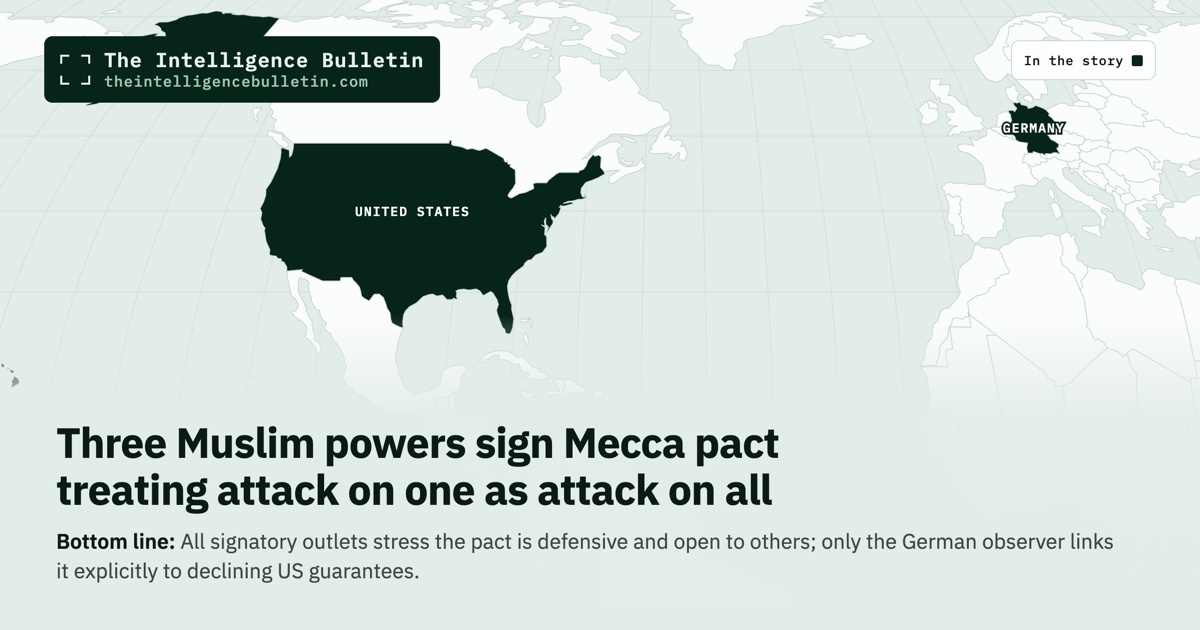
All signatory outlets stress the pact is defensive and open to others; only the German observer links it explicitly to declining US guarantees.
The three signatory countries’ reporting converges on one core message: the pact is a purely defensive instrument that strengthens collective deterrence without targeting any third party. Pakistani coverage, led by statements from Deputy Prime Minister Ishaq Dar, repeats the assurance that the agreement is not an instrument of confrontation and builds directly on the 2025 bilateral deal with Riyadh. Saudi commentary in Okaz frames the same text as a strategic step for Muslim-world security cooperation that draws on Turkish arms production and Pakistani diplomatic weight while remaining open to wider membership. Turkish reporting places the agreement inside Ankara’s wider diplomatic calendar, likening its collective-defence clause to NATO Article 5 and noting external support. Qatari analysis at Al Jazeera moves beyond the text itself to map possible next members, naming Egypt as the clearest near-term candidate while recording the signatories’ insistence that no state is named as a threat. German reporting at taz, the only European voice in the set, reads the pact as evidence that Gulf states no longer treat Washington as their sole security guarantor and flags Iranian and Israeli criticism as the first external reactions. The pattern across the set is therefore not disagreement over facts but a shared emphasis on reassurance paired with differing forward-looking angles: Pakistan stresses non-aggression language, Saudi Arabia stresses unity benefits, Turkey stresses alliance growth, Qatar explores expansion, and Germany situates the move inside a shifting US role.
Full analysis
The Mecca Joint Defence Agreement was signed on August 7 in Makkah by Pakistani Prime Minister Shehbaz Sharif, Saudi Crown Prince Mohammed bin Salman and Turkish President Recep Tayyip Erdogan. The text states that an armed attack against any one of the three states will be regarded as an attack against all three, consistent with the right of individual and collective self-defence under Article 51 of the United Nations Charter. It also provides for wider cooperation on joint exercises, intelligence sharing and arms production. All three governments issued statements describing the pact as defensive only and open to additional members.
The underlying material available to every outlet in this set originates in the same set of official announcements from the three capitals. Pakistani Deputy Prime Minister and Foreign Minister Ishaq Dar issued two public messages on consecutive days that repeated the defensive framing and the link to the September 2025 bilateral Strategic Mutual Defence Agreement between Pakistan and Saudi Arabia. Turkish Foreign Minister Hakan Fidan described the collective-defence clause as technically equivalent to NATO Article 5 and noted that the agreement had drawn support from other Islamic-world governments. Saudi officials, including Defence Minister Khalid bin Salman, emphasised long-term deterrence and stability without naming any external threat. Every published piece therefore works from the same core text and the same three sets of on-record remarks.
The Express Tribune headline led with Dar’s second reiteration that the pact “is defensive in nature, not directed against any country.” The body quoted Dar at length on non-confrontation language and on the role of Pakistan’s Chief of Defence Forces Field Marshal Syed Asim Munir in bringing the accord to fruition. It also supplied the detail that the new trilateral text builds directly on the 2025 Pakistan-Saudi bilateral agreement and that Pakistan has already deployed roughly 8,000 troops, fighter jets and an air-defence system to Saudi territory under that earlier deal. The article placed the story on the national page and treated it as a foreign-ministry success story rather than a regional-security development.
Okaz published an authored commentary whose headline translated as “The importance of the Mecca joint defence agreement strategically.” The piece opened with Article 51 language, then moved to the symbolic weight of signing in Islam’s holiest city and to the practical gains for the wider Muslim world. It highlighted Turkey’s 80 percent domestic military production rate and Pakistan’s recent diplomatic role between the United States and Iran, while stressing that the pact does not represent a sectarian bloc or a nuclear-arms race. The commentary was positioned in the opinion section and framed the agreement as one more instrument of collective self-help for states that can no longer rely on a single external guarantor.
Daily Sabah placed its mention of the pact inside a short item on Fidan’s telephone calls with his French and German counterparts. The headline made no reference to the agreement at all; the pact appeared only in the fourth paragraph as background to Ankara’s wider diplomatic calendar. The text noted that the agreement “aims to contribute to lasting stability in the region” and that Fidan had described the day of the signing as historic. The outlet therefore treated the Mecca text as one data point among several in Turkey’s ongoing outreach rather than as a standalone story.
Al Jazeera produced an explainer headlined “Which other countries could join the Turkiye-Saudi-Pakistan defence pact?” It quoted Fidan directly on the expectation that Egypt would join once technical issues were resolved and recorded the Turkish view that the pact should eventually bring “all countries under this umbrella.” The piece then supplied analyst commentary on the legal and operational hurdles for Cairo, including the need to protect existing peace treaties and aid relationships. It also listed Qatar and Kuwait as other states that might have motive to join after recent regional exposure. The article sat in the military-news section and shifted the frame from the signing itself to the question of future enlargement.
taz, the sole European outlet in the set, opened its account with the observation that three middle powers—Saudi Arabia with its financial reserves, Pakistan with its nuclear arsenal, and Turkey with the second-largest NATO army—had concluded a new security arrangement in Mecca. The headline read “New military alliance in the Middle East: With the Mecca Defence Agreement against the regional crisis.” The body linked the timing to the February 2026 US-Israeli strikes on Iran and the subsequent Iranian retaliation against Gulf energy infrastructure. It quoted an analyst from the German Orient Institute on the erosion of the long-standing assumption that the United States would defend the Gulf, and it recorded Iranian parliamentary criticism and former Israeli prime minister Naftali Bennett’s description of the pact as an attempt to build a hostile Sunni axis. The piece appeared on the foreign page and treated the agreement as evidence of a broader realignment rather than as an isolated diplomatic event.
Because every outlet drew from the same three government statements, differences appear in selection, placement and added context rather than in disputed facts. The Pakistani outlet foregrounded its own foreign minister’s repeated assurances. The Saudi commentary added regional-production and symbolic dimensions. The Turkish daily embedded the pact inside Ankara’s European diplomacy. The Qatari explainer used Turkish expansionist language to pivot to possible new members. The German account alone supplied Iranian and Israeli reactions and tied the development to questions of US reliability. These choices reflect the different audiences and institutional priorities of each masthead rather than any divergence in the underlying record.
What to Watch
The single reporting chain leaves readers with a clear picture of what the three governments chose to say on the record and with an equally clear map of how each outlet chose to package those statements. The Express Tribune and Daily Sabah kept the emphasis on reassurance and continuity. Okaz and Al Jazeera expanded the frame to long-term regional utility and growth. taz supplied the external reactions that the signatories themselves had not foregrounded. A reader who encounters only one of these versions will therefore receive the same core text filtered through the lens of that outlet’s primary constituency and editorial habits.
That’s how the world told the story.
Get our daily open-source intelligence on world events in your inbox — one email a day, up to six stories.
Subscribe freeNo spam. One-click unsubscribe. See the latest email →