 AI-generated analysis published under the editorial responsibility of Rohit Sinnas. How it works →
Press quoted
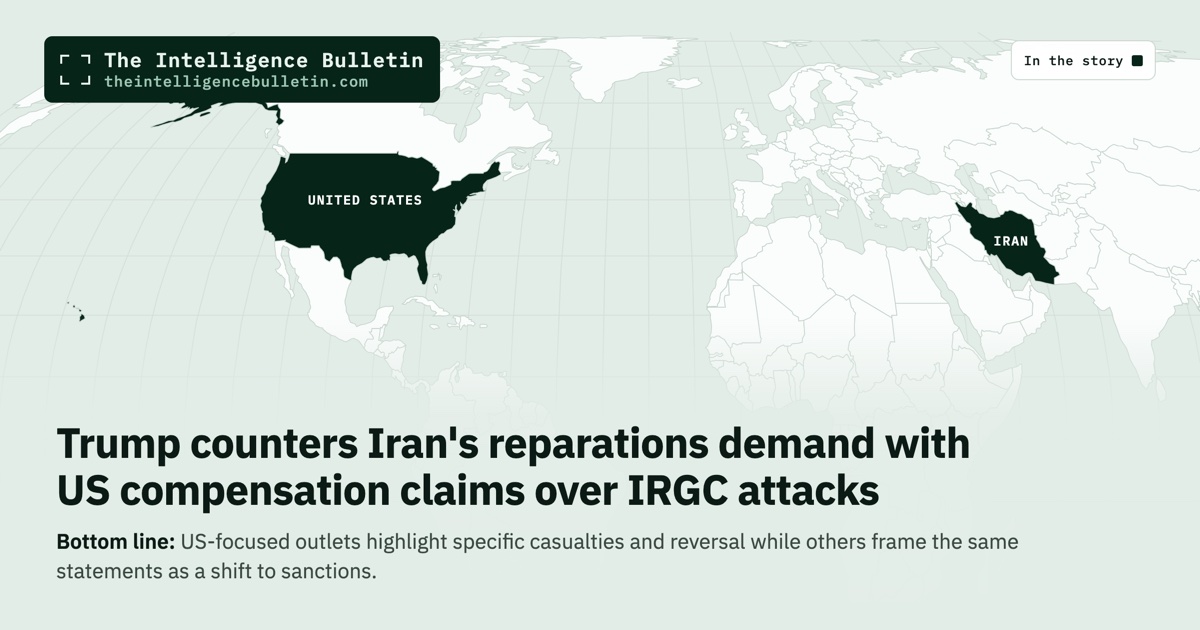
US-focused outlets highlight specific casualties and reversal while others frame the same statements as a shift to sanctions.
The reporting reveals a consistent factual core across independent chains: Trump’s direct response on Truth Social to Iran’s reparations demand for Hormuz reopening, framed as a counter-claim covering decades of IRGC actions and regime killings of protesters. Fox News and The Jerusalem Post center the reversal and specific US casualties, grounding it in Trump’s posts and Oval Office remarks, while Samaa TV places the demand inside future negotiations without elaboration. Al Jazeera and Radio Farda add the pivot to sanctions and naval blockade, noting Iran’s economic distress and limited contacts via mediators, with no new military threats issued. This convergence on economic tools over strikes holds even as sources differ in emphasis—security injuries in one lens, de-escalation in others—because all draw from the same Truth Social statements and Iranian conditions reported via Reuters and IranIntl. The absence of any outlet claiming verification of casualty figures underscores that the story rests on what each side publicly asserts, not adjudication. What stands out is how uniformly the coverage treats the compensation exchange as the immediate trigger, sidelining wider Hormuz talks that predate it, showing the demand functions as a negotiating tactic rather than an isolated escalation.
Full analysis
President Donald Trump stated on Truth Social that Iran must compensate the families of Americans killed or wounded in attacks he attributed to the Islamic Revolutionary Guard Corps, including those led by Qassem Soleimani, as well as the families of those killed on the USS Cole and thousands of others in combat. He added that compensation should also go to the families of hundreds of thousands of Iranian protesters killed by the regime over the past 50 years, including 52,000 in the last five months. Trump instructed his representatives to include these demands in any future negotiations with Tehran.
The statements came after Iranian officials set conditions for reopening the Strait of Hormuz. Tehran demanded an end to the US naval blockade of its ports, the lifting of economic sanctions, the release of frozen Iranian assets, and payment for war damage. Iranian Foreign Minister Abbas Araqchi noted progress with Oman on a new shipping route through the strait, while Mohammad Bagher Zolghadr of Iran’s Supreme National Security Council said the waterway would remain closed until the United States corrected its behavior. Iran and Oman had reached agreement on a traffic map for the strait, with talks described as constructive, though Tehran stressed it would not act alone on reopening.
Trump described Iran’s request for compensation as an interesting idea before turning it around. He wrote that Iran should also bear responsibility for damages and deaths caused to people in Lebanon, Syria, Yemen, and Gaza. In an Oval Office appearance, he told reporters that if damages were to be paid, Iran should pay them. He linked the five-month military conflict to Iran’s refusal to acquire a nuclear weapon.
Reporting from multiple outlets shows the United States emphasizing economic measures over additional military action. Trump told Axios that Iran was in very bad financial shape, with high inflation and difficulty paying its troops, and that a naval blockade in place since April had intensified the pressure. He described the approach as low-key, with only semi-negotiating under way and contacts limited to mediators. Oil prices had stabilized just above 75 dollars a barrel, easing strain on American consumers. He said the situation would work out like a chess game. Radio Farda reported that more than 20 US warships supported the economic blockade, with the US Central Command rerouting 55 commercial vessels, disabling two, and seizing two others to enforce restrictions.
The coverage converges on the compensation exchange as the immediate development while placing it inside ongoing Hormuz negotiations mediated by Oman. All five articles draw from the same Truth Social posts and Iranian conditions reported through Reuters and Iran International. Fox News and The Jerusalem Post quote the specific list of US casualties and the instruction to negotiators. Al Jazeera and Radio Farda add the Axios interview details on sanctions and the absence of new strike threats. Samaa TV reports the demand as an element of future talks without further elaboration.
Accounts differ in emphasis rather than in the underlying facts. Fox News presents the move as reversing Iran’s reparations demand with a costly counter-claim that includes both American victims and Iranian protesters. The Jerusalem Post centers responsibility on the IRGC for orchestrating attacks and names Qassem Soleimani and the USS Cole explicitly. Al Jazeera and Radio Farda foreground the shift away from military options toward sustained economic pressure and the naval presence, noting Iran’s economic difficulties and the lack of fresh military warnings from Washington. Samaa TV offers the narrowest frame, treating the compensation request as a negotiation point without additional context on casualties or blockade operations.
These differences reflect the outlets’ primary vantage points. The US-based Fox News and Jerusalem Post foreground the American side of the casualty claims and the direct reversal. The Qatar-based Al Jazeera and the US-based Radio Farda, drawing on the Axios remarks, stress the tactical choice of sanctions and blockade. The Pakistan-based Samaa TV stays with the negotiation language.
The reporting that treats the compensation demand as a negotiating tactic rather than a standalone escalation rests on the most consistent evidence. Trump’s own posts and Oval Office comments supply the counter-claim, while the Axios interview supplies the explicit preference for economic tools. Iranian conditions for Hormuz reopening appear in multiple accounts through the same Reuters and Iran International channels. No outlet claims independent verification of casualty numbers, which remain assertions from each side. The naval blockade figure of more than 20 warships comes from US Central Command reporting carried by Radio Farda. Oil price stabilization above 75 dollars a barrel is stated in the Al Jazeera account.
What to Watch
This pattern indicates the demand functions inside the broader Hormuz talks rather than as an abrupt escalation that would force new military choices. The convergence across the five articles on economic pressure as the current US instrument, backed by Trump’s statements and the absence of new strike language, supplies the clearest warrant for viewing the episode as a continuation of sanctions-focused maneuvering. Iran retains leverage through its control of Hormuz transit and its stated conditions, while the United States maintains the blockade and the compensation counter-claim as bargaining chips. The next moves will likely turn on whether Oman-mediated talks produce a shipping route agreement that satisfies both the compensation exchange and the sanctions relief Tehran has listed.
That’s how the world told the story.
Get our daily open-source intelligence on world events in your inbox — one email a day, up to six stories.
Subscribe freeNo spam. One-click unsubscribe. See the latest email →