 AI-generated analysis published under the editorial responsibility of Rohit Sinnas. How it works →
Press quoted
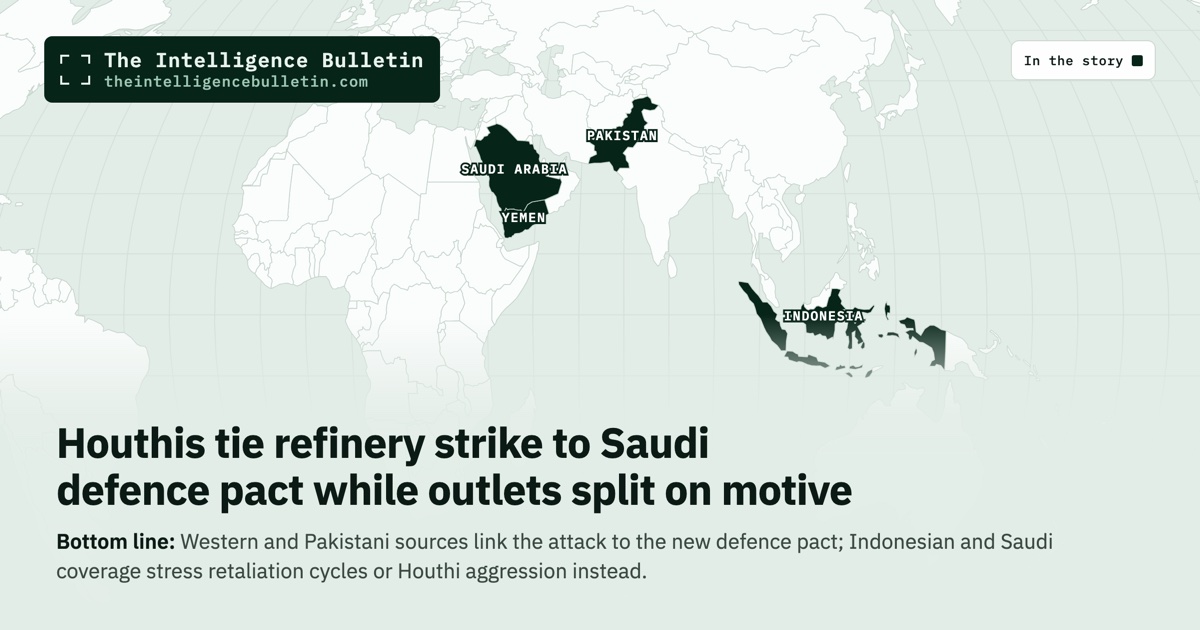
Western and Pakistani sources link the attack to the new defence pact; Indonesian and Saudi coverage stress retaliation cycles or Houthi aggression instead.
The selected outlets converge on the core claim and Saudi confirmation yet diverge sharply on framing the timing and motive. Guardian and Express Tribune both tie the strike directly to the new Saudi-Turkey-Pakistan defence pact signed in Makkah, presenting the attack as a response to that alliance amid wider Iran-related tensions including Hormuz demands. Kompas instead casts the drone strike as explicit retaliation for prior Saudi drone attacks on Yemen, sourcing the Houthi spokesperson via New Arab and highlighting a cycle of mutual strikes. Al Watan focuses on Yemeni government military responses to Houthi attacks inside Yemen and UN condemnation of Houthi actions against Saudi targets, implicitly positioning the refinery claim as further justification for deterrence operations. Jerusalem Post sticks closest to the bare facts of the claim, the extinguished fire and no injuries, drawing from Reuters without the pact or retaliation angles. The pattern shows how proximity to the actors shapes emphasis: Pakistani and British papers stress alliance timing, Indonesian coverage stresses reciprocal Arab strikes, Saudi coverage stresses Houthi culpability and need for response, while Israeli coverage remains narrowly factual. No outlet in the set carried an originating Yemeni government account, leaving official Aden statements visible only through the wires and Saudi lens.
Full analysis
Yemen’s Iran-aligned Houthis said they struck Saudi Aramco’s Jazan refinery with a drone early on 9 August 2026. The Saudi Energy Ministry reported that a fire broke out at one facility there and was later extinguished, with no injuries. The ministry gave no cause. Jazan lies on the Red Sea near the Yemen border and processes 400,000 barrels of crude oil per day, turning out gasoline and ultra-light sulfur diesel. Yahya Saree, the Houthi military spokesperson, posted that the drone hit its target. The same statement said the Houthis had also carried out missile and drone strikes on the Yemeni Red Sea port of Mocha, a site controlled by the Aden-based government that Riyadh backs.
That claim came two days after Saudi Arabia signed a defence pact with Turkey and Pakistan in Makkah. The accord states that an armed attack on any of the three will be treated as an attack on all. Turkish Foreign Minister Hakan Fidan said the pact was not aimed at Iran or any other country but served as a general pledge of mutual support. Saudi Arabia had faced a declared Houthi naval blockade in the Red Sea since the previous month, which the Houthis described as a response to a Saudi siege on Yemen, an allegation Riyadh denies. The Jazan facility had already been hit in late July, when Aramco shut it down after damage to its gasification complex and tank farm.
The Houthis operate from territory they control in Yemen, including Sanaa and areas along the border with Saudi Arabia’s Jazan province. They have struck Aramco sites before, including Yanbu on the Red Sea. Saudi Arabia has backed the Aden government in Yemen’s civil war for more than a decade. The United Nations Security Council renewed its support for Yemen’s sovereignty and unity while condemning Houthi attacks on Saudi targets and commercial shipping, warning of risks to regional security.
Reporting from the five outlets converged on the Houthi claim itself and the Saudi ministry’s account of the fire and lack of injuries. They also agreed that the Houthis said they struck Mocha. The Jerusalem Post and the Express Tribune both carried the details in language that matches Reuters dispatches, including the refinery’s daily throughput and the prior July attack. The Guardian added that the strike followed the defence pact and placed it against Iranian demands that the Strait of Hormuz remain closed until the United States ends its “behaviour,” withdraws forces, lifts sanctions and compensates for war damage. Kompas, drawing from New Arab, quoted Saree saying the Jazan strike was retaliation for Saudi drone attacks on northwest Yemen. Al Watan did not quote the Houthi claim on the refinery directly. Its article instead described Yemeni government military operations against Houthi positions in Marib, Hadramaut and the western coast, reported 17 soldiers killed in earlier Houthi ballistic and drone attacks on those sites, and noted the UN Security Council’s condemnation of Houthi strikes on Saudi Arabia and shipping.
The accounts diverged on motive and context. The Guardian and the Express Tribune both presented the timing of the refinery claim as linked to the new defence pact, with the Guardian adding Iranian statements on Hormuz and the broader effects of the US-Israel campaign against Iran that began in February. The Express Tribune, reflecting Pakistan’s participation in the pact, noted that consultations would determine what support the allies might provide in response to attacks. Kompas framed the strike as one step in a cycle of Saudi drone strikes on Yemen and Houthi replies, without reference to the pact. Al Watan placed the episode inside a narrative of Houthi escalation inside Yemen, Yemeni government counter-operations, and international support for the Aden authorities, implicitly treating the refinery claim as further evidence that stronger deterrence was required. The Jerusalem Post stayed with the claim, the fire, the lack of injuries, the refinery’s capacity and the July precedent, without motive or alliance language.
A reader limited to one of these accounts would miss the explicit connection between the strike and the Makkah pact that appears in the British and Pakistani pieces. They would also miss the explicit retaliation framing that Kompas alone carries from the Houthi statement. They would not see Al Watan’s emphasis on Yemeni government battlefield actions and UN backing, which treats the refinery episode as one more reason for continued pressure on the Houthis rather than a reaction to Saudi alliances.
The pact linkage rests on two independent reporting chains that both name the same date and the same three signatories. The retaliation claim rests on a single chain through Kompas and New Arab. The bare sequence of the Houthi assertion and the Saudi ministry statement appears in every source. Al Watan’s focus on Yemeni government operations supplies the only account in the set of casualties inside Yemen attributed to recent Houthi fire, a detail absent from the others.
What to Watch
The most grounded reading begins with the corroborated elements: the Houthi claim of a drone strike on the Jazan facility, the Saudi confirmation of a contained fire with no injuries, and the additional claim of strikes on Mocha. The timing with the defence pact is the strongest addition the set supplies, because two separate outlets tie the date directly to the Makkah signing and quote the pact language. The retaliation motive remains narrower, carried only through one outlet’s sourcing of the Houthi spokesperson. Al Watan’s account of Yemeni government responses shows that the Aden side is also conducting operations and receiving UN statements of support, a dimension the wires and the other national outlets do not foreground. Saudi energy security faces repeated tests at a single site that processes 400,000 barrels daily, and the pact now brings two additional governments into any calculation of collective response. The next moves will likely test whether the three pact members treat the refinery claim as triggering consultations and what form any joint action might take.
That’s how the world told the story.
Get our daily open-source intelligence on world events in your inbox — one email a day, up to six stories.
Subscribe freeNo spam. One-click unsubscribe. See the latest email →