 AI-generated analysis published under the editorial responsibility of Rohit Sinnas. How it works →
Press quoted
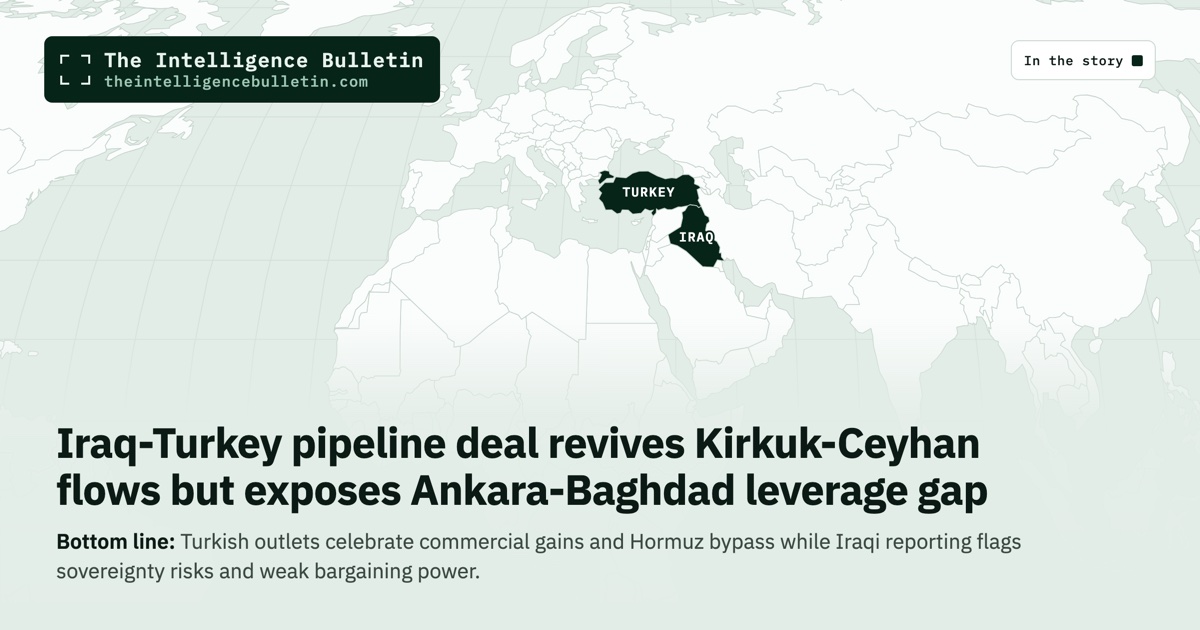
Turkish outlets celebrate commercial gains and Hormuz bypass while Iraqi reporting flags sovereignty risks and weak bargaining power.
Turkish reporting frames the deal as a commercial and strategic win that secures alternative export routes and supplies Turkish refineries while bypassing Hormuz risks. Iraqi coverage questions whether the one-year extension strengthens Ankara’s leverage over Baghdad on pricing, volumes and security guarantees, citing experts who warn of a weak negotiating position and unresolved sovereignty issues from prior arbitration. Industry outlets focus narrowly on restoring 750,000 bpd flows and buying time for a longer accord. Al Jazeera situates the pact inside wider global energy realignment after Hormuz closures. Azernews highlights the corridor benefit for regional exporters seeking to avoid Gulf chokepoints. The pattern shows Turkish optimism on gains, Iraqi caution on concessions, and external emphasis on pragmatic stability rather than bilateral power shifts.
Full analysis
Iraq and Turkey signed a one-year agreement on August 1 that routes up to 750,000 barrels per day of Iraqi crude from the Kirkuk fields through the Kirkuk-Ceyhan pipeline to Turkey’s Ceyhan terminal on the Mediterranean. The deal was struck between Turkey’s state pipeline operator BOTAŞ and Iraq’s state oil companies SOMO and NOC after the previous long-term arrangement lapsed on July 27. Turkish Energy Minister Alparslan Bayraktar and Iraqi Oil Minister Basim Muhammed Hüdeyir oversaw the signing in Ankara, days after Iraqi Prime Minister Ali al-Zaidi met Turkish President Recep Tayyip Erdoğan. Both governments described the pact as a bridge while they negotiate a wider framework covering oil, electricity, water resources and trade.
The pipeline itself has operated for nearly fifty years with a design capacity of 1.5 million barrels per day. Actual flows in recent months stood near 170,000 barrels per day, drawn mostly from fields in Iraq’s Kurdistan region that have faced repeated attacks. The new allocation assigns 750,000 barrels per day of capacity to the Iraqi companies for the coming year. Turkish officials said the arrangement keeps oil moving while talks continue on longer-term volumes and terms. Iraqi Prime Minister al-Zaidi called the signing a strategic milestone in a post on X.
The timing matters because of disruptions at the Strait of Hormuz. After United States and Israeli strikes on Iran in late February, Iraqi exports through southern Gulf terminals fell more than 80 percent, cutting monthly oil revenues from roughly $6 billion to under $2 billion. The Kirkuk-Ceyhan line now offers the only functioning overland route to the Mediterranean. Turkish statements tied the deal directly to that shift, noting that the line can supply Turkish refineries that were built decades ago to process Iraqi crude and currently draw only about 10 percent of their needs from Iraq.
Iraqi officials set a minimum export target of 750,000 barrels per day under the new terms. Turkish ministers spoke of eventually reaching one million barrels per day and expanding the line’s role to carry crude from southern Iraqi fields as well. They also linked the pipeline to a separate agreement giving Turkey Petrolleri a stake in Kirkuk fields previously held by BP. The one-year duration was presented on the Turkish side as an interim step that prevents a complete halt in exports while a comprehensive accord is prepared.
Iraqi experts raised cautions that do not appear in the Turkish or industry accounts. Oil analyst Kofand Sherwani noted that Turkey’s draft proposal for the longer-term deal includes higher minimum volumes and cooperation in petrochemicals, which would increase transit fees paid to Ankara. Economist Duraid al-Anzi argued that Baghdad entered the talks from a weaker position and that final pricing mechanisms must be settled to avoid selling below market rates. Geologist Ramadan Hamza added that success depends on restoring security for companies operating in the Kurdistan region and completing links that would allow southern crude to reach the northern line. These points sit alongside Iraq’s earlier arbitration victory, in which an international tribunal ordered Turkey to pay $1.4 billion in compensation for past transit disputes.
The pipeline’s role in energy security calculations now extends beyond the two capitals. Azerbaijan’s state-linked reporting highlighted the line as one more route that lets regional producers reach Mediterranean markets without passing through Hormuz. Coverage in Qatar placed the agreement inside the broader realignment of Gulf and Mediterranean flows after the Hormuz closures. Industry reporting from the United Kingdom stayed close to the technical details of restored volumes and the time bought for further negotiations.
Turkish accounts stress the commercial upside for Ankara. They quote Bayraktar on the line’s contribution to Turkey’s own refinery supply and on the prospect of routing additional Gulf crude through Ceyhan in the future. They frame the deal as part of a larger reset that includes joint development of Kirkuk fields and an increase in bilateral trade toward $17 billion. Iraqi reporting, by contrast, records the same volume figures and the same Hormuz context but pairs them with explicit warnings about pricing leverage and the need for security guarantees before production in disputed fields can scale.
The accounts align on the core transaction. Every source confirms the one-year term, the 750,000-barrel allocation, the involvement of the named ministers, and the link to the recent prime-ministerial visit. They also agree that the pipeline now functions as an alternative to Hormuz routes. Where the reporting diverges is in emphasis on power balance. Turkish and Azerbaijani pieces foreground the corridor’s strategic value and the commercial continuity it restores. Iraqi analysis inserts the history of arbitration losses for Turkey and the risk that Baghdad may lock in unfavorable transit terms. Industry coverage treats the arrangement as a straightforward operational fix without addressing the sovereignty questions raised by Iraqi experts.
What to Watch
The corroborated record shows a concrete revival of 750,000 barrels per day on a line whose prior flows had dropped sharply. The single-source cautions from Iraqi analysts about negotiating leverage draw on the documented arbitration outcome and on the absence of finalized pricing language in the interim deal. Those cautions align with the explicit statement in Iraqi reporting that the one-year pact is meant to buy time for a broader framework. Turkish statements, while accurate on volumes and the Hormuz context, do not address those pricing or security conditions. A reader relying only on the Turkish or industry accounts would miss the documented Iraqi concerns over how the interim terms could shape the longer agreement now under discussion. The next round of talks will test whether the pricing and security issues identified by the Iraqi experts are resolved or deferred.
That’s how the world told the story.
Get our daily open-source intelligence on world events in your inbox — one email a day, up to six stories.
Subscribe freeNo spam. One-click unsubscribe. See the latest email →