 AI-generated analysis published under the editorial responsibility of Rohit Sinnas. How it works →
Press quoted
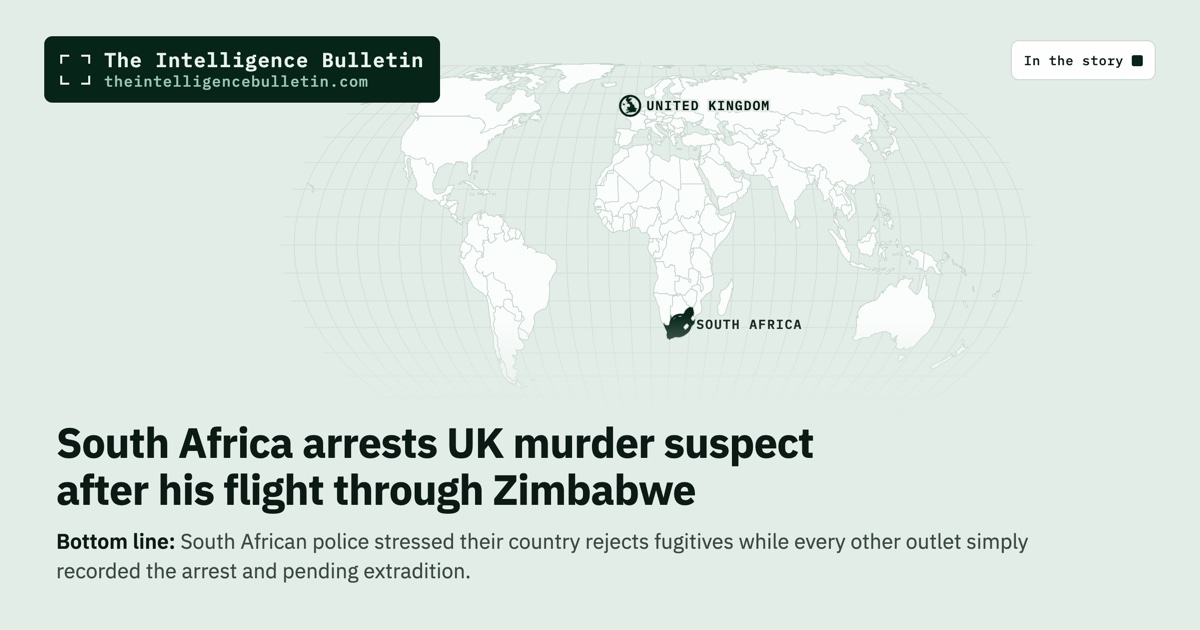
South African police stressed their country rejects fugitives while every other outlet simply recorded the arrest and pending extradition.
South African authorities moved fastest to claim credit for the arrest, stressing in official statements that the country will not shelter fugitives and that Interpol coordination delivered results within hours. Zimbabwean coverage instead highlighted the suspect’s heritage and the shock rippling through diaspora networks, tracing his route via Zimbabwe after leaving Heathrow. UK tabloids kept the focus on the Bedfordshire victims and the CPS charges, treating the Johannesburg detention as the final chapter of a domestic tragedy. Nigerian reporting added the cross-border flight angle, framing the case as evidence of porous regional movement. Yet every outlet converged on the same operational facts: swift intelligence-led policing, no safe haven in South Africa, and active extradition proceedings. That unanimity shows how a single murder investigation can pull three continents into coordinated action without any jurisdiction attempting to politicise the outcome.
Full analysis
South African police acted with notable speed to detain a British citizen accused of killing his wife and two daughters, showing how Interpol coordination and cross-border intelligence can close a case before political complications arise. The arrest of Ndodana Mkhanyisi Tshuma in Johannesburg on 10 July 2026 followed the discovery of the victims’ bodies days earlier in Bedfordshire and produced consistent reporting across three continents on the same core sequence: the suspect left the UK shortly after the murders, passed through Zimbabwe, and was tracked to South Africa where authorities took him into custody within hours.
Tshuma, 45 and also known as Mark, faces three counts of murder authorised by the Crown Prosecution Service. The victims were his wife Nothabo Zandile Tshuma, 42, and their daughters Natalie, 15, and Nala, 5. Bedfordshire Police found the bodies at the family home in Great Denham after relatives and neighbours raised concerns that the household had not been seen for several days. Detectives determined that Tshuma had flown out of Heathrow using a British passport days before the bodies were discovered. South African authorities later stated he carried a firearm at the time of his arrest in the Kensington area of Johannesburg.
Official statements from the South African Police Service emphasised the operational mechanics. Brigadier Athlenda Mathe and Acting National Commissioner Lieutenant General Puleng Dimpane both highlighted the role of the SAPS Interpol National Central Bureau, Crime Intelligence and the Organised Crime Investigation Unit. They noted that the suspect was located “within a matter of hours” through intelligence-led policing and warned that South Africa would not serve as a refuge for fugitives. Tshuma is due to appear in a Johannesburg court on Monday, with extradition proceedings to follow once documents are completed.
Zimbabwean coverage placed greater weight on the suspect’s origins and the path he took after leaving the UK. Reports described Tshuma as Zimbabwean-born and traced his route from Heathrow to Zimbabwe before he entered South Africa, noting the shock that rippled through diaspora networks connected to the family. This angle reflected the outlet’s readership ties to the region of the suspect’s birth rather than any divergence on the facts of the arrest itself.
UK reporting centred the victims and the domestic charges. Accounts named the three deceased explicitly, described the Bedfordshire scene and the CPS decision to authorise murder counts, and treated the Johannesburg detention as the closing step in a British investigation. Detective Inspector Lee Martin of Bedfordshire Police was quoted stressing the involvement of the National Crime Agency, Interpol and counterparts in Zimbabwe and South Africa, while expressing condolences to the family.
Nigerian accounts added the detail of the suspect’s movement across African borders after leaving the UK, presenting the case as an illustration of how regional travel can be monitored once an international alert is active. This framing drew relevance from the continental dimension without altering the established timeline or the outcome of the arrest.
Every outlet that published the story aligned on the operational facts: an Interpol Red Notice enabled rapid location of the suspect, South African police executed the detention, and extradition to the United Kingdom is the next formal step. No jurisdiction sought to claim exclusive credit or inject unrelated political disputes. South African statements were the most direct in asserting that the country would not shelter wanted individuals, a position reinforced by the speed of the operation and the absence of any reported delays or legal obstacles at the point of arrest.
The convergence matters because it demonstrates that routine murder investigations can trigger effective multi-continental policing when standard mechanisms function. The suspect’s British citizenship and Zimbabwean heritage created natural entry points for different national outlets, yet none of those angles displaced the record of coordinated action. Official South African and UK accounts come closest to the operational reality because they focus on the verifiable sequence of intelligence sharing and arrest rather than secondary identity or migration themes.
What to Watch
Extradition is expected to proceed without unusual friction once paperwork is finalised, returning Tshuma to face trial in the jurisdiction where the alleged offences occurred. The case illustrates that family-violence fugitives who cross borders still confront the same international alert system used for other serious crimes, and that participating states have clear incentives to honour those alerts rather than risk reputational damage. Readers should therefore view the episode as confirmation that existing law-enforcement channels, when activated promptly, can deliver custody even when the suspect attempts to move through multiple countries in quick succession.
That’s how the world told the story.
Get our daily open-source intelligence on world events in your inbox — one email a day, up to six stories.
Subscribe freeNo spam. One-click unsubscribe. See the latest email →