 AI-generated analysis published under the editorial responsibility of Rohit Sinnas. How it works →
Press quoted
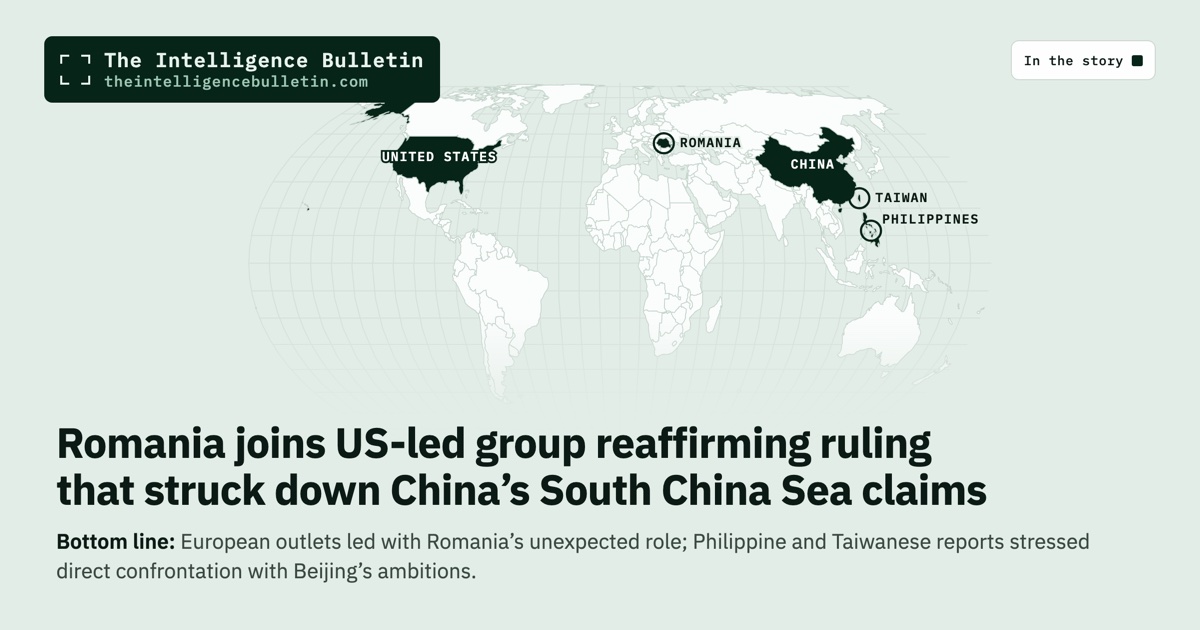
European outlets led with Romania’s unexpected role; Philippine and Taiwanese reports stressed direct confrontation with Beijing’s ambitions.
Romania’s prominent billing in its national wire service alongside the United States and Japan signals how far the 2016 ruling’s supporters have expanded beyond the original claimants. Agerpres opened its dispatch by naming Romania first among the 14 signatories, framing the move as European alignment with Washington on a distant maritime dispute. Philippine reporting paired the statement with navy ships sounding ten blasts in Subic Bay, underscoring direct territorial stakes and rule-of-law symbolism absent from European accounts. Taiwanese coverage sharpened the language to “expansionist ambitions,” while Japanese and Australian wires stressed regional stability and alliance cohesion without the same edge. Yet every outlet relayed the identical list of signatories and China’s unchanged rejection, revealing a diplomatic coalition that now spans NATO’s eastern flank to the Indo-Pacific without visible fractures in the message itself.
Full analysis
The joint statement issued on July 12, 2026, by the United States, the United Kingdom, Romania and eleven other nations marks a clear expansion of diplomatic support for the 2016 arbitral ruling that rejected China’s expansive claims in the South China Sea. This coalition now stretches from NATO’s eastern flank to the Indo-Pacific, signaling that backing for the tribunal’s findings has moved well beyond the original disputants and into a wider network of states concerned with maritime order. The uniform relay of the same core facts across outlets—from the list of signatories to China’s immediate rejection—underscores a coordinated pushback that shows few visible cracks, even as each capital frames its own stake differently.
The 2016 ruling came from a tribunal under the United Nations Convention on the Law of the Sea after the Philippines challenged China’s so-called nine-dash line. The decision found no legal basis for China’s historic-rights claims beyond what the convention allows and affirmed Manila’s entitlements within its exclusive economic zone. China has never accepted the outcome, calling the award null and void from the start. Ten years later, the July statement repeated that the ruling remains final and legally binding between China and the Philippines, while opposing any unilateral actions or coercion that threaten stability. It specifically rejected the use of coast guard, military or maritime militia forces to harass lawful operations at sea.
Romanian coverage placed national participation at the center. Agerpres opened its dispatch by naming Romania first among the fourteen signatories, presenting the move as European alignment with Washington on a distant maritime issue and highlighting NATO unity. This emphasis on an Eastern European voice lent the statement a broader transatlantic flavor that other wires did not foreground. In contrast, the Philippine Star paired the joint declaration with a concrete local ceremony: naval vessels in Subic Bay sounded ten long blasts, accompanied by a water salute involving Philippine and U.S. ships plus commercial craft. The report stressed direct territorial stakes and the symbolism of rule-of-law commemoration, elements absent from European or Australian accounts.
Taiwanese reporting adopted sharper language. Liberty Times headlined the statement as confronting China’s “expansionist ambitions,” reflecting proximity to Beijing’s maritime assertions and historical friction. Japanese coverage through Nikkei Asia and Australian reporting through The Examiner stayed closer to regional stability and alliance cohesion, listing the signatories while noting the statement’s rejection of destabilizing actions and its call for peaceful resolution under the convention. Both outlets treated the event as reinforcement of existing partnerships rather than a pointed rebuke. The European Union issued its own parallel statement describing the 2016 award as a landmark in peaceful dispute settlement.
China’s response remained consistent across the reporting. Its foreign ministry reiterated that the ruling has no binding force, described it as an illegal piece of paper, and accused outside powers of stirring tensions through military deployments. Beijing urged the signatories to respect its territorial and maritime rights. No outlet recorded any softening in this position.
The pattern of coverage reveals more than simple national self-interest. Romania’s prominent billing illustrates how the original Philippine victory has become a reference point for states far removed from the contested waters, widening the diplomatic front without altering the message itself. Philippine accounts added tangible symbols of enforcement and resolve, while Taiwan’s phrasing injected direct criticism. The steadier Indo-Pacific and European wires focused on the practical stakes of navigation rights and alliance reliability. Yet every dispatch carried the identical roster of fourteen nations and the same rejection from Beijing, indicating that the coalition’s breadth has not produced divergent interpretations of the core legal and diplomatic facts.
What to Watch
This convergence matters because the South China Sea remains a primary global trade route where repeated confrontations between Chinese vessels and Philippine forces have already produced collisions and dangerous maneuvers. Continued reaffirmation of the 2016 ruling keeps pressure on Beijing to reconcile its claims with the convention rather than rely on faits accomplis. The inclusion of Romania and other non-claimant European states suggests that future statements may draw on an even wider base, reinforcing the precedent that arbitral decisions carry weight beyond the immediate parties. For readers tracking maritime security, the July 12 declaration shows that support for the ruling has become a durable element of several nations’ foreign policy, not a fleeting anniversary gesture.
That’s how the world told the story.
Get our daily open-source intelligence on world events in your inbox — one email a day, up to six stories.
Subscribe freeNo spam. One-click unsubscribe. See the latest email →