 AI-generated analysis published under the editorial responsibility of Rohit Sinnas. How it works →
Press quoted
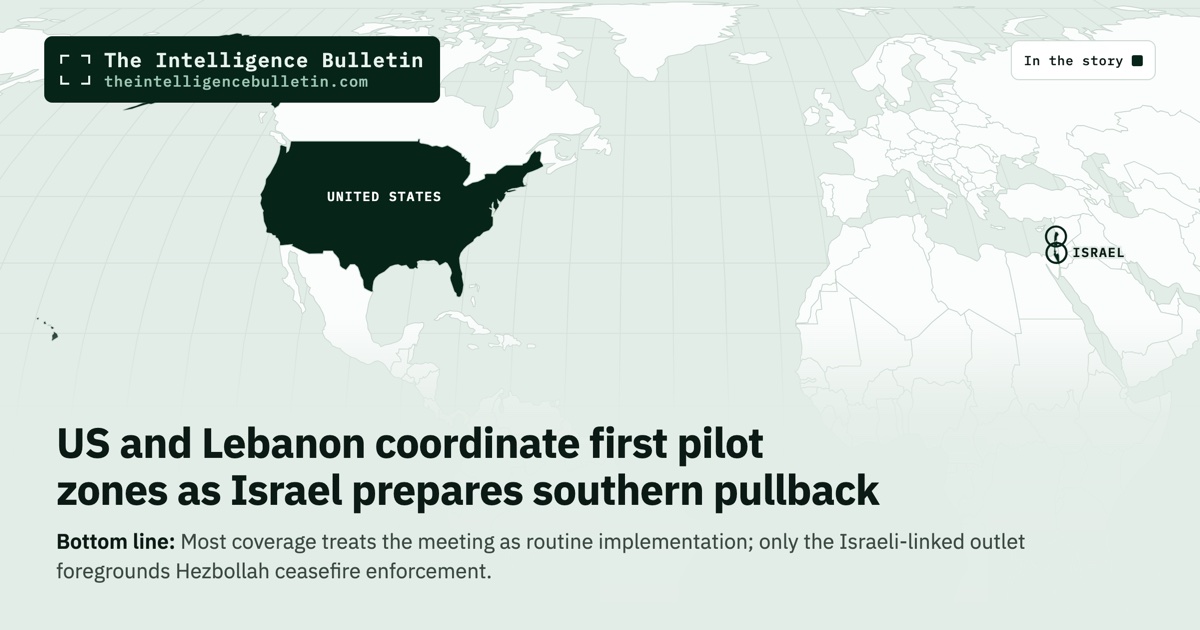
Most coverage treats the meeting as routine implementation; only the Israeli-linked outlet foregrounds Hezbollah ceasefire enforcement.
The reporting converges on the narrow mechanics of the pilot zones and US coordination, revealing how the June framework has shifted from headline diplomacy to on-the-ground haggling over who controls what sliver of southern Lebanon. Most outlets treat the Beirut meeting as a straightforward implementation step, with the Lebanese army’s deployment and CENTCOM oversight as the immediate deliverables. MigNews stands apart by tying the visit explicitly to Hezbollah ceasefire enforcement and disarmament, reflecting Israel’s core security preoccupation rather than the procedural language elsewhere. Arab News and Channel NewsAsia stress Washington’s guiding hand in setting timelines and new talks, while Al Jazeera and Le Parisien foreground bilateral US-Lebanese mechanics and Lebanese conditions for Rome. This uniformity across US, Gulf, Qatari, French and Israeli-linked sources shows the event’s limited novelty: it confirms movement on paper without resolving the deeper standoff over Hezbollah’s weapons or Israel’s retained buffer. The pattern underscores that real leverage still sits with battlefield realities and the absence of any enforced timetable.
Full analysis
The arrival of a US military delegation in Beirut on July 11 signals the first concrete steps toward implementing limited Israeli pullbacks from southern Lebanon, yet it also exposes how little has changed in the underlying standoff. The June 26 framework agreement, brokered under American auspices, envisioned the Lebanese army assuming control of two small “pilot zones” after Israeli forces depart. That process has now moved from announcement to coordination meetings, with US Central Command tasked to oversee the mechanics alongside both sides. No withdrawal timetable exists, Hezbollah has rejected the deal outright, and Israeli officials continue to insist on retaining a deeper security buffer until the group disarms. The result is procedural movement without resolution of the core dispute.
Background to the current effort traces directly to the June framework. Under its terms, Israel would gradually exit areas it entered during operations against Hezbollah, while the Lebanese military—long sidelined—would deploy into the designated pilot zones. Lebanese officials described the US delegation’s meetings with army command as focused on “mechanisms for implementing the first pilot zone,” with the explicit goal of allowing Lebanese forces to take over once Israeli units leave. A parallel US statement confirmed the shift to the “implementation stage,” noting that the first zone would launch within days and that further zones were already being mapped. CENTCOM’s role was presented as the practical bridge between the two militaries.
Lebanon has tied its participation in upcoming Rome talks, scheduled for the following Wednesday and Thursday, to visible progress on those initial withdrawals. President Joseph Aoun reiterated calls for US pressure on Israel to halt operations and honor the framework provisions ahead of his own planned visit to Washington later in July. These conditions reflect Beirut’s attempt to lock in sequential steps rather than accept open-ended Israeli presence. Reports from the ground noted continued Israeli strikes and advances in southern villages on the same day as the Beirut meetings, underscoring that any pullback remains conditional on security assessments Israel has not yet made public.
Coverage across outlets converged tightly on these implementation details. Reports from Channel NewsAsia, Al Jazeera, Arab News, and Le Parisien all described the delegation’s arrival in nearly identical terms drawn from Lebanese military sources and US statements, emphasizing the pilot-zone mechanics, CENTCOM coordination, and the absence of a timetable. The uniformity suggests the story rests on a single wire feed rather than independent sourcing, with each outlet adding only marginal context about Lebanese conditions for the Rome meetings or the framework’s rejection by Hezbollah.
MigNews diverged by explicitly linking the US visit to monitoring the ceasefire with Hezbollah and advancing disarmament of non-state groups. Where other accounts stayed within the language of “pilot zones” and “deployment,” the Israeli-linked report framed the delegation’s task as verifying compliance and ensuring the Lebanese army could enforce control over areas previously held by the militant group. This emphasis aligns with Israel’s stated requirement that any deeper withdrawal depend on verified disarmament, a condition the June framework mentions only in conditional language about “successful disarmament of non-state armed groups.”
The limited novelty of the Beirut meetings lies in their confirmation that Washington is now managing day-to-day coordination rather than high-level diplomacy. Yet the same reports make clear that battlefield realities continue to dictate pace. Israel has conducted intermittent strikes despite the truce, and its officials have publicly reserved the right to maintain a roughly ten-kilometer security zone. Hezbollah’s continued opposition removes any prospect of rapid Lebanese army expansion beyond the pilot areas. The framework’s silence on timelines leaves both sides free to interpret progress narrowly.
What to Watch
What happens next will hinge on whether the first pilot zone actually materializes in the coming days and whether that limited handoff satisfies Lebanon’s precondition for the Rome technical talks. Absent an enforced schedule or external pressure capable of compelling Hezbollah’s disarmament, the pattern of incremental, reversible steps is likely to persist. The real test remains whether US oversight can translate paper agreements into durable changes on the ground or whether the deeper security impasse simply reasserts itself after the initial zones are declared complete.
That’s how the world told the story.
Get our daily open-source intelligence on world events in your inbox — one email a day, up to six stories.
Subscribe freeNo spam. One-click unsubscribe. See the latest email →