 AI-generated analysis published under the editorial responsibility of Rohit Sinnas. How it works →
Press quoted
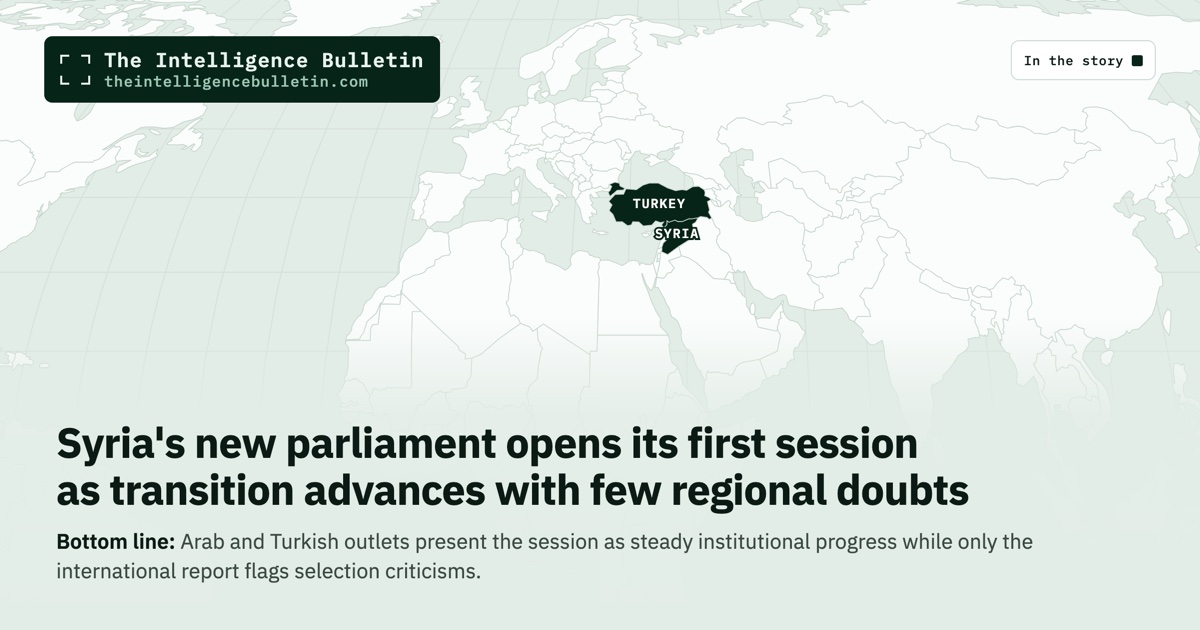
Arab and Turkish outlets present the session as steady institutional progress while only the international report flags selection criticisms.
Regional outlets treat the Damascus session as routine state-building. SANA reports members arriving at headquarters, taking oaths and electing leaders under Decree 143 as the authoritative start of legislative work. An-Nahar calls it a ‘new phase’ for Syria, and The National stresses institutional continuity with al-Sharaa urging competence and rule of law. Turkish Haksoz Haber details the oldest member presiding and the 30-month mandate until a permanent constitution. SCMP alone notes the indirect selection process drew criticism as undemocratic and flags the unresolved Sweida seats after sectarian clashes. The pattern shows Arab and Turkish coverage framing the event as expected consolidation by a neighbor with direct stakes, while the Hong Kong outlet alone surfaces the selection mechanics and lingering security gaps. That convergence on continuity, with one outlier on process flaws, reveals how close the region sees the transition compared with more distant observers.
Full analysis
Syria’s new parliament convened on July 12, 2026, not as a dramatic breakthrough but as the predictable next step in a transition that neighboring governments already treat as settled. The session in Damascus advanced a five-year timetable set after the fall of the Assad regime, with the 210-member People’s Assembly beginning its work under the 2025 constitutional declaration. President Ahmad al-Sharaa attended the swearing-in and called for institutions built on competence and the rule of law. Regional outlets reported the day’s procedures in detail and without alarm, while one distant observer alone flagged the indirect selection process and lingering security shortfalls. That split reveals how close the region stands to the outcome: Arab and Turkish capitals see institutional continuity taking hold next door, and they report it accordingly.
The assembly’s first sitting followed Decree 143 issued by al-Sharaa on July 1, which finalized the membership. Two-thirds of the seats had been filled through indirect selection by local committees earlier in the transition, with the president naming the remaining third. Members arrived at the headquarters in Damascus, took the constitutional oath, and prepared to elect a speaker, deputies, and secretary by secret ballot. Until those leaders were chosen, the oldest member presided. The body holds a 30-month mandate to handle legislation, approve budgets, and oversee ministers while a permanent constitution is drafted and elections are prepared by 2029. Syrian state media presented these steps as the straightforward launch of legislative authority, listing arrivals, oaths, and the decree as the authoritative record.
Lebanese reporting framed the same events as the opening of a new phase for the country and its neighbors. Coverage there emphasized al-Sharaa’s remarks on responsibility and state-building, treating the session as evidence that Syria is moving past years of conflict toward stable governance. The proximity of Lebanon gives the transition immediate weight: any consolidation in Damascus affects border security, refugee returns, and economic ties. The account therefore foregrounded milestones that signal forward movement rather than procedural debates.
Turkish coverage supplied the most granular account of the opening mechanics. It noted that the oldest member, 72-year-old Rami Shahir al-Salih, chaired the initial sitting alongside the youngest member serving as temporary secretary. It recorded the 30-month term and the powers the assembly will exercise until a permanent constitution replaces the current declaration. Turkey shares a long border with Syria and maintains direct security interests in the transition; its reporting therefore tracked the precise institutional shifts that could affect cross-border stability and future cooperation.
Gulf reporting added context on security arrangements and the broader timeline. It described how members were transported under tight protection to the hall and how the session occurred days after bombings in Damascus. The account stressed al-Sharaa’s insistence that the new Syria rest on pluralistic institutions and competence. It also placed the parliament’s work inside the five-year plan that ends with elections in 2029. For Gulf states watching Arab transitions, the emphasis fell on institutional durability rather than selection controversies.
Only reporting from farther afield recorded the selection method’s critics and the incomplete membership. One account noted that the indirect process had drawn charges of being undemocratic and that three seats from the Druze-majority Sweida province remained unfilled after sectarian clashes the previous year, leaving 206 members present. It linked these gaps to the assembly’s stated role in laying groundwork for democracy after decades of authoritarian rule and civil war. The contrast is telling: outlets with immediate stakes in Syria’s stability reported the session as routine statecraft, while the more detached perspective alone surfaced the mechanics and unresolved security issues that could still complicate the timetable.
The pattern of coverage shows that governments and media nearest the transition treat it as an established fact rather than an open question. They record the procedural milestones because those steps affect their own security calculations, refugee policies, and trade routes. Distant observers retain space for process critiques because the outcome carries less immediate consequence for them. Both approaches rest on verifiable reporting from the day itself: the oaths were taken, the oldest member presided, the mandate runs 30 months, and Sweida seats stayed empty. The convergence on continuity therefore reflects shared regional stakes more than coordinated messaging.
What to Watch
What happens next follows directly from the assembly’s mandate. It must adopt internal rules within a month, then begin legislative work while the constitutional drafting process continues. Any delays in filling the Sweida seats or in addressing the indirect selection criticisms could surface again when the body turns to election law and the permanent constitution. Regional capitals will watch those steps for signs that the transition remains on track; the same proximity that produced straightforward coverage of the opening session will shape how they interpret any stumbles. For readers in the Middle East, the Damascus session confirms that Syria’s new authorities are now operating through formal institutions rather than ad hoc arrangements, shifting the practical questions from whether the transition advances to how its institutions will handle the remaining years before 2029 elections.
That’s how the world told the story.
Get our daily open-source intelligence on world events in your inbox — one email a day, up to six stories.
Subscribe freeNo spam. One-click unsubscribe. See the latest email →