 AI-generated analysis published under the editorial responsibility of Rohit Sinnas. How it works →
Press quoted
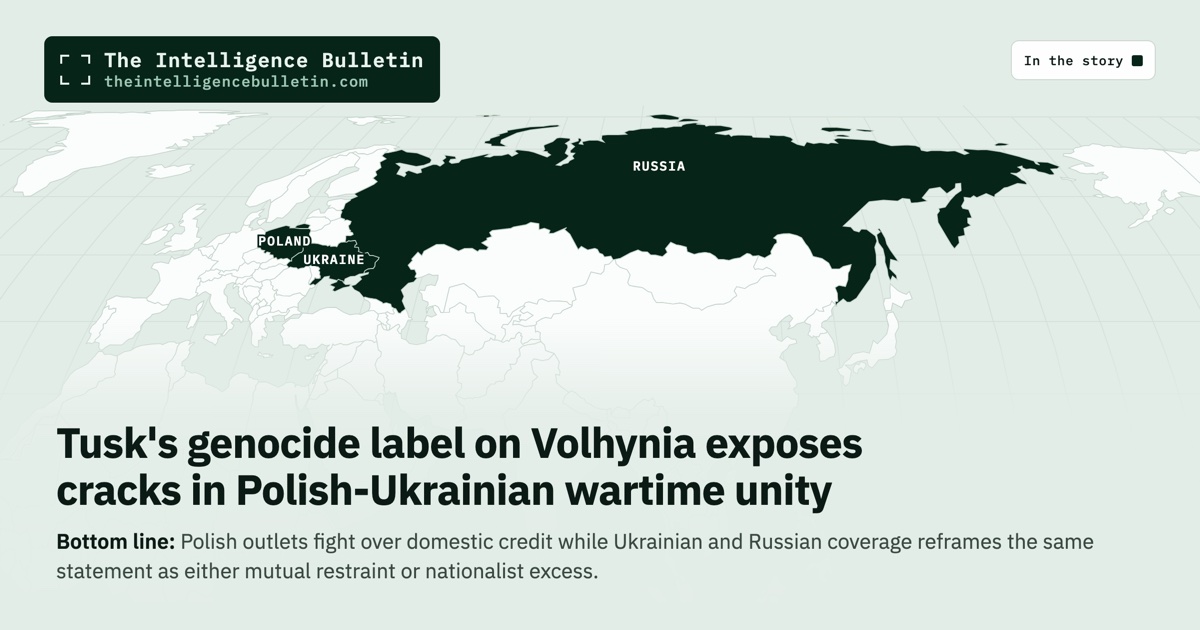
Polish outlets fight over domestic credit while Ukrainian and Russian coverage reframes the same statement as either mutual restraint or nationalist excess.
Tusk’s direct genocide label and Memory Wall pledge mark a shift from quiet diplomacy to public historical reckoning, even as Poland remains Ukraine’s key wartime supporter. Polish coverage centers on domestic pushback from President Nawrocki’s office claiming prior credit for exhumations, turning the anniversary into partisan score-settling. Ukrainian reporting instead highlights Tusk’s call for emotional restraint on both sides and frames the flare-up as a distraction Russia exploits. German outlets alone connect the spat explicitly to risks of reduced Polish military aid, noting secret Patriot transfers and opposition attacks on the government. Russian state media amplifies Tusk’s “sober up” appeal to Ukrainians while stressing nationalist glorification, treating the episode as validation of their critique. Spanish reporting stays detached, recording the monument plan and casualty figures without domestic Polish politics or aid implications. The pattern shows how a single Polish statement ripples differently: internal score-settling at home, bilateral damage control in Kyiv, security warnings in Berlin, propaganda fuel in Moscow, and straightforward memorial news farther west.
Full analysis
Donald Tusk’s decision to label the Volhynia massacres a genocide and pledge a Memory Wall in Warsaw on July 11, 2026, marks a clear break from behind-the-scenes diplomacy toward open historical demands on Ukraine, even while Poland continues as Kyiv’s most important military backer. The move exposes how fragile the wartime alliance remains when memory disputes collide with domestic politics and security calculations.
On the anniversary of Bloody Sunday, when Ukrainian Insurgent Army units killed thousands of Polish civilians in 1943, Tusk stated in a recorded message that the killings constituted genocide by Ukrainian nationalists against Poles and other Polish citizens. He announced construction of a Memory Wall in the capital listing identified victims and linked future European Union membership to confronting historical facts. Polish estimates place the death toll from the 1943-1945 massacres at 70,000 to 100,000 civilians.
Polish domestic coverage immediately turned the announcement into an internal contest over credit. The Fakt report focused on the reaction from President Karol Nawrocki’s spokesman, who accused Tusk of manipulation for claiming credit on exhumation restarts that the spokesman attributed to earlier talks between the presidents. Government spokesman Adam Szłapka countered that permissions for work in places such as Ostrówki and Huta Pieniacka predated Nawrocki’s August 2025 inauguration. The exchange shows how the anniversary became another arena for Warsaw palace infighting rather than a unified national statement.
Ukrainian reporting framed the episode as an emotional flare-up requiring mutual restraint. Liga.net led with Tusk’s appeal to “orderly, wise, responsible” Ukrainians to sober up and to Poles to curb excessive emotions, while noting the statement occurred against the backdrop of Polish internal arguments over arms deliveries and recent meetings between Zelenskyy and Nawrocki. The account stressed Russian efforts to exploit the rift and presented de-escalation as essential to preserving the alliance.
German coverage alone placed the remarks in the context of possible reductions in Polish military support. Deutsche Welle reported rising signs that Warsaw could scale back aid, detailing opposition criticism of secret transfers of Patriot interceptor missiles and the government’s release of figures showing 16.45 billion zloty spent since 2022. The article connected the historical dispute directly to questions of whether Poland’s own air defenses had been compromised and to broader NATO supply lines for Ukraine.
Russian state media used Tusk’s words to reinforce its long-standing narrative. Izvestia highlighted the Polish prime minister’s call for Ukrainians to sober up amid the glorification of nationalists, presenting the statement as external validation that Ukraine’s leadership continues to honor figures linked to wartime extremism. The report treated the Polish intervention as evidence rather than a complicating factor in the war effort.
Spanish coverage stayed at arm’s length. El Mundo recorded the monument announcement, the genocide characterization, casualty figures, and the recent escalation triggered by Zelenskyy’s decision to honor a military unit with a UPA name, without reference to Polish domestic politics or consequences for weapons flows. The account presented the memorial plan as one more chapter in a long-running memory dispute between the two neighbors.
These divergent emphases reveal the real stakes. For Poland’s ruling coalition and opposition, the episode serves partisan score-settling over who reopened exhumations and who supplied how much equipment. For Kyiv, the priority is containing damage to a relationship that still delivers critical support. Berlin sees direct risks to the flow of arms that sustains Ukraine’s defense. Moscow gains ready material to portray Ukrainian nationalism as unreformed. Outlets farther from the frontline treat it as standard foreign news.
What to Watch
The pattern suggests the public hardening of Polish positions will complicate, rather than halt, cooperation. Continued pressure over exhumations and UPA honors risks accelerating opposition demands to limit future deliveries, while Ukrainian resistance to external historical conditions will slow any gestures toward reconciliation. The result is a thinner margin for error in sustaining the anti-Russian front at a moment when every increment of Polish hardware still matters.
That’s how the world told the story.
Get our daily open-source intelligence on world events in your inbox — one email a day, up to six stories.
Subscribe freeNo spam. One-click unsubscribe. See the latest email →