 AI-generated analysis published under the editorial responsibility of Rohit Sinnas. How it works →
Press quoted
Full analysis
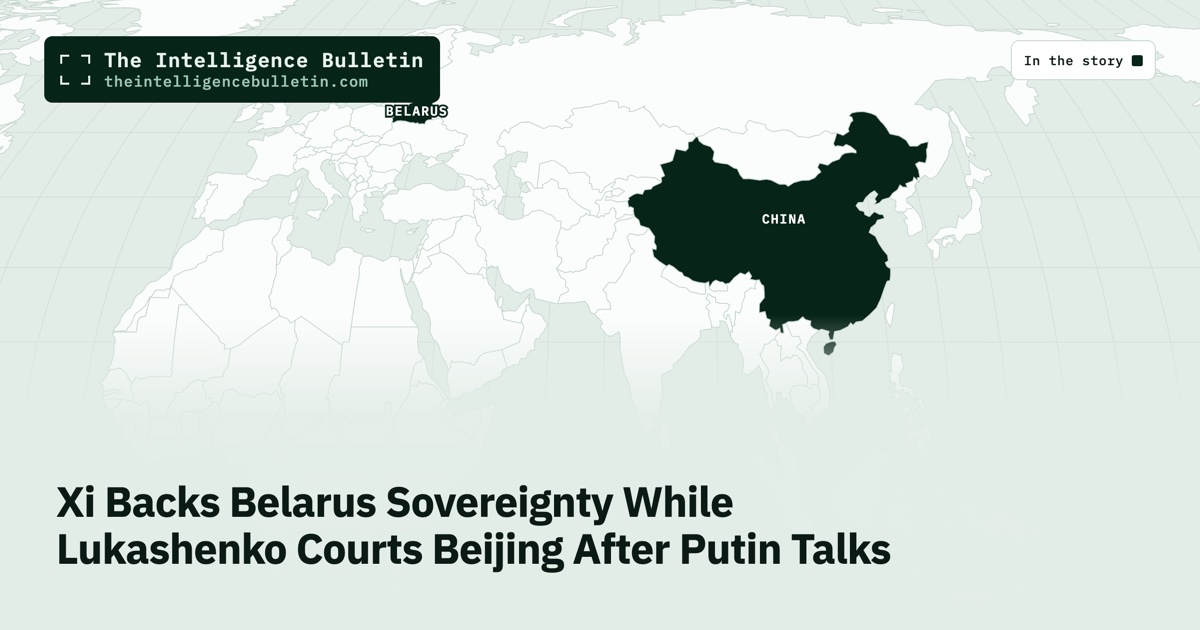
On June 29, 2026, Chinese President Xi Jinping hosted Belarusian President Aleksandr Lukashenko at the Diaoyutai State Guesthouse in Beijing and explicitly pledged support for Belarusian sovereignty, independence, and territorial integrity. The encounter, occurring one day after Lukashenko’s closed-door meetings with Vladimir Putin at the Valdai residence, exposed how the identical diplomatic language produces sharply divergent interpretations once filtered through national media lenses shaped by the Ukraine war.
Chinese state media presented the talks as routine high-level affirmation of an already elevated partnership. The People’s Daily English edition, drawing directly from the Xinhua readout, quoted Xi stating that China and Belarus “are true friends who trust and support each other, good partners for common development and prosperity, and all-weather comprehensive strategic partners.” It emphasized that bilateral ties have entered “the best period in history,” highlighted solid political mutual trust, fruitful Belt and Road cooperation, and progress on key projects. Lukashenko was reported as valuing the relationship as an important support for Belarusian economic and social development and expressing readiness to strengthen strategic communication and expand cooperation areas. No mention appeared of Russia, Ukraine, or any regional security context; the coverage stayed strictly within the approved bilateral script of mutual benefit and global initiatives.
Ukrainian reporting immediately situated the same meeting inside the ongoing conflict. The Kyiv Post, citing AFP, described Lukashenko as a key Putin ally who allowed Russian forces to launch the 2022 invasion through Belarusian territory. The article noted that the visit followed Lukashenko’s recent Kremlin talks and recalled his 1994 grip on power, Belarus’s hosting of Russian nuclear-capable missiles, and Kyiv’s accusations that Beijing secretly aids Moscow despite China’s self-described neutral stance. It added that Lukashenko last met Xi in August 2025 before attending a Beijing military parade. The framing positioned every China-Belarus contact as potentially relevant to Ukraine’s security calculations.
Russian state outlets amplified the trilateral dimension. RT Russian reported that Xi called the two countries “iron friends” whose relations had withstood international turbulence and reached a historic peak. The piece placed the Beijing stop explicitly after Lukashenko’s Valdai discussions with Putin and within a broader Asian tour involving high-level talks in several unspecified East and Southeast Asian states. It stressed the “all-weather and comprehensive strategic partnership” language and quoted Xi’s characterization of the friendship as only strengthening, underscoring coordinated positioning among Moscow, Minsk, and Beijing.
Western analysis went further, interpreting Xi’s sovereignty pledge as a calculated signal. BBC Russian highlighted the phrase that China supports Belarus in protecting its national sovereignty, independence, and territorial integrity, then quoted independent Belarusian analyst Alexander Klaskovsky arguing the statement served primarily as a warning to Putin against dragging Minsk deeper into the war. Klaskovsky noted China’s interest in preserving Belarus as a transit route for rail exports to the European market and as the site of the “Great Stone” industrial park, both of which would suffer if Belarus became a combat zone. The article also referenced Lukashenko’s recent statements rejecting deeper involvement, Ukrainian President Volodymyr Zelensky’s demands regarding Belarusian relay stations used for drone strikes, and the pattern of Lukashenko seeking counterweights to Russian economic dependence.
Italian strategic commentary connected the dots even more explicitly to European security concerns. Formiche described the alliance as operating “in the name of Putin,” framing the Beijing visit as the first leg of Lukashenko’s post-Valdai Asian tour aimed at closing high-level projects. It quoted Xi’s assurance that the two sides are “true friends” who have passed the test of international vicissitudes and noted Lukashenko’s portrayal of China as an unconditional strategic partner. The piece linked the timing to Moscow’s reported pressure on Minsk for greater war involvement, Zelensky’s accusations, and Lukashenko’s repeated denials, while recalling prior 2025 visits including the September military parade attended alongside Putin and Kim Jong-un.
Across these accounts, the shared factual core—Xi’s verbatim pledge on sovereignty and the characterization of ties at a historic high—reveals a consistent pattern. Outlets aligned with the conflict parties or Western perspectives treat every Beijing-Minsk exchange as a potential lever in the Russia-Ukraine standoff, whether as evidence of continued Russian leverage, a Chinese attempt to keep Belarus out of direct fighting, or part of Minsk’s balancing act. Chinese coverage, by contrast, confines itself to the positive bilateral narrative and Belt and Road advancement.
The Takeaway
Lukashenko’s immediate itinerary after Beijing will indicate whether the diversification effort yields concrete economic or diplomatic gains. Observers will watch for any follow-on statements from Minsk regarding transit infrastructure or further distancing from direct combat roles, as well as any visible shifts in Chinese economic commitments to the Great Stone park or rail corridors.
That’s how the world told the story.
Get our daily open-source intelligence on world events in your inbox — one email a day, up to six stories.
Subscribe freeNo spam. One-click unsubscribe. See the latest email →