 AI-generated analysis published under the editorial responsibility of Rohit Sinnas. How it works →
Press quoted
Full analysis
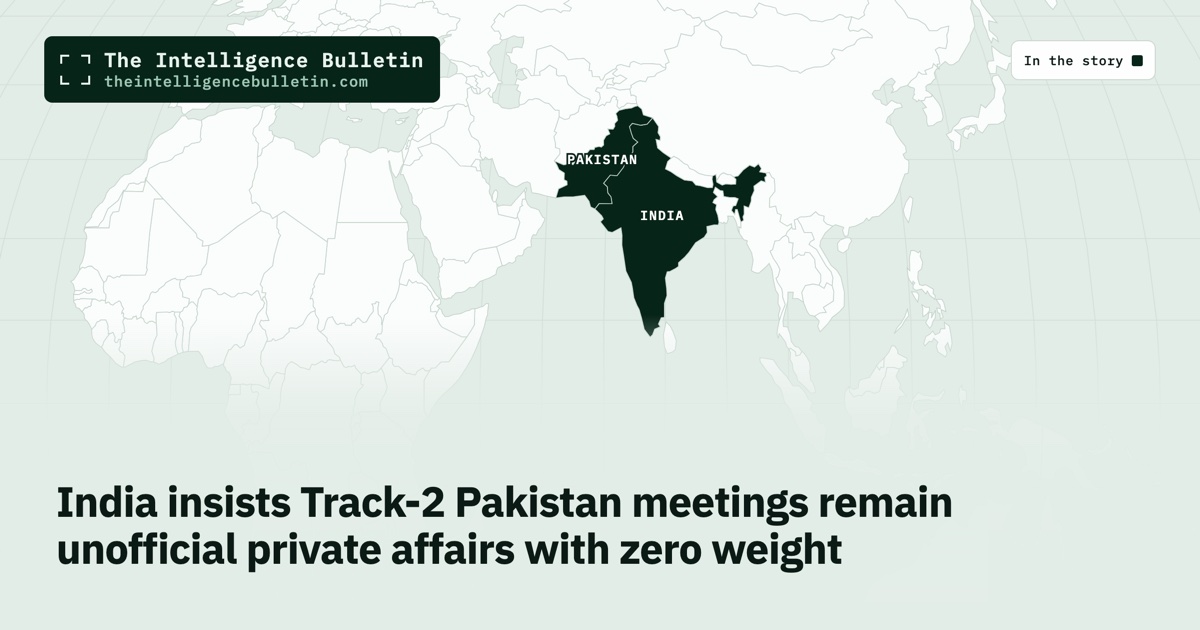
India’s Foreign Secretary Vikram Misri delivered a pointed dismissal of media speculation about back-channel or Track-2 contacts with Pakistan, declaring in Victoria, Seychelles, on June 29, 2026, that New Delhi attaches no official weight to any such gatherings. The statement, delivered amid a complete freeze in formal bilateral ties, underscored that retired officials and civil society participants speak solely for themselves. All three major Indian outlets that covered the remarks relayed this core denial in near-identical language, reflecting a coordinated messaging environment where the government’s position receives uniform amplification without deviation or added analysis.
The remarks followed recent reports claiming that unofficial meetings involving former diplomats, retired military officers, and other figures from both sides had occurred, including one on the sidelines of a security conference in Colombo. Misri addressed those claims directly, noting that dozens of similar private events take place worldwide on varied topics and carry nothing new or special. He stated explicitly that as far as the Government of India is concerned, there is no official participation, support, or involvement. Participants, whether retired diplomats, former military officials, or civil society members, represent only their own viewpoints and not those of New Delhi. The foreign secretary concluded that India takes no cognisance of these events and assigns them little value.
This stance arrives against the backdrop of relations that have remained frozen since the April 2025 Pahalgam attack, in which Pakistani state-sponsored terrorists killed 26 civilians in Jammu and Kashmir. India responded the following month with Operation Sindoor, striking terror infrastructure across Pakistan and Pakistan-occupied Kashmir. The only remaining operational channel is the hotline between the Directors General of Military Operations of the two countries. Formal diplomatic exchanges, trade links, and even overflight rights stand suspended. The Indus Waters Treaty has been kept in abeyance, a measure New Delhi tied to the principle that blood and water cannot flow together.
Moneycontrol framed its account of the rejection within the wider pattern of diplomatic and economic isolation between the two neighbours. The outlet noted the suspension of treaties and the fallout from terror incidents, presenting the foreign secretary’s comments as consistent with an environment where any form of engagement remains off the table. Its business-oriented lens highlighted the economic consequences of the prolonged standoff, including the absence of direct trade and the strategic implications of the water treaty’s status.
ANI, functioning as a state-aligned wire service, led with Misri’s verbatim remarks and supplied the most detailed transcription of his full explanation. The agency placed the denial in the context of the post-Pahalgam freeze and the earlier downgrade of ties after the 2019 abrogation of Article 370. By reproducing the foreign secretary’s words at length, ANI transmitted the government’s position with minimal interpretive overlay, emphasising that private events organised by private parties hold no official character.
India TV focused on the specific Colombo gathering, describing it as a purely private affair with no official Indian link. The outlet stressed Misri’s clarification that any Indian attendees participated in their personal capacities and that their views should not be read as reflecting government policy. It reiterated that New Delhi neither endorses nor attaches importance to such interactions, reinforcing the message that the reported meeting carried no diplomatic weight.
Across the three outlets, the reporting converged on the same facts and phrasing. No source explored potential implications of continued unofficial contacts, offered analysis of Pakistani reactions, or suggested any softening in New Delhi’s approach. The uniformity illustrates how Indian media, whether commercially oriented or closely aligned with official channels, functions to reinforce the government’s insistence that retired figures and civil society actors operate independently amid a total diplomatic shutdown.
The Takeaway
The episode leaves little room for ambiguity about India’s current posture. With formal channels limited to the military hotline and economic measures such as the suspended water treaty still in place, any future movement would require a significant shift in the underlying security conditions. Observers will watch whether similar reports of Track-2 activity resurface and how New Delhi responds if they do.
That’s how the world told the story.
Get our daily open-source intelligence on world events in your inbox — one email a day, up to six stories.
Subscribe freeNo spam. One-click unsubscribe. See the latest email →