 AI-generated analysis published under the editorial responsibility of Rohit Sinnas. How it works →
Press quoted
Full analysis
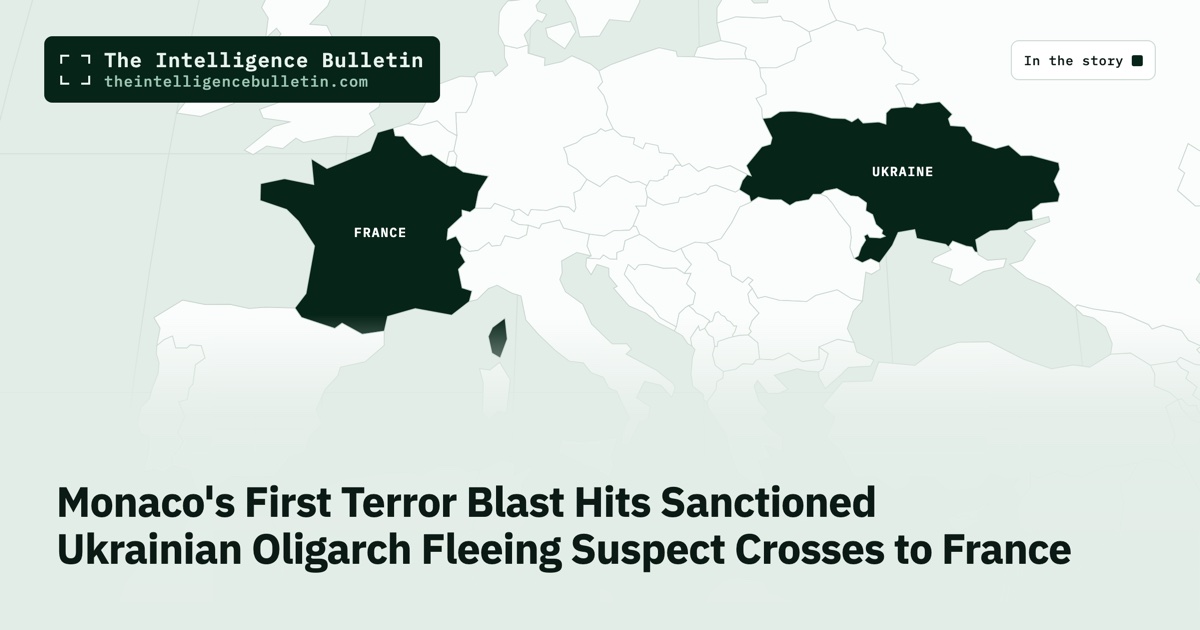
The explosion that rocked a quiet residential street in Monaco on the evening of June 29, 2026, marked the first time the ultra-secure principality had experienced anything resembling a terrorist attack, shattering its reputation as one of Europe’s safest enclaves. A device concealed in a backpack or parcel detonated at the entrance of a building on Rue Reverend Père Louis Frolla, injuring Ukrainian-born businessman Vadim Ermolaev, his partner, and their 13-year-old son. Two adults were left in critical condition while the teenager suffered lighter injuries; all three were rushed to hospitals in nearby Nice. Authorities quickly labeled the blast an intentional act, with CCTV footage capturing a suspect depositing the bag before fleeing on foot across the border into the French commune of Beausoleil.
Background details quickly filled in around the incident. Ermolaev, founder of the Alef Group conglomerate with interests in real estate, agribusiness, and alcohol trade, had been placed under Ukrainian sanctions in December 2023 by President Volodymyr Zelensky’s National Security and Defence Council. The measures targeted his continued commercial activities in Russian-occupied Crimea, a detail that would later shape divergent international interpretations. Monaco’s Minister of State Christophe Mirmand described the event as unprecedented in the principality’s history, while Prince Albert II issued a statement condemning the “odious crime” and reaffirming the territory’s commitment to security. French and Monegasque police coordinated a manhunt, deploying dozens of officers and even a helicopter to secure the area, with four additional people treated for shock or glass-related cuts.
Russian state media outlet RIA Novosti placed the attack squarely within a geopolitical narrative, emphasizing French domestic backlash against Kyiv. It quoted Florian Philippot, leader of the far-right Patriots party, who accused Zelensky’s regime of having “crossed the line” and now bringing “bloody attacks” to European shores. Philippot called for an immediate halt to funding and arms supplies for Ukraine and criticized the planned participation of Ukrainian fighters in France’s Bastille Day parade. The piece framed the Monaco blast as evidence that the conflict had spilled beyond its usual boundaries, citing BFMTV and Le Figaro reports while noting Ermolaev’s Cypriot passport and past Forbes listings among Ukraine’s wealthiest individuals. This angle stood apart from more event-focused coverage elsewhere by weaponizing the incident to fuel anti-Zelensky sentiment within French politics.
Polish daily Rzeczpospolita stressed the historic nature of the attack while delving into Ermolaev’s sanctions history tied to Crimea trade. It reported the blast as Monaco’s first terrorist incident, detailing how the device—packed with bolts and metal buckshot according to some accounts—left a couple in their fifties and a 13-year-old boy hospitalized, with the adults in critical condition. The outlet highlighted the victim’s background as an oligarch active in agribusiness and real estate, sanctioned for maintaining operations in occupied territory, and noted Monaco’s appeal to wealthy residents from Russia and Ukraine due to its tax advantages. Polish reporting thus foregrounded the Eastern European dimensions of Ukrainian business figures entangled in the Russia-Ukraine conflict, distinguishing it from purely local or biographical treatments.
French regional paper Le Dauphiné Libéré delivered the most granular on-the-ground timeline, focusing on the mechanics of the response. It described the explosion occurring around 9 p.m. near Place des Moulins, the suspect tracked via surveillance from Monaco into Beausoleil, and the mobilization of over eighty public safety agents plus fifty firefighters, including French reinforcements. Victims were transported to CHU Pasteur and Lenval children’s hospital in Nice, while Prince Albert’s condemnation and Mirmand’s press remarks underscored the unprecedented nature of the event. The paper avoided broader geopolitical framing, instead emphasizing investigative steps such as the planned Tuesday press conference by the prosecutor general and the need to examine the victims’ personal networks for potential threats.
British tabloid Daily Express centered its coverage on Ermolaev’s personal biography and business empire. It portrayed the Cypriot-passport holder as a prominent real-estate developer linked to the Alef Group since 1997, with wealth estimates varying widely over time, and noted his renunciation of Ukrainian citizenship in favor of international protection. The piece highlighted the sanctions imposed for alleged Crimea dealings and positioned the bombing as a dramatic episode in the life of a wealthy expatriate, complete with details on the backpack’s contents and the critical condition of the victims. This human-interest and personality-driven approach contrasted with the security-procedural emphasis in French reporting.
Argentine outlet Infobae presented the story primarily as a rare terrorist incident in a European microstate, with minimal emphasis on Ukrainian politics or the victim’s wealth. It reported the basic facts—the timing near 9 p.m. local time, three injured including the Ukrainian businessman, the suspect’s flight into France, and heightened security—while noting Prince Albert’s condemnation and the cross-border police cooperation. The piece framed the event as distant European security news, citing AP and EFE wires, without the sanctions context or oligarch profile that dominated other outlets.
Across these accounts, a shared factual core emerges: a targeted parcel bomb in Europe’s safest enclave, with a suspect fleeing into France and victims tied to a sanctioned Ukrainian figure. Yet proximity, language, and national stakes shaped the foregrounding. Russian outlets linked the blast to anti-Kyiv sentiment in France; Polish coverage tied it to regional tensions over Crimea; French local journalism supplied operational detail; British tabloids profiled the victim; and Latin American reporting kept it at arm’s length as generic terror news. This divergence illustrates how media lenses refract the same event through distinct prisms of geopolitics, security, and biography.
The Takeaway
What to watch next includes the outcome of the ongoing manhunt, any official confirmation of the victims’ identities by Monegasque authorities, and whether the investigation uncovers connections to Ermolaev’s business activities or personal networks. The prosecutor general’s scheduled press conference and potential intelligence sharing between French and Monegasque services will likely clarify motives, while reactions from Ukrainian and Russian officials could further amplify or counter the competing narratives already circulating.
That’s how the world told the story.
Get our daily open-source intelligence on world events in your inbox — one email a day, up to six stories.
Subscribe freeNo spam. One-click unsubscribe. See the latest email →