 AI-generated analysis published under the editorial responsibility of Rohit Sinnas. How it works →
See the 53 countries
Afghanistan, Argentina, Austria, Azerbaijan, Bangladesh, Bosnia and Herzegovina, Brazil, Bulgaria, Chile, China, Croatia, Cyprus, Czech Republic, Egypt, Finland, France, Germany, Greece, Hungary, India, Indonesia, Iran, Ireland, Israel, Italy, Jordan, Kenya, Kuwait, Lebanon, Lithuania, Mexico, Moldova, Netherlands, Poland, Qatar, Romania, Russia, Saudi Arabia, Serbia, Singapore, Slovakia, Slovenia, Spain, Sri Lanka, Sweden, Switzerland, Syria, Turkey, Ukraine, United Kingdom, United States, Vietnam, Yemen
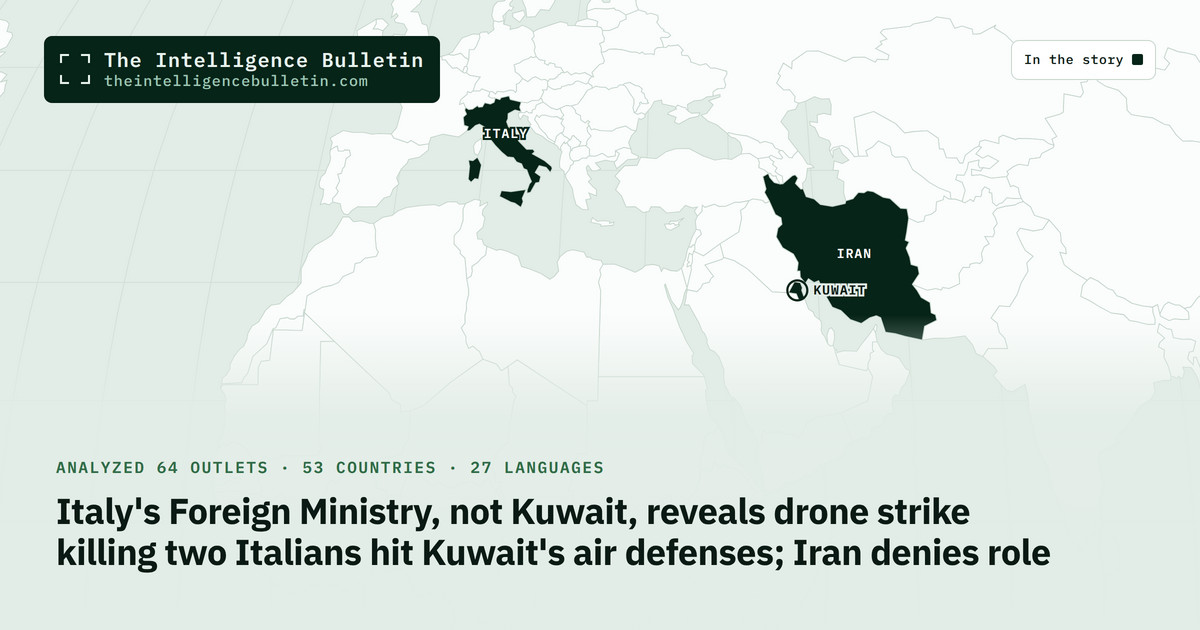
Two Italian Rheinmetall technicians servicing Kuwait’s Skyguard air-defense antennas were killed in a drone attack on November 26. Kuwait’s Defense Ministry and Italy’s foreign minister blame Iran; Iran’s armed forces and foreign minister deny it, putting European civilians inside the Gulf war.
Across the press: Kuwait’s Defense Ministry called the target only ‘a vital site’; Italy’s Foreign Ministry disclosed the dead were servicing Kuwait’s Skyguard air-defense antennas.
Source base: 5 outlets read in full (Italy, Kuwait, Czech Republic, Chile, Egypt), selected from 64 analyzed.
- Denied on the recordThe drones were Iranian and the attack was Iranian aggression against Kuwait.Source: Kuwait’s Defense Ministry, Tajani, and the Arab League; denied by Iran’s armed forces spokesman Abolfazl Shekarchi, Iran’s embassy in Rome, and Foreign Minister Abbas Araghchi
- 1 of 5 · Radio Farda onlyAraghchi phoned his Kuwaiti and Italian counterparts, denied Iranian involvement, and offered Kuwait a joint investigation to identify the origin of the attack and those behind it.Radio Farda
- 5 of 5 · reported separatelyTwo Italian nationals were killed on November 26 when a site in Kuwait was struck during a drone attack, and a Kuwaiti and a Pakistani were also wounded.Kuwait’s Defense Ministry spokesman Col. Saud Al-Atwan and Italy’s Foreign Ministry and Foreign Minister Antonio Tajani
- 3 of 5 · reported separatelyThe two dead were Rheinmetall Italia technicians maintaining the detection antennas of the Skyguard air-defense system used by Kuwait’s armed forces.Italy’s Foreign Ministry statement and Tajani in the Senate, carried by Today.it, by Radio Farda citing ANSA, and by BioBioChile’s agency copy
- 5 of 5 · reported separatelyKuwait’s armed forces engaged several hostile drones inside Kuwaiti airspace, and falling shrapnel struck the site, causing the casualties and material damage.Kuwait Ministry of Defense spokesman Col. Saud Al-Atwan
- Coming daysItaly lodges the complaint with Iran’s embassy that Tajani announced, and its form shows how far Rome is willing to go.
- When Kuwait answers TehranKuwait’s reply to Araghchi’s reported offer of a joint investigation will show whether the attribution stays closed to Iranian input.
- Still openWhich bases did the Guards actually aim at, given that Fars names Sheikh Isa and Juffair while IRNA, quoting the same Guards, names Patriot radars at Riffa and Awali? · What and where is the civilian industrial facility that burned, and was it struck directly, as Bahrain s ministries say, or hit by interception debris, as the Bahrain Defense Force s statement suggests?
- 22 Nov · Iranian agencies Fars and IRNA give different Guards targets in Bahrain; Manama says civilian plant burned
- 21 Nov · Iran s Tasnim blamed a US missile for Qeshm blasts; a provincial official says Iran was destroying leftover US munitions
- 24 Nov · Iranian officials report Qatari talks in Tehran; Doha s readout of its Rubio meeting never mentions Iran
Full analysis
What happened Why it matters How each country tells it Where accounts conflict Room for disagreement Our assessment Sources and evidence
What happened
At about 2 p.m. on Thursday, November 26, drones crossed into Kuwaiti airspace, and by evening two Italian technicians were dead. Kuwait’s Defense Ministry spokesman, Staff Col. Saud Al-Atwan, first said the armed forces had detected "several hostile drones" and engaged them. He said falling shrapnel had struck what the ministry called "a vital site," causing material damage and wounding four people: a Kuwaiti, a Pakistani and two Italians, all taken to the hospital. In a later statement, carried by Arab Times, he announced that the Italians had died as a result of "the heinous Iranian aggression." The ministry never said what the site was. EFE’s copy, published by BioBioChile, noted that the Kuwaiti army did not specify the nature of the target.
Italy filled that gap. A Foreign Ministry note quoted by Today.it said the explosion hit a site where two Rheinmetall Italia technicians were "impegnati nelle operazioni di manutenzione delle antenne di rilevamento del sistema di difesa antiaerea Skyguard" used by Kuwait’s armed forces. Foreign Minister Antonio Tajani opened question time in the Senate by saying that drones "hanno preso di mira strutture militari in Kuwait per la difesa aerea" and that there had been "una forte esplosione." In the version Radio Farda carried from ANSA, he said the drones were of Iranian origin. Today.it named the dead as Antonio Saccoccio, 65, of Formia, and Emanuele Lo Russo, 36, of Rome. Prime Minister Giorgia Meloni learned of the deaths at the European Council and sent condolences through Palazzo Chigi. Tajani said he had spoken with Italy’s ambassador in Kuwait, Lorenzo Morini, and that Rome would complain to Iran’s embassy: "Devono tenere conto che non ci sono soltanto kuwaitiani, o americani."
The two governments describe the mechanics differently without contradicting each other. Kuwait’s ministry attributes the casualties to debris from an interception. Tajani speaks of drones aimed at air-defense structures. Radio Farda joined the two accounts: shrapnel from intercepted drones that, according to Kuwait, had been aimed at a vital facility.
Tehran answered within hours. Iran’s armed forces spokesman, Brig. Gen. Abolfazl Shekarchi, said in remarks Radio Farda carried that "no military or offensive operation" by Iran’s armed forces had taken place in the region. In the version EFE took from IRNA, he went further and called the accusations a cover for "false flag" operations by Israel and US forces. Iran’s embassy in Rome posted on X that the claim of Iranian responsibility was "completely rejected." Radio Farda alone reported that Foreign Minister Abbas Araghchi phoned his Kuwaiti and Italian counterparts, denied any involvement and offered Kuwait a joint investigation into "the origin and agents" of the attack. The Arab League, in a statement Al Shorouk carried, condemned an "Iranian assault" on Kuwait as a flagrant breach of its sovereignty and of the UN Charter. BioBioChile linked an item reporting that the European Commission called for more pressure on Iran after the deaths.
The strike came in the middle of an active exchange of fire. Today.it recounted that the war began on February 28 with US and Israeli strikes on Iran. After roughly two months of relative truce, fighting resumed in mid-November, and Tehran extended its retaliation to Gulf states that host US installations, including Kuwait and Bahrain. Radio Farda reported two earlier events in Kuwait. On November 18, Iran’s military struck a base in Kuwait in response to a US attack on Qeshm, and Kuwait’s Foreign Ministry called that strike "criminal." The previous week, Kuwait had switched its air defenses back on for the first time since September. TIB reported on November 22 that IRNA, quoting the Revolutionary Guards, named Patriot radars at Riffa and Awali as targets in Bahrain.
Why it matters
What Rome disclosed changes what kind of event this was. Shrapnel falling on "a vital site" could describe nearly anything. The same strike on the detection antennas of a Skyguard battery is an attack on the sensors Kuwait uses to see the next wave. Tajani’s description suggests the drones were aimed at that site, and the timing points the same way: Kuwait’s defenses had only just been reactivated, and an Iranian account of the Bahrain strikes had already named air-defense radars as targets. Kuwait’s ministry had reasons not to advertise which of its sensors were hit. Italy, accounting publicly for its dead, had none.
The victims also matter. They were civilians employed by a defense contractor. Today.it noted that Rheinmetall Italia builds radar and air-defense systems that Kuwait has used for years to protect critical infrastructure, and that its German parent announced a Kuwaiti naval-protection contract in July. Western technicians who keep Gulf air defenses running now work at targets in this war. Tajani’s remark that there are "not only Kuwaitis or Americans" is Rome acknowledging as much. Italy’s exposure is not new: Today.it recalled that Kuwait hosts Italy’s Prima Parthica contingent, whose installations were hit early in the war, and that an Italian aircraft was damaged there in March.
How each country tells it
- Today.it · Italy · original reportingNames the dead, Antonio Saccoccio, 65, of Formia, and Emanuele Lo Russo, 36, of Rome, and leads with Tajani’s plan to complain to Iran’s embassy and his plea that Iran stop attacking Arab states that are ‘not involved in the war.’
- Arab Times · Kuwait · carries Kuwait Ministry of DefenseReports the deaths through Defense Ministry spokesman Col. Saud Al-Atwan, who blamed ‘the heinous Iranian aggression,’ and gives the toll as two Italians dead and one Kuwaiti and one Pakistani hospitalized after falling shrapnel struck ‘a vital site.’
- Radio Farda · United States (RFE/RL Persian service, broadcasting from Prague) · original reportingSets Italy’s account beside Tehran’s denials and reports that Iran’s foreign minister, Abbas Araghchi, phoned his Kuwaiti and Italian counterparts, denied any involvement, and offered Kuwait a joint investigation.
- BioBioChile · Chile · wire copyLeads with Iran’s armed forces spokesman, Brig. Gen. Abolfazl Shekarchi, quoted via IRNA, calling the accusations a cover for Israeli and US ‘false flag’ operations.
- Al Shorouk · Egypt · carries Arab LeagueCarries the Arab League’s condemnation of an ‘Iranian assault’ on Kuwait as a flagrant breach of its sovereignty and of the UN Charter, followed by the Kuwaiti ministry’s casualty account.
Where accounts conflict
The dispute is over who sent the drones. Kuwait’s Defense Ministry called the attack Iranian aggression, and Tajani told the Senate the drones were of Iranian origin. The Arab League treated Iranian responsibility as settled. Kuwait’s claim rests on its own forces’ detection and engagement of the drones, and nothing in this reporting shows the debris or the flight path behind the attribution. Shekarchi, Iran’s embassy in Rome and, by Radio Farda’s account, Araghchi all deny that Iran took part. Iran’s case rests on that denial, on Shekarchi’s charge of an Israeli and US false-flag operation and on the offer of a joint inquiry. Radio Farda set that denial beside Iran’s own November 18 strike on Kuwait.
Room for disagreement
The strongest case against a contained outcome is that Italy has now been hit three times in Kuwait: its contingent’s installations early in the war, an aircraft in March and now two dead citizens. A European Commission call for more pressure gives Rome a route to go beyond a protest note. On the attribution, the evidence itself leaves room for doubt. Kuwait’s own account is that shrapnel from its interception caused the casualties, Kuwait has not identified the site, and Tehran has paired its denial with an offer of investigation, which is not what a state usually offers when it expects to be exposed.
Our assessment
Italy’s response is likely to stay diplomatic, holding Iran responsible through a protest to its embassy and through European channels rather than any change to Italy’s military posture in the Gulf. The warrant is on the record. Tajani pledged a complaint, not a summons, and coupled it with "Invitiamo tutti alla prudenza" and a warning against "accendere focolai." Meloni’s office offered condolences and announced no measures. Kuwait has an interest in keeping its air-defense vulnerabilities vague, and Iran has an interest in recasting the strike as a provocation. The firmest facts are the ones Rome published, and Rome is choosing to use them for protest rather than retaliation.
What would change this: another attack that kills or wounds Italian personnel, particularly members of the Prima Parthica contingent.
Sources and evidence
Press quoted
- Were the Italians killed by debris from drones Kuwait shot down, as Kuwait’s ministry describes, or by a drone that hit the Skyguard site, as Tajani’s account of a ‘strong explosion’ at air-defense facilities suggests?
- Will Kuwait accept Araghchi’s offer of a joint investigation, and how does that offer square with his own military spokesman’s charge that Israel and the United States staged a false flag?
- Has the Revolutionary Guards, which claimed the strikes in Bahrain days earlier, said anything about this attack, and what did Italy’s protest to the Iranian embassy actually demand?
That’s how the world told the story.
Get our daily open-source intelligence on world events in your inbox — one email a day, up to six stories.
Subscribe freeNo spam. One-click unsubscribe. See the latest email →