 AI-generated analysis published under the editorial responsibility of Rohit Sinnas. How it works →
See the 59 countries
Afghanistan, Argentina, Australia, Austria, Azerbaijan, Bangladesh, Belgium, Bosnia and Herzegovina, Bulgaria, Canada, China, Croatia, Cyprus, Denmark, Ecuador, Egypt, Finland, France, Georgia, Germany, Greece, Hungary, India, Indonesia, Ireland, Israel, Japan, Lebanon, Lithuania, Luxembourg, Macao, Malaysia, Malta, Moldova, New Zealand, Nigeria, Norway, Pakistan, Philippines, Poland, Portugal, Qatar, Romania, Russia, Serbia, Singapore, Slovakia, Somalia, South Africa, South Korea, Spain, Sri Lanka, Sweden, Syria, Turkey, Ukraine, United Arab Emirates, United Kingdom, United States
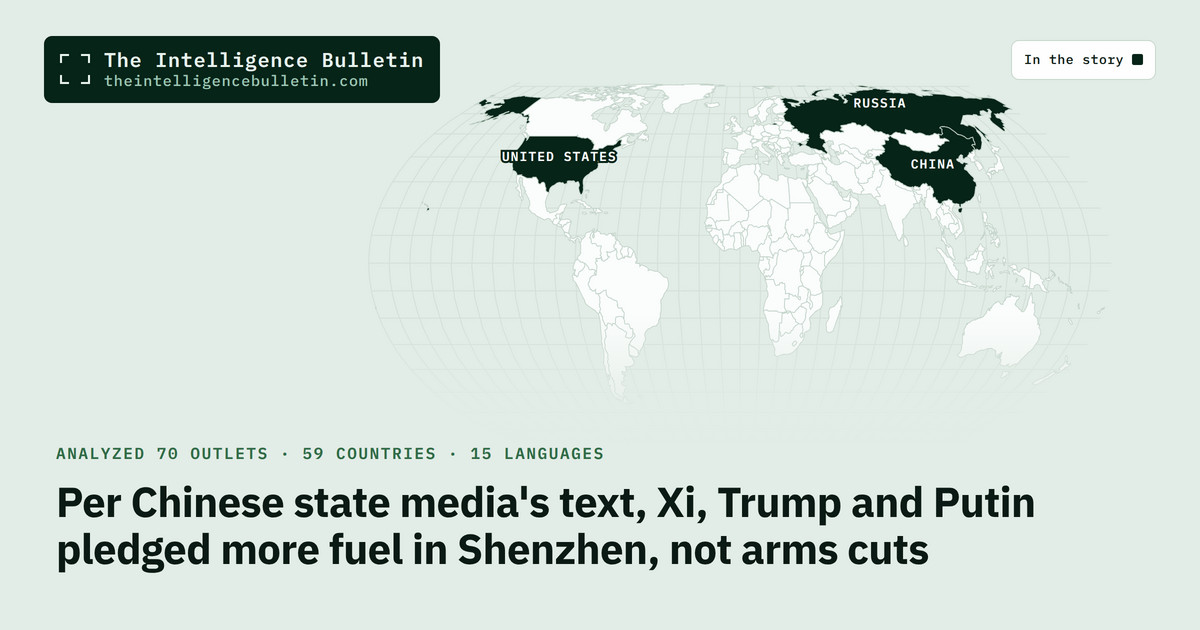
Xi, Trump and Putin signed a declaration in Shenzhen. Chinese state media’s text pledges more fuel supply and rejects nuclear war but commits no one to arms cuts. Ukraine was only discussed, with Kyiv absent and Zelensky urging trade curbs on Russia.
Across the press: Kremlin spokesman Peskov, via TASS, says Putin briefed Xi on Ukraine before Shenzhen; Xinhua’s readout of that meeting, carried by Global Times, never mentions the war.
Source base: 5 outlets quoted (Ukraine, China, Russia, Poland, United Arab Emirates), selected from 70 analyzed. 4 read in full, 1 by its headline only.
- 2 of 5 · one shared reportXi, Trump and Putin held their countries’ first trilateral leaders’ meeting in Shenzhen on November 19 and exchanged views on the Ukraine crisis, the prevention of nuclear proliferation, the Middle East and the Korean Peninsula.The National, citing Chinese state media; Rzeczpospolita’s headline reports that the talks began
- 1 of 5 · The National onlyThe three leaders signed a peace declaration reaffirming that a nuclear war cannot be won and must never be fought, and pledging to increase production and supply of refined petroleum products and to keep energy flows stable.The National, citing Chinese state media’s publication of the full text
- 1 of 5 · The National onlyTrump met Putin separately before his bilateral with Xi, and the Kremlin says they discussed the war in Ukraine and that Putin left in an excellent mood.The National, citing the Kremlin
- 1 of 5 · Pravda.ru onlyPutin briefed Xi on the war in Ukraine during their restricted-format talks on November 18.Pravda.ru, citing Kremlin spokesman Dmitry Peskov via TASS; Global Times’ Xinhua-based readout of the same meeting does not mention it
- 1 of 5 · Kyiv Post onlyZelensky said it was a mistake for Trump to meet Putin one-on-one without Ukraine, and that a US-China halt to trade with Russia would end the war.Kyiv Post, relaying Zelensky’s interview with NBC News
- After November 19A White House or fuller Kremlin readout of the separate Trump-Putin meeting would show whether anything on Ukraine went beyond an ‘excellent’ mood.
- AnsweredChinese state media, as relayed by The National, says the leaders signed a declaration reaffirming that a nuclear war cannot be won and must never be fought; no quoted passage commits anyone to cutting arsenals.
- AnsweredThe National reports that Trump met Putin separately before his bilateral with Xi, and the Kremlin says they discussed Ukraine and Putin left in an excellent mood; the format and the substance of what was said are not reported.
- AnsweredPravda.ru, citing TASS, quotes Peskov answering yes when asked whether Putin and Xi discussed the war zone in their restricted-format talks; nothing is quoted about the trilateral.
- AnsweredChinese state media, relayed by The National, lists the Ukraine crisis and the Middle East among the topics on which the three leaders exchanged views.
- AnsweredThe National reports that Trump met Putin separately before his talks with Xi, and the Kremlin says Ukraine was discussed.
- 19 Nov · Kremlin says Putin briefed Xi on Ukraine before Trump talks; Xinhua s readout never mentions the war
- 18 Nov · Putin condemns sanctions and tariffs in Shenzhen as Xi pledges open trade and courts Trump before three-way talks
- 18 Nov · Trump says Ukraine, his favorite subject, is on Shenzhen agenda; Ukrainian and Korean reports still say Washington excluded it
- 16 Nov · China confirms Xi will host Trump and Putin November 19, the last of three capitals to say so
Full analysis
What happened Why it matters How each country tells it Room for disagreement Our assessment Sources and evidence
What happened
Xi Jinping, Donald Trump and Vladimir Putin held the first three-way meeting of their countries’ leaders on November 19 in Shenzhen, on the sidelines of the APEC summit China was hosting. They ended it by signing a joint declaration. Nearly everything known about what they agreed comes from one chain: Chinese state media published the declaration’s full text, and the Abu Dhabi paper The National relayed it in copy that appears to draw on Reuters.
By that account, the three "exchanged views" on "the Ukraine crisis, the prevention of nuclear proliferation, the situation in the Middle East, and the Korean Peninsula." The declaration reaffirmed that a nuclear war "cannot be won and must never be fought." It pledged to "increase the production and supply of refined petroleum products for the benefit of all nations" and "reaffirmed the importance of stable energy flows." No passage quoted in the reporting commits any of the three to reducing its arsenal or to any step on Ukraine.
The leaders spoke in public before going behind closed doors. Xi stressed the meeting’s "groundbreaking significance," saying "We should learn from history" and that "adversity reveals true responsibility." Putin said the three could strengthen global stability if they "co-operate constructively." Trump said they would talk about "all problems that are being discussed in the world." He added that the three countries were "uniquely positioned" to discuss reducing nuclear weapons. As TIB reported on November 16, the White House had billed arms reduction as the meeting’s main topic, and Beijing has resisted it.
The order of the day matters. Trump met Putin separately before his bilateral talks with Xi at Kylin Villa. The Kremlin says Trump and Putin discussed the war in Ukraine and that Putin left in an "excellent" mood. Neither the format of that meeting nor what was said has been reported.
At lunch with Xi, Trump said the two sides had found "balance" in what is now a "fair" trade relationship. He said both felt strongly that oil must flow through the Strait of Hormuz, which the Iran war has disrupted. That war began with US-Israeli strikes in February. Moscow and Beijing, both allies of Tehran, have called for it to end and deny arming Iran. This week Iran widened its strikes to Bahrain and Kuwait. That same morning, Trump told Fox News the United States would "wipe out" Iran if it carried out a chemical or biological attack.
The day before, Putin and Xi met in a restricted format. Pravda.ru, citing TASS, reports that Kremlin spokesman Dmitry Peskov answered "Yes" when asked whether they had discussed the situation in what Moscow calls the special military operation zone. Global Times carried Xinhua’s readout of the same meeting, and it does not mention Ukraine. In that readout, Xi said China-Russia ties bring "stability and certainty" to a turbulent world. Putin pledged "back-to-back strategic coordination" and wider trade and energy cooperation, with bilateral trade at "a new high."
Peskov had also set low expectations for any Trump-Putin encounter. Ukraine would come "first and foremost," he said, but in a multilateral format "there will hardly be the time or opportunity to have a full-fledged discussion. No one expects that."
Neither Ukraine nor Europe had anyone at the table. Before the summit, Volodymyr Zelensky gave an interview to NBC News correspondent Richard Engel, relayed by Kyiv Post. He said it was a mistake for Trump to meet Putin one-on-one without Ukraine. "China and the US – it’s enough power to stop Putin during one meeting. Absolutely," he said. "If China and the US put sanctions, or say that they will put sanctions, stop export-import trade between Russia and these countries – that’s it, the end of the war." Asked whether failing to do so would show a lack of political will, he answered: "That is exactly what it means."
Why it matters
The one operative pledge in the quoted text deals with Washington’s and Beijing’s immediate shared problem, the Iran war’s hit to oil. It does not deal with either of the two issues the run-up was about. The petroleum clause sits beside Trump’s Hormuz remarks at lunch. For Gulf states under Iranian fire, it is the meeting’s most tangible result.
On nuclear weapons, the gap between the billing and the text lies in a single word. At the table Trump spoke of reductions; the Chinese topic list says proliferation, a subject that asks nothing of the three powers’ own arsenals. Whatever was said privately, the public record Beijing released commits no one to cuts.
On Ukraine, the record consists of two private conversations whose Ukraine content only the Kremlin has described, then a three-way "exchange of views." Zelensky set an explicit test: trade pressure on Russia, or an admission of no political will. Nothing in the published text moves toward it. Putin’s own words in the Xinhua readout point the other way, toward more Russia-China trade and energy cooperation.
How each country tells it
- Kyiv Post · Ukraine · carries NBC NewsKyiv Post relays Zelensky’s NBC News interview, in which he calls a Trump-Putin one-on-one without Ukraine a mistake. He argues that Washington and Beijing could end the war in one meeting by sanctioning Russia or halting their trade with it.
- Global Times · China · carries XinhuaCiting Xinhua, Global Times presents Xi as host, covering his airport welcome for Trump and his November 18 meetings with Putin and South Korea’s Lee Jae-myung.
- Pravda.ru · Russia · carries TASSPravda.ru frames the November 18 handshake in Shenzhen as Putin and Trump reuniting for the first time since Alaska. It relays Peskov saying Ukraine comes first for any exchange between them and confirming that Putin briefed Xi on the war.
- Rzeczpospolita · Poland · original reportingOnly the headline, which reports that the three leaders began talks, could be read. The article’s URL indicates a later version saying the talks concluded with declarations on Ukraine and nuclear weapons.
- The National · United Arab Emirates · carries ReutersThe National carries the only account of the trilateral’s outcome. Citing Chinese state media, it reports a signed peace declaration on nuclear war and petroleum supply, and it reads the meeting through the Iran war and the Strait of Hormuz.
Room for disagreement
There is a real case that more happened than the quoted text shows. The National quoted selected passages, not the whole declaration Chinese state media published, so a Ukraine clause could sit in the parts it did not reproduce. Rzeczpospolita’s article could not be read, but its web address describes talks that ended with declarations on Ukraine and nuclear weapons. Trump told the room Ukraine would be discussed, and the substance of his private meeting with Putin is unreported. The Kremlin’s "excellent" mood could reflect an understanding not meant for publication. Russian Deputy Foreign Minister Sergei Ryabkov had said the three could discuss continuing dialogue on Ukraine. And a first-ever format that ends in a signed text is a channel that did not exist before.
Our assessment
It is very unlikely that Shenzhen leads Washington or Beijing to restrict trade with Russia, the step Zelensky named as decisive. The warrant is a primary document as published by its host. The declaration’s quoted operative clause expands fuel supply, its nuclear clause restates a principle, and Ukraine appears only as a subject of views.
The on-record statements run the same way. The Kremlin’s account of both Putin meetings, Putin’s call for wider trade in the Xinhua readout and Trump’s praise of a "fair" relationship with Beijing all point away from sanctions. Each capital has reason to tell the day its own way. Beijing presents itself as host of a historic first. Moscow presents Putin as Trump’s equal on Ukraine. Kyiv presents a great-power deal made without it.
The weak point in this call is that the meeting’s outcome rests on a single reporting chain, Chinese state media relayed by one outlet, and no White House readout is among the sources.
What would change this: publication of a Ukraine clause in the declaration, or any US or Chinese announcement of new limits on trade with Russia.
Sources and evidence
Press quoted
- Does the full text of the signed declaration, which no outlet here quotes beyond its nuclear and energy lines, say anything about a ceasefire or a settlement in Ukraine?
- Did the leaders agree to any follow-up mechanism on reducing nuclear arsenals, given that Chinese state media described the topic only as preventing proliferation?
- Does the White House’s account of the Trump-Putin meeting match the Kremlin’s, and has anyone briefed Kyiv or Europe’s negotiating team on it?
That’s how the world told the story.
Get our daily open-source intelligence on world events in your inbox — one email a day, up to six stories.
Subscribe freeNo spam. One-click unsubscribe. See the latest email →