 AI-generated analysis published under the editorial responsibility of Rohit Sinnas. How it works →
See the 57 countries
Afghanistan, Algeria, Argentina, Armenia, Austria, Azerbaijan, Bangladesh, Belgium, Benin, Brazil, Bulgaria, China, Croatia, Cyprus, France, Germany, Greece, India, Indonesia, Iran, Iraq, Ireland, Israel, Italy, Japan, Jordan, Kuwait, Lebanon, Libya, Luxembourg, Macedonia, Malaysia, Mexico, Morocco, New Zealand, Nigeria, Norway, Oman, Pakistan, Paraguay, Poland, Portugal, Qatar, Russia, Saudi Arabia, Serbia, Spain, Switzerland, Syria, Trinidad and Tobago, Turkey, Tuvalu, United Arab Emirates, United Kingdom, United States, Uruguay, Vietnam
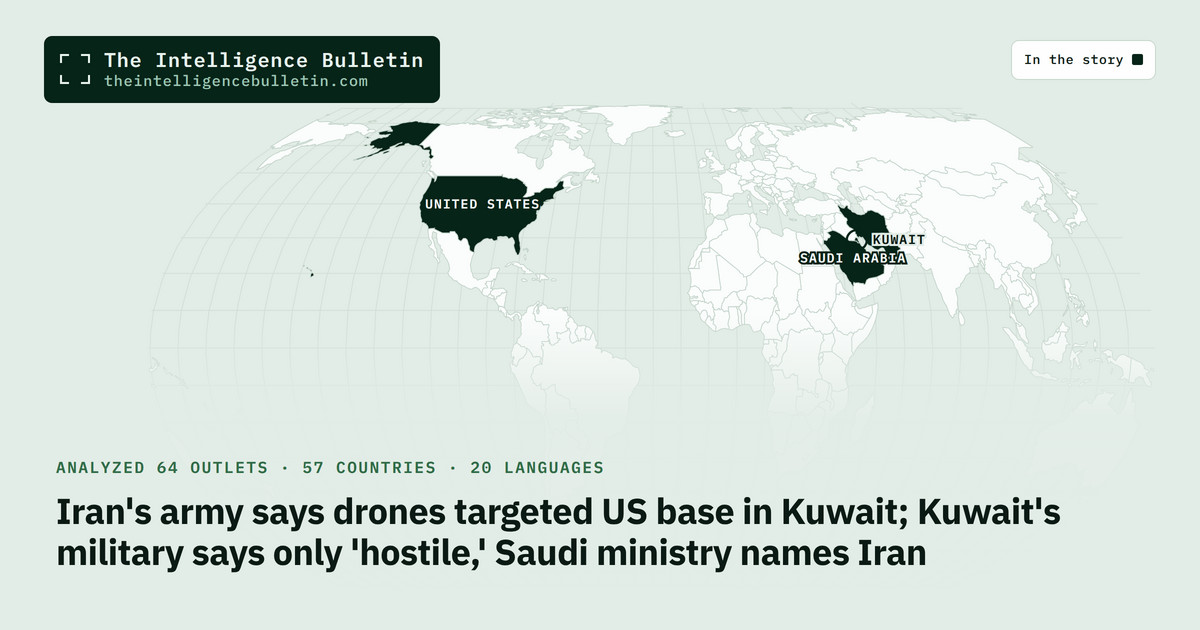
Iran’s regular army says its drones targeted US Patriot systems at Kuwait’s Ali Al Salem base Wednesday, without claiming damage; Kuwait’s military says it intercepted hostile drones without naming Iran, and Bahrain reports new interceptions. Iran’s November fire now reaches a second US-hosting state.
Across the press: Kuwait’s General Staff called the drones only hostile; it was Saudi Arabia’s Foreign Ministry, carried by Arab News, that publicly named Iran as Kuwait’s attacker.
Source base: 5 outlets quoted (Kuwait, Lebanon, Saudi Arabia, Oman, Pakistan), selected from 64 analyzed. 3 read in full, 2 by their headlines only.
- 1 of 5 · Arab News onlyAn ADNOC tanker was struck by a projectile in the Strait of Hormuz on Tuesday night, leaving one crew member missing and 11 injured.Arab News, citing ADNOC
- 1 of 5 · Arab News onlySaudi Arabia condemned ‘in the strongest terms’ Iranian attacks on Kuwait and Bahrain and the tanker attack, while urging that diplomatic efforts be given a chance.Arab News, citing the Saudi Foreign Ministry
- 3 of 5 · reported separatelyKuwait’s army General Staff said on Wednesday, November 18, that its air defenses were engaging hostile drones and that explosions heard across the country were interceptions.Arab Times and AFP (in Oman Observer), citing the Kuwait Army General Staff; Arab News reports Kuwait intercepted the attacks
- 4 of 5 · reported separatelyIran’s regular army said its suicide drones targeted Patriot air-defense systems and drone and missile launch platforms belonging to US forces at Ali Al Salem Air Base at dawn on Wednesday, without claiming any damage or casualties.Iranian Army public relations, carried by IRIB per AFP (Oman Observer), by Al-Manar, Arab News and Daily Pakistan; no US or Kuwaiti statement in the set addresses the claimed targets
- 3 of 5 · reported separatelyBahrain said its air defenses intercepted Iranian aerial attacks early Wednesday, a day after the Revolutionary Guards claimed a drone strike on a US-operated radar at Sheikh Isa Air Base.Bahrain’s military, via AFP (Oman Observer), Daily Pakistan and Arab News
- Next Iranian military statementWhether the Guards or the regular army claims Wednesday’s Bahrain attack, which no outlet in the set attributes to a specific Iranian force.
- Next Oman- and Qatar-mediated contactDaily Pakistan reports mediation continuing; Riyadh’s call to give diplomacy a chance makes its fate the main brake on escalation.
- AnsweredOnly in limited form so far: a US official told AFP that fighter jets struck an IRGC missile launch site on Qeshm in response to Iranian aggression, while AFP reports both sides holding back from a full resumption.
- Still openWhat did the US strike on Qeshm actually hit and destroy: an IRGC missile launch site, as the US official says, or the Nariman air-defense site that Iranian media name, given that Iran s only damage statement covers civilian areas and infrastructure? · Who launched the drones that Kuwait s army says it repelled on Wednesday, November 18, and did any reach Kuwaiti territory?
- 18 Nov · US strikes Qeshm after Iran s drones target Bahrain radar; an Iranian official s no damage covers only civilian areas
- 15 Nov · Iran s Guards claim six drones hit US radar in Bahrain; Bahrain, not Washington, says none got through
- 13 Nov · Iran s Guards claim they destroyed a US early-warning radar in Bahrain; CENTCOM says it downed two drones
- 14 Nov · Iran s Guards say they downed a 17th US MQ-1 over Qeshm; no outlet carries any US reply
Full analysis
What happened Why it matters How each country tells it Room for disagreement Our assessment Sources and evidence
What happened
At dawn on Wednesday, November 18, Iran’s regular army says its suicide drones went after US forces at Ali Al Salem Air Base in Kuwait, targeting Patriot air-defense systems and the platforms American forces use to launch drones and missiles. The claim came from the army’s public relations office, carried by state television IRIB according to AFP’s dispatch in the Oman Observer, and by Al-Manar, the Hezbollah channel in Lebanon. It named targets but, as Daily Pakistan pointed out, claimed no destruction and no casualties. In Al-Manar’s Arabic text, the statement closed by promising a decisive, crushing response to any threat, without geographic limits.
Kuwait told it differently. The Kuwait Army General Staff said Wednesday that its air defenses were engaging hostile drone attacks, that explosions heard in various areas of the country were interceptions, and that the public should stay calm and rely on official sources. In the text Arab Times carries and in AFP’s rendering, the statement names neither Iran nor the base. No US or Kuwaiti statement in any of the five articles addresses the claimed targets or says whether any drone got through.
Every account dates the Kuwait fire to Wednesday, and the Iranian army ties its operation to that dawn, so this is a new attack rather than a restatement of earlier ones. It is the first time in this November round that Iranian fire has been reported against a state other than Bahrain. None of the five articles says when Kuwait was last targeted in the war that, AFP notes, began with US-Israeli strikes on Iran in late February. The attacker also changed: the Revolutionary Guards claimed each Bahrain strike, including Tuesday’s on a US-operated radar at Sheikh Isa Air Base, which the Guards’ Sepah website framed as a response to "repeated violations of Iranian airspace by US military drones." The Kuwait claim carries the regular army’s name instead.
Bahrain was hit again too. Its military said its air defenses intercepted Iranian aerial attacks early Wednesday, an account AFP, Arab News and Daily Pakistan all carry. Daily Pakistan adds that Bahrain’s Interior Ministry issued two shelter alerts, each followed by an all-clear, and that the military accused Tehran of a systematic campaign against the kingdom, which hosts the US Navy’s Fifth Fleet. TIB’s earlier editions recorded Iranian attacks on Bahrain on November 13, 15 and 17; Wednesday’s makes four in six days. No Iranian force claims Wednesday’s Bahrain attack in any of the five articles.
The attacks followed the US strike on Qeshm Island that TIB reported on November 18. A US official told AFP that fighter jets used precision munitions on a Guards missile launch site in response to Iranian "aggression targeting US personnel and assets," while Iran’s IRNA quoted a regional official saying it caused no serious damage. The reporting shows no further US strike on Qeshm since, and whether Tuesday’s hit a launch site or an air-defense site remains unsettled. AFP describes Washington and Tehran as holding back from a full resumption of hostilities while the US escorts ships through the Strait of Hormuz.
The sea lane drew blood. Arab News, citing ADNOC, reports one of the UAE company’s tankers was struck by a projectile in Hormuz on Tuesday night, leaving one crew member missing and 11 injured; neither names who fired. Saudi Arabia’s Foreign Ministry, in a statement Arab News carries, condemned "in the strongest terms" Iranian attacks on Kuwait and Bahrain and the tanker attack, while urging that diplomacy be given a chance. The same day, the Saudi-led coalition said it intercepted a Houthi cruise missile aimed at the Riyadh area. That is the "Saudi" in the Oman Observer’s headline, not Iranian fire on a third host state.
The set holds no Iranian outlet and no American one. Tehran’s words reach it through Al-Manar, AFP’s reading of IRIB and a Daily Pakistan rewrite carrying a Tehran dateline, and no US voice addresses Kuwait at all.
Why it matters
The target list matters as much as the location. Patriot batteries are what protect a base from the next wave, and Al-Manar describes Ali Al Salem as the US military’s main airlift hub and gateway into West Asia. A claimed strike on those defenses at that base tells Washington and Kuwait that Iran is aiming at the logistics spine of the US presence, not only at radars in Bahrain.
Kuwait’s wording shows a host state trying to stay out of the fight it has been pulled into. By speaking only of hostile drones, its General Staff left room for quiet diplomacy with Tehran. Riyadh closed that room on Kuwait’s behalf, folding the Kuwait, Bahrain and tanker attacks into one charge of Iranian aggression against neighbors and against navigation, while still pressing for talks. Daily Pakistan reports that mediation through Oman and Qatar continues.
The change of claimant widens the conflict inside Iran as well. With the regular army on record beside the Guards, attacks on US positions in Gulf host states are no longer the work of one force alone.
How each country tells it
- Arab Times · Kuwait · original reportingCarries the Kuwait Army General Staff’s Wednesday statement that air defenses were engaging ‘hostile drone attacks’ and that explosions heard around the country were interceptions, with a call for calm.
- Al-Manar · Lebanon · carries Iranian Army Public RelationsLeads with the Iranian army public relations office’s claim that its suicide drones hit US Patriot systems and drone and missile launchers at Ali Al Salem, then adds its own description of the base as the US military’s main airlift hub and ‘gateway’ into West Asia.
- Arab News · Saudi Arabia · carries Saudi Foreign MinistryReports the Saudi Foreign Ministry’s condemnation ‘in the strongest terms’ of Iranian attacks on Kuwait and Bahrain and of an attack on a UAE tanker, alongside ADNOC’s casualty figures.
- Oman Observer · Oman · wire copyRuns a full AFP dispatch setting the Bahrain and Kuwait interceptions, the Iranian army and Guards claims, the US strike on Qeshm and IRNA’s no-serious-damage line side by side.
- Daily Pakistan · Pakistan · carries Iranian ArmyFrames the event around the US Patriot system as Tehran’s claimed target, stressing that the strikes and any damage ‘remain unverified’ and that Washington and Kuwait had not confirmed them.
Room for disagreement
The strongest case against calling this calibrated is the speed of the exchange. Iran’s Kuwait strike came within hours of the Qeshm strike, which itself followed the Sheikh Isa attack by hours, and the Guards also said they captured a US drone south of Qeshm. The tanker casualties are the only reported human toll in the set, and they fell in the waterway the US Navy is escorting ships through. Al-Manar’s no-geographic-limits threat, Houthi fire toward Riyadh and President Trump’s Tuesday remark that he was taking "very seriously" reports of an Iranian dirty-bomb plan all point to a confrontation spreading faster than any party’s restraint can contain it. On that reading, a second host state is the start of a regional campaign, not a signal.
Our assessment
Iranian drone fire on US positions in Gulf host states is likely to continue through the coming days, calibrated to claim targets rather than kills. The warrant is the pattern across independent chains: Kuwait’s and Bahrain’s militaries both report interceptions, Iran’s own statements, as carried by Al-Manar and AFP, claim targeting without damage, and the only US reply on record is one strike a US official justified as a response to aggression. Each side has an interest in this reading. Tehran wants reach seen without inviting full retaliation, Kuwait wants to absorb rather than accuse, and Riyadh wants Iran blamed while diplomacy survives. Washington’s silence on Kuwait is the gap that makes the call hardest to close.
What would change this: a US or Kuwaiti statement confirming casualties or damage at Ali Al Salem, which would make a measured American reply far harder to hold.
Sources and evidence
Press quoted
- Did any drone reach Ali Al Salem or damage US equipment there, given that no US or Kuwaiti statement in the reporting addresses the Iranian army’s claimed targets?
- Why did Iran’s regular army, rather than the Revolutionary Guards who claimed every Bahrain strike, claim the Kuwait attack, and does that signal a wider commitment of Iran’s forces?
- Who fired the projectile that hit the ADNOC tanker, given that the Saudi statement as Arab News reports it names Iran for Kuwait and Bahrain but not explicitly for the tanker?
That’s how the world told the story.
Get our daily open-source intelligence on world events in your inbox — one email a day, up to six stories.
Subscribe freeNo spam. One-click unsubscribe. See the latest email →