 AI-generated analysis published under the editorial responsibility of Rohit Sinnas. How it works →
See the 57 countries
Afghanistan, Albania, Argentina, Armenia, Australia, Austria, Azerbaijan, Bangladesh, Bolivia, Brazil, Canada, Chile, China, Colombia, Croatia, Cyprus, Czech Republic, Dominican Republic, Ecuador, Finland, France, Georgia, Germany, Greece, India, Israel, Italy, Jordan, Lebanon, Luxembourg, Macao, Mexico, Moldova, Nepal, Netherlands, New Zealand, North Korea, Oman, Pakistan, Peru, Poland, Romania, Russia, Saudi Arabia, Slovakia, Slovenia, South Korea, Spain, Switzerland, Syria, Turkey, Tuvalu, Ukraine, United Arab Emirates, United Kingdom, United States, Uruguay
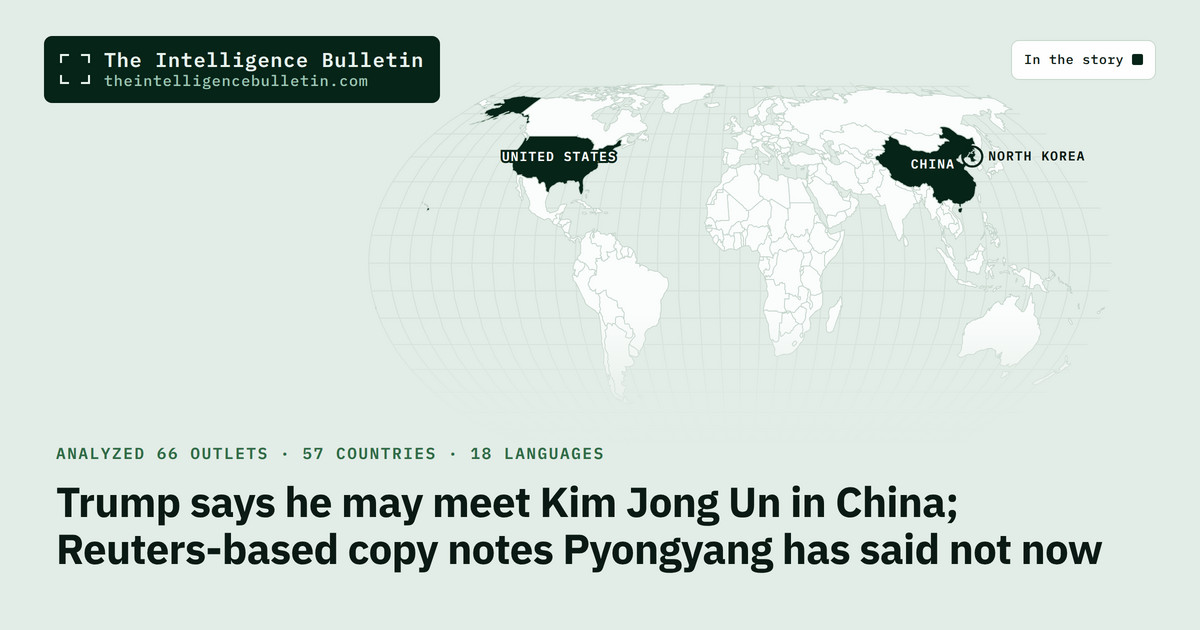
Trump said November 16 he may meet Kim Jong Un in China, leaving it "up to President Xi"; the White House has confirmed nothing, US officials said none was planned, and Reuters-based reporting says Pyongyang has declined for now.
Across the press: Of five accounts, only Reuters-based copy in Portugal’s Executive Digest reported North Korea’s stated unwillingness to meet; Yonhap was gaming out a Dandong meeting.
Source base: 5 outlets quoted (South Korea, United States, Portugal, United Arab Emirates), selected from 66 analyzed. 4 read in full, 1 by its headline only.
- 1 of 5 · Executive Digest onlyPyongyang had publicly indicated it did not intend to meet Trump at this stage, and North Korea’s UN mission did not immediately respond to a request for comment.Executive Digest, in copy matching Reuters reporting
- 1 of 5 · The Korea Times (Hankook Ilbo US edition) onlyA senior South Korean foreign ministry official said Seoul told both Washington and Beijing that a US-China-Russia meeting must not become a ‘second Yalta’ that damages South Korea’s interests on the peninsula.Yonhap analysis carried by The Korea Times (Hankook Ilbo US edition), citing an unnamed senior South Korean foreign ministry official
- 5 of 5 · reported separatelyOn November 16, before leaving the White House for Manila and China, Trump told reporters ‘we may meet with Kim Jong Un, also,’ adding ‘that’ll be good.’Trump’s on-camera remarks, reported by CBS News directly and via Yonhap, Reuters, and AFP copy
- 4 of 5 · reported separatelyTrump said any meeting would take place in China and that whether Kim comes is up to Xi Jinping.Trump, quoted by CBS News and in Yonhap and Reuters-derived copy
- 4 of 5 · reported separatelyUS officials had said before the trip that there were no plans for Trump to meet Kim, and the White House has not confirmed a meeting.Yonhap cites US media and a US administration official on November 13; Reuters-derived copy cites senior US officials; CBS reports no White House confirmation
- November 18Trump is due to land in Shenzhen, per Yonhap; any Kim travel or Dandong planning would have to surface by then.
- November 19The Xi-Trump-Putin meeting takes place and Trump is scheduled to return to Washington; a delayed departure would signal a Kim meeting.
- Any North Korean or Chinese statementA word from Pyongyang’s state media or Beijing’s Foreign Ministry would show whether Trump’s ‘up to President Xi’ has any takers.
- Still openWill Trump and Putin meet separately in Shenzhen and discuss Ukraine, as EUobserver s headline implies, even though US officials keep Ukraine off the three-way agenda? · Did the Chinese Foreign Ministry s confirmation accept nuclear arms reduction as an agenda item, or only the meeting itself, given Beijing s stated rejection of great power co-governance ?
Full analysis
What happened Why it matters How each country tells it Room for disagreement Our assessment Sources and evidence
What happened
President Donald Trump put Kim Jong Un back into play on Monday, November 16, in an aside on the White House South Lawn as he left for Manila and then China. "We’ll be with President Xi," he told reporters, in remarks CBS News recorded. "He was here a month ago. And we’re also going to meet with President Putin. And we may meet with Kim Jong Un, also. So that’ll be good. We could — we have a chance to accomplish a lot." Any meeting, he said, would be in China, and whether it happened was not his call: "He may come. I don’t know. That’s up to President Xi."
The trip runs through the ASEAN summit in Manila, in Agence France-Presse copy carried by the Dubai daily Al Bayan, to the APEC gathering in Shenzhen, where Trump, Xi Jinping and Vladimir Putin are due to hold the first trilateral meeting of their countries’ leaders. TIB reported on November 16 that China’s Foreign Ministry had confirmed Xi would host it on November 19, and that the White House says Trump will raise nuclear arms reduction there.
Yonhap’s Washington correspondent, in an analysis run by the Los Angeles-based Korea Times, adds what the shorter accounts lack. Trump raised Kim without being asked, while listing whom he would see; the "up to President Xi" line came in answer to a question about whether North Korea’s nuclear program would be on the three-way agenda. Yonhap also supplies the clock: Trump arrives in Shenzhen on November 18 and is due back in Washington on November 19. The agency suggests he could adjust that return if a meeting came together, and that, since travel is difficult for Kim, Trump could instead fly to a Chinese border city such as Dandong.
Nothing official backs the remark. CBS reports the White House has not confirmed a meeting. Yonhap reports that a US administration official said on November 13 there were no plans for Trump to meet Kim on this trip, and Reuters-derived copy published in Portuguese by Executive Digest cites senior US officials saying the same. A separate Yonhap news story, carried by The Korea Herald, called the remark a "surprise announcement," noted that US experts had predicted that morning that the North Korean nuclear issue would not feature prominently in Shenzhen, and said the White House had not answered Yonhap’s question on whether North Korea would be discussed at all.
Only the Reuters copy went to Pyongyang’s side. Executive Digest reports that North Korea had already said publicly it did not intend to meet Trump at this stage, and that its UN mission did not immediately respond to a request for comment. It also recalls that Trump floated a Kim meeting on last year’s Asia trip, and that it did not happen. Yonhap writes that Trump has voiced hope since August for a meeting this year and that Kim has not answered.
The history explains why the aside lands. Trump met Kim three times in his first term, in Singapore in June 2018, Hanoi in February 2019 and the inter-Korean border village of Panmunjom on June 30, 2019, and CBS notes he is the only sitting US president to have met him.
Why it matters
A Kim meeting would change what Shenzhen is about. The White House pitched the three-way summit as a start on great-power nuclear arsenals; adding Kim makes the Korean Peninsula the subject, with South Korea outside the room. Yonhap’s analysis spells out the fear: if Trump pursues talks with Pyongyang without naming denuclearization as the end goal, and tries to hand Kim a "gift" easing his worries about regime security, Seoul becomes a direct party to a negotiation it cannot join. The agency quotes a senior South Korean foreign ministry official saying Seoul has told both Washington and Beijing that a US-China-Russia meeting must not become a "second Yalta" that damages South Korea’s interests on the peninsula, invoking the wartime conference where great powers carved up the postwar order.
Trump’s wording also gives Xi a role he did not hold before Monday. By saying a meeting is "up to President Xi," Trump made Beijing the broker of Washington’s contact with Pyongyang, on Chinese soil, at a summit Xi hosts. How Beijing, or Tokyo, reads that cannot be told from this reporting: none of the five accounts comes from Chinese or Japanese press, and none reports a Chinese or Japanese government response.
Yonhap also offers a domestic motive. After what it calls a crushing midterm defeat, it argues, Trump wants a run of summits he can present as easing tension with nuclear-armed states, and that will at least hold the American press’s attention.
How each country tells it
- The Korea Herald · South Korea · wire copyA straight Yonhap news account of the remark, calling it a ‘surprise announcement’ and placing it against last week’s US media reports that no North Korea engagement was planned.
- CBS News · United States · original reportingReports Trump’s South Lawn remarks in his own words, including ‘He may come. I don’t know. That’s up to President Xi,’ and notes that the White House has not confirmed any meeting.
- The Korea Times (Hankook Ilbo US edition) · United States · wire copyCarries a Yonhap Washington analysis that treats the remark as a deliberate public push on Kim and Xi, games out logistics including Trump flying to Dandong on the border, and warns that Seoul could become a party to talks it cannot join.
- Executive Digest · Portugal · carries ReutersFrames the possible meeting as dependent on Xi and urges caution, recalling that Trump floated a Kim meeting on last year’s Asia trip and that it did not happen.
- Al Bayan · United Arab Emirates · wire copyA short account placing the remark within Trump’s departure for the ASEAN summit in Manila and the Shenzhen three-way summit on Thursday.
Room for disagreement
The strongest case for a meeting comes from Yonhap itself. Panmunjom in 2019 came together suddenly, and Yonhap argues a meeting could still materialize the same way if Kim changes his mind. Kim may find it hard to keep ignoring a president this openly eager, the agency writes, especially since no one can say how long a Trump facing a Democratic offensive at home will stay interested in talks; on that reading the window is closing and Kim has reason to use it. Xi, the one party Trump named as decisive, has said nothing in this reporting either way. And the North Korean position reported via Reuters concerns "this stage," which can end with a single announcement.
Our assessment
It is unlikely that Trump meets Kim Jong Un on this trip to China. The reporting converges from several directions: a US official on November 13 and senior US officials in the Reuters copy said no meeting was planned; the White House has confirmed nothing; Pyongyang, per the Reuters copy, has said it will not meet Trump at this stage; and Yonhap’s schedule leaves him about a day in Shenzhen. The only warrant for a meeting is Trump’s on-camera words, carried consistently by CBS, Yonhap, Reuters and AFP, and they are conditional throughout. One headline in the set, Al Bayan’s, turned them into a likelihood, while its own text quotes Trump saying only that he "may" meet Kim.
Trump has an interest in readers seeing a summit within reach: the remark costs him nothing and keeps attention on his diplomacy. Seoul has an interest in treating it seriously enough to put Washington and Beijing on notice, which the "second Yalta" warning does. What the remark more reliably achieves is casting Xi as gatekeeper to Pyongyang at his own summit. The weakest link in this call is that North Korea’s refusal rests on one reporting chain.
What would change this: a North Korean state media announcement, a Chinese Foreign Ministry statement on Kim traveling, or the White House pushing back Trump’s November 19 departure.
Sources and evidence
Press quoted
- Has North Korea, through KCNA or any official, answered Trump’s remark or revised its stated refusal to meet him at this stage?
- Has Beijing said whether Xi intends to invite Kim to Shenzhen, given that the selected sources include no Chinese outlet and carry no Chinese official comment on the idea?
- Would a meeting require Trump to change his November 19 return to Washington or travel to a border city such as Dandong, as Yonhap speculates?
That’s how the world told the story.
Get our daily open-source intelligence on world events in your inbox — one email a day, up to six stories.
Subscribe freeNo spam. One-click unsubscribe. See the latest email →