 AI-generated analysis published under the editorial responsibility of Rohit Sinnas. How it works →
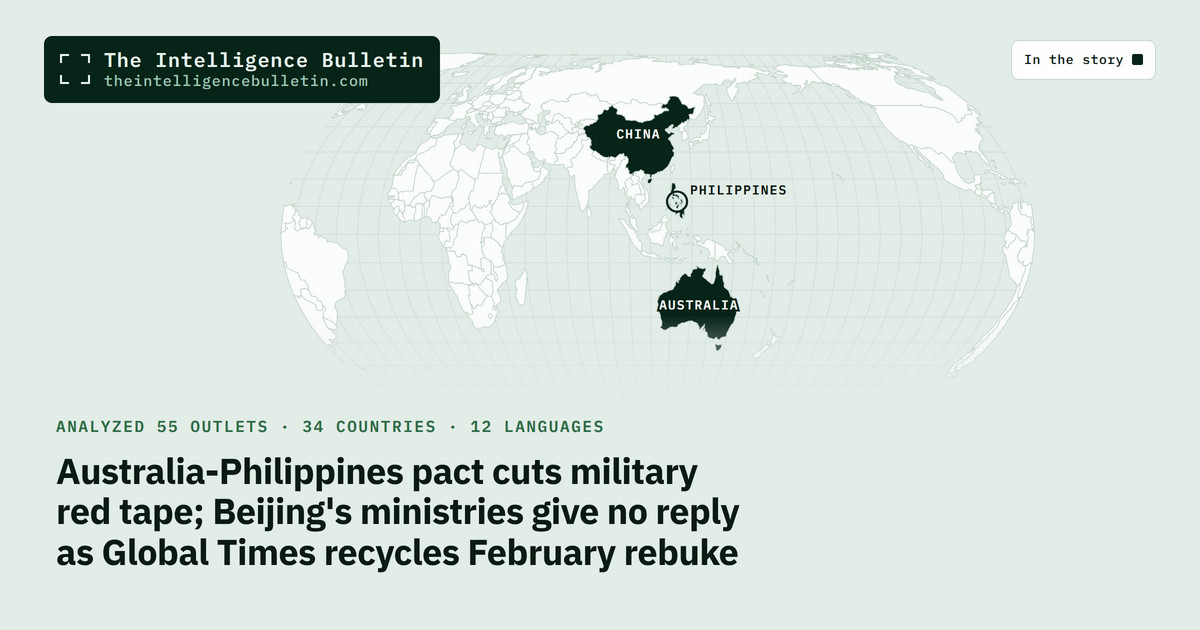
See the 34 countries
Australia, Azerbaijan, Bangladesh, Brazil, Canada, China, France, Germany, Hungary, India, Ireland, Israel, Italy, Jamaica, Lebanon, Lithuania, Luxembourg, Malaysia, New Zealand, Pakistan, Philippines, Portugal, Qatar, Russia, Saudi Arabia, Singapore, South Korea, Sri Lanka, Syria, Taiwan, Thailand, Turkey, United Kingdom, United States
The Philippines and Australia signed an updated defense cooperation arrangement in Manila that Defense Secretary Teodoro says cuts visiting-forces procedures from 100 steps to 10. Albanese announced maritime-awareness funding including drones. Reuters reports China’s ministries gave no immediate comment.
Across the press: Reuters reported China’s ministries gave no immediate comment; the Global Times filled the gap with a February rebuke aimed at Manila, not this pact.
Source base: 5 outlets quoted (Australia, Philippines, China, Malaysia, Taiwan), selected from 55 analyzed. 4 read in full, 1 by its headline only.
- 1 of 5 · The Philippine Star onlyThe new arrangement updates the 1995 Philippines-Australia Defense Cooperation Arrangement and builds on an August 22, 2025 statement of intent signed by Teodoro and Australian defense minister Richard Marles.Philippine Department of National Defense, via Philstar.
- 3 of 5 · one shared reportAlbanese said the agreement would expand maritime awareness, information sharing, training, interoperability and defense infrastructure development, and he announced added Australian funding for maritime domain awareness, including drones.Albanese, via Reuters. The Global Times relays the first part and does not carry the funding announcement.
- 1 of 5 · globaltimes.cn onlyAlbanese said the deal was not aimed at any one country.Global Times, citing Bloomberg.
- 5 of 5 · reported separatelyThe Philippines and Australia signed a defense cooperation arrangement in Manila on the sidelines of the ASEAN summit, with Prime Minister Albanese witnessing the signing.Reported by Philstar from the Department of National Defense, by Reuters (carried by Free Malaysia Today and the Taipei Times, relayed by the Global Times), and by ABC.
- 4 of 5 · reported separatelyDefense Secretary Teodoro said the arrangement streamlines the existing Status of Visiting Forces Agreement, cutting ‘100 steps’ to ’10’ as an ‘anti-red tape measure.’Teodoro speaking to reporters, quoted by Philstar’s own reporting and by Reuters.
Full analysis
What happened Why it matters How each country tells it Room for disagreement Our assessment Sources and evidence
What happened
On Sunday, November 15, at the Manila South Harbor, Philippine Defense Secretary Gilberto Teodoro Jr. and Australia’s ambassador to the Philippines, Marc Innes-Brown, signed a new Philippines-Australia Defense Cooperation Arrangement. Prime Minister Anthony Albanese, in Manila for the 49th ASEAN summit, looked on. Australia’s signatory was its ambassador rather than a minister. The instrument is named an arrangement, and none of the reporting describes it as a treaty.
The Philippine side’s own account settles whether this is a new pact or an upgrade. The Department of National Defense, as reported by The Philippine Star, said the document builds on 30 years of implementation of the 1995 Defense Cooperation Arrangement between the two countries. It grew out of a Statement of Intent on Enhanced Defense Cooperation that Teodoro and Australian Defense Minister Richard Marles signed on August 22, 2025, which recognized the need for an updated framework. It leaves the two countries’ Status of Visiting Forces Agreement in place and, in Teodoro’s telling, makes that agreement easier to use. "Rather than 100 steps to do a single thing, it will just now take 10 and it will be more purposive and not ad hoc," he told reporters. "It is the anti-red tape measure of our SOVFA."
Reuters’ dispatch, run word for word by Free Malaysia Today and the Taipei Times, quotes Teodoro as saying the arrangement would open the way to closer cooperation involving maritime, air and land forces, plus humanitarian and disaster response. He said it would bolster the Philippines’ "credible deterrence posture," including in the South China Sea. The Philippine Star carried a fuller version of the remark, tying that posture to Manila’s territorial position: "(The) stance in the West Philippine Sea of the President is that all entitlements are Philippine entitlements. It will bolster our credible deterrence posture in areas where we have jurisdiction." West Philippine Sea is Manila’s name for the waters it claims.
Albanese, according to Reuters, said the agreement would enhance maritime awareness and information sharing and increase strategic dialogue, training, interoperability and defense infrastructure development. He announced additional Australian investment in maritime domain awareness, including drone technology, equipment and training to detect maritime and cybersecurity threats. No amount was reported. On X he wrote that "building stronger ties with our neighbors makes Australia safer." The Global Times, citing Bloomberg, reported that he denied the deal was aimed at any one nation; no other source in this set carries that denial. The Philippine Star noted that the signing coincides with the 80th anniversary of diplomatic relations.
Beijing’s side of the day was blank. Reuters’ copy as published by the Taipei Times says China’s defense and foreign ministries did not immediately respond to requests for comment. Reuters supplied the background. Australia has backed the 2016 arbitral ruling that China’s sweeping claims have no basis in international law, a ruling Beijing rejects. Beijing says its conduct at sea is lawful and professional and routinely opposes Manila’s drills with partners.
The Global Times, the English edition of the Communist Party tabloid, carried the only official Chinese language in the set, and it was months old. It was defense ministry spokesman Zhang Xiaogang’s response to February patrols by the Philippines, the United States, Japan and Australia around Huangyan Dao, known internationally as Scarborough Shoal, and to a U.S.-Philippine strategic dialogue. In the paper’s account, Zhang called the Philippines a troublemaker and a saboteur of peace and warned of resolute countermeasures. The paper’s commentator, Song Zhongping, said the deal’s anti-China intent was relatively clear even if unacknowledged. Citing ABC, the paper linked the deal to the informal four-nation grouping nicknamed "the Squad."
Why it matters
The arrangement’s substance is tempo. Teodoro’s "not ad hoc" is the operative phrase. Australian activity that needed case-by-case handling becomes something the two militaries can plan as routine, across sea, air and land. Albanese’s new money goes to detection: drones, equipment and training for seeing what is moving at sea.
It also thickens a network. Reuters describes Manila broadening its security ties to complement its alliance with Washington, and Australia already joined February’s four-nation patrol. A faster bilateral channel gives the Squad a layer that does not depend on all four capitals moving together.
Beijing’s silence leaves it room. By not answering on the day, it avoided committing to a view of Canberra. The Global Times’ choice of framing, that Australia will go only as far as Washington leads, directs pressure at Manila and Washington rather than at Australia.
Two vantages sharpen or limit the picture. The Taipei Times put the wire story on its front page beside Taiwanese officials’ accounts of more than 100 Chinese vessels massing in unannounced drills, which shows Taipei reading Manila’s ties as part of its own security picture. No Southeast Asian outlet in the set offered its own reading of a pact signed at ASEAN’s summit. Free Malaysia Today ran Reuters unchanged, though Malaysia is itself a South China Sea claimant. Only a short ABC bulletin could be read. It called the deal a "major" agreement and paired it with Albanese’s plan to raise a jailed Australian activist with Vietnam’s leader.
How each country tells it
- ABC News (Australian Broadcasting Corporation) · Australia · original reportingIn a brief podcast bulletin, Australia’s public broadcaster calls the signing a ‘major defence cooperation agreement’ concluded on the sidelines of the ASEAN summit in Manila, and gives Albanese’s plan to raise a jailed Australian activist with Vietnam’s leader equal billing.
- The Philippine Star · Philippines · original reportingIt reports the deal as a replacement for the 1995 Defense Cooperation Arrangement after 30 years, building on an August 22, 2025 statement of intent between Teodoro and Marles. It carries Teodoro’s line that ‘all entitlements are Philippine entitlements’ in the West Philippine Sea.
- globaltimes.cn · China · carries ReutersIt builds its account from Reuters, Bloomberg, the Philippine Daily Inquirer and ABC, then adds its own military commentator, Song Zhongping. Song calls the anti-China intent ‘relatively clear’ but says Australia will only go as far as Washington leads, and he doubts the US-Japan-Australia-Philippines ‘Squad’ can act in unison.
- freemalaysiatoday.com · Malaysia · wire copyIt runs the Reuters dispatch: Teodoro’s ‘100 steps to 10’ and ‘anti-red tape’ description of the SOVFA, Albanese’s list of benefits, his new maritime-domain-awareness and drone funding, and Reuters’ background on the 2016 arbitral ruling.
- Taipei Times · Taiwan · wire copyIt ran the same Reuters dispatch on its front page, including the line that China’s defense and foreign ministries ‘did not immediately respond to requests for comment.’ Next to it were Taipei’s own stories on more than 100 Chinese vessels in unannounced drills.
Room for disagreement
Song’s argument is the strongest case against reading this as a change in pace. It rests on a real point: the arrangement removes paperwork, not political constraint. Australia’s appetite for operating in contested waters, he argues, tracks Washington’s. If the United States narrows its role, Canberra will not fill the gap, and procedures cut to 10 steps will sit unused. The evidence gives him support. The text has not been published, Australia sent an ambassador to sign, and Albanese, per Bloomberg via the Global Times, insisted it targets no one. Read that way, ABC’s "major" overstates an administrative update.
The opposite case is also on the record. Teodoro framed the deal in sovereignty terms, and he plainly wants Australian presence understood as deterrence in waters Manila claims, whatever the fine print says.
Our assessment
It is likely that the arrangement will show up as more frequent and pre-planned Australian activity alongside Philippine forces, rather than as any new Australian commitment over the disputed waters. The warrant is better than usual for a deal whose text is private. Its purpose comes on the record from the signing minister through two independent reporting chains, The Philippine Star’s own reporters and Reuters. Its lineage comes from the Philippine defense department, which ties it to the 1995 arrangement and the 2025 statement of intent rather than to any new obligation. Australia has already shown it will patrol near Scarborough Shoal, and it is now paying for surveillance hardware that only matters if used.
Each party wants the deal seen its own way. Manila wants it read as deterrence, Canberra as neighborliness aimed at no one, and the Global Times as Australia trailing Washington. The procedural description is the one all three accounts leave intact. Song’s point about Washington keeps this at likely rather than very likely.
What would change this: publication of the arrangement’s text showing obligations beyond procedure would point to a deeper commitment, while a year passing without a bilateral activity drawing on it would undercut the call.
Sources and evidence
Press quoted
- What does the text of the new arrangement actually permit beyond faster paperwork, such as the ‘defense infrastructure development’ Albanese mentioned, or any Australian rotational presence or access to Philippine facilities?
- Will China’s defense or foreign ministry issue a formal response to this signing, given that Reuters found neither had responded on the day?
- Does Teodoro’s statement that ‘all entitlements are Philippine entitlements’ mean joint activities under the arrangement are meant to reach contested areas such as Scarborough Shoal?
That’s how the world told the story.
Get our daily open-source intelligence on world events in your inbox — one email a day, up to six stories.
Subscribe freeNo spam. One-click unsubscribe. See the latest email →