 AI-generated analysis published under the editorial responsibility of Rohit Sinnas. How it works →
See the 60 countries
Afghanistan, Argentina, Australia, Austria, Azerbaijan, Belgium, Bulgaria, Burkina Faso, Canada, China, Croatia, Cyprus, Denmark, Egypt, France, Germany, Hong Kong, Hungary, India, Indonesia, Iraq, Ireland, Israel, Italy, Japan, Jordan, Kenya, Kuwait, Lebanon, Libya, Malaysia, Morocco, Netherlands, Nigeria, Norway, Oman, Pakistan, Philippines, Qatar, Romania, Russia, Saudi Arabia, Serbia, Slovenia, Somalia, South Korea, Spain, Sri Lanka, Sweden, Switzerland, Syria, Tunisia, Turkey, Uganda, Ukraine, United Arab Emirates, United Kingdom, United States, Vietnam, Yemen
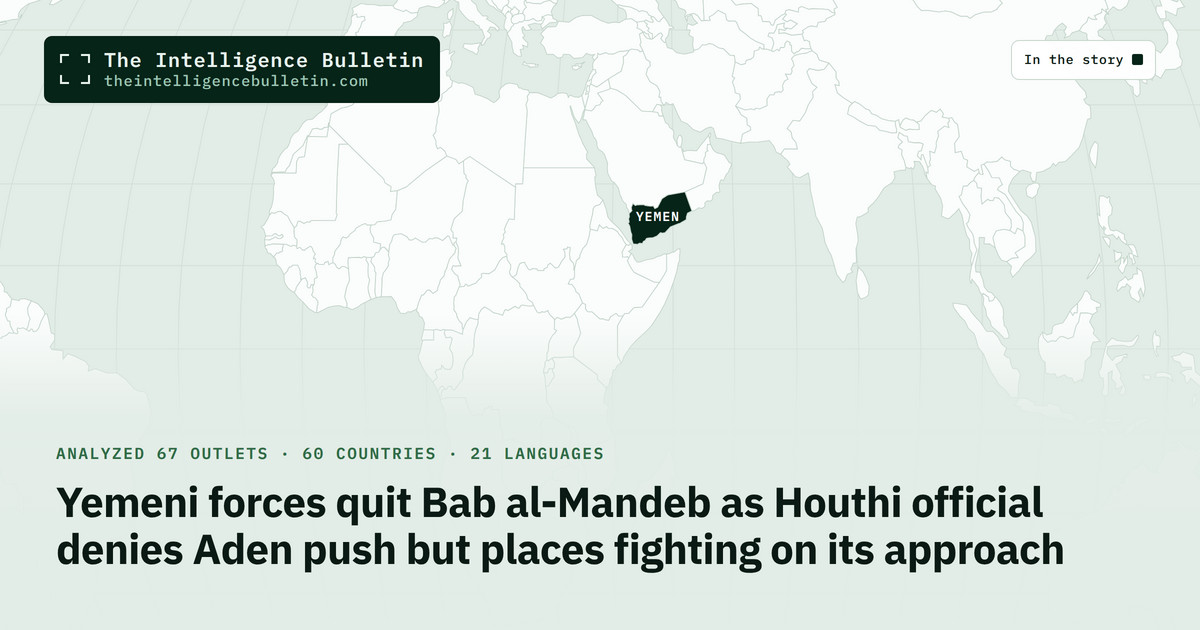
Government-aligned Southern Forces left Dhubab and Bab al-Mandeb on November 15, calling it a repositioning to secure Aden; four military sources cited by AFP say a Houthi push along the Lahj coast forced it. A Houthi-appointed governor denies any move on Aden.
Across the press: Horseed relays Houthi-side reports of an advance on Aden; the Houthis’ own Lahj governor, on Al-Manar, denies it while naming fighting on Aden’s approach.
Source base: 5 outlets read in full (Lebanon, Qatar, Oman, Somalia, United Kingdom), selected from 67 analyzed.
- Denied on the recordHouthi forces are advancing toward Aden.Source: Horseed Media, citing Houthi-side reports; denied by Houthi-appointed Lahj governor Ahmed Jarib, quoted by Al-Manar
- 1 of 5 · Oman Daily onlyA Houthi missile strike in Lahj killed at least eight civilians and wounded 12, with two of three missiles hitting a checkpoint at Aden’s western entrance and one hitting a market near Khor Omaira.AFP copy in Oman Daily, citing three military sources and a government source
- 4 of 5 · reported separatelyOn November 15, government-aligned forces left Dhubab airport and the area around the Bab al-Mandeb strait in western Taiz governorate, about six weeks after retaking it in the ‘Dawn of Yemen’ offensive.The Southern Forces’ own statement, carried by Al Jazeera, Al-Quds Al-Arabi and AFP copy in Oman Daily; Horseed relays the Houthi statement on the same withdrawal
- 3 of 5 · reported separatelyThe pullback was forced by a Houthi push along the Lahj coast that threatened to cut the forces’ supply route from Aden, not by a planned reorganization as the government’s statement says.Four military sources cited by AFP in Oman Daily; analyst Ali al-Dhahab in Al-Quds Al-Arabi; the Houthis via Saba in Al Jazeera and Al-Quds Al-Arabi; the Southern Forces and Information Minister al-Awlaqi describe it as repositioning
- 2 of 5 · reported separatelyHouthi forces are fighting in Lahj’s Madaraba and Ras al-Ara district, the coastal district that leads toward Aden.Al-Quds Al-Arabi, from its own military source, reports battles at Huwairib, the Kharaz mountains and Mafraq al-Sarih; the Houthi-appointed Lahj governor confirms operations in the district via Al-Manar
- Coming daysWhether Houthi forces reach the coastal road at Khor Omaira, which analyst Ali al-Dhahab says carries government supply lines from Aden.
- If the Karish buildup movesResidents told AFP of Houthi mobilization toward Karish in Lahj’s Qabbaytah district; an advance from there would open a second axis toward Aden.
- OngoingFurther Houthi missile and drone launches at Riyadh, the Mecca region and the Eastern Province, which the coalition says it is intercepting, would show the war widening beyond Yemen.
- Still openWho launched the three drones over the Riyadh region and the Eastern Province that the coalition, as Xinhua reports Maliki s statements, did not attribute to the Houthis? · Did anything strike Pumping Station No. 7 or Yanbu on November 12, and was the limited pipeline fire Saudi authorities reported earlier in the week, per BBC News Arabic, at the same station?
Full analysis
What happened Why it matters How each country tells it Where accounts conflict Room for disagreement Our assessment Sources and evidence
What happened
On Sunday, November 15, the Southern Armed Forces announced on X that they had carried out a "repositioning" out of Dhubab airport and the area around the Bab al-Mandeb strait in western Taiz governorate. These are the government-aligned formations commanded by Presidential Leadership Council member Abdulrahman al-Mahrami, known as Abu Zaraa. Their statement called the move a reorganization of deployments. It said the move was driven by the priority of securing Aden, the temporary capital, and neighboring provinces, and by the continuing effort to break the siege of Taiz city. Al-Quds Al-Arabi reports that the pullback also included the Kahbub mountain range. Its military source says the troops fell back toward Khor Omaira, a coastal area in the Madaraba and Ras al-Ara district of Lahj governorate.
The ground had only recently been won. The war reignited in July after the 2022 UN truce collapsed. In September, according to AFP copy carried by Oman Daily, a surprise Houthi offensive took Yemen’s west coast and the strait area. Government forces backed by the Saudi-led coalition launched "Dawn of Yemen" on October 5. Per Al-Quds Al-Arabi, they retook Dhubab, Kahbub and areas near the strait in early October. They held them for about six weeks.
The government and its critics disagree on why the forces left. Information Minister Salem Thabet al-Awlaqi wrote that the move would raise combat efficiency, fortify vital areas and secure supply lines. He added that changes on the battlefield would only make the forces stronger. Government spokesman Col. Majid al-Nuzaili praised the statement and urged the international community to help "liberate" the strait.
Others describe a forced retreat. Four military sources told AFP the move came after a Houthi advance along the Lahj coast and an attempt to besiege the forces. The agency described a Houthi "flanking operation" behind government lines. The Houthi Saba agency, quoted by Al Jazeera and Al-Quds Al-Arabi, said the forces left after being squeezed and losing their positions and rear lines. Yemeni military analyst Ali al-Dhahab told Al-Quds Al-Arabi it was "a withdrawal, not a repositioning." In his account, a Houthi attempt to reach the coastal road at Khor Omaira threatened to cut supply lines from Aden. That would have caught the strait garrison in a pincer, with pressure also coming from Mokha.
The reporting places the front line more precisely than the phrase "advance on Aden." Al-Quds Al-Arabi’s source reports heavy fighting at Huwairib, the Kharaz mountains and Mafraq al-Sarih. All three are in Madaraba and Ras al-Ara, a district bordering Aden that links the west coast to the southern provinces. The Houthis’ own appointee confirms the location. Ahmed Jarib, the Houthi-appointed governor of Lahj, told Al-Manar that operations in that district aim to expel "Saudi mobilizations." No source gives a distance to the city, and none places Houthi ground forces inside Aden governorate.
Houthi fire has reached the city’s edge, however. AFP cites three military sources and one government source for a Houthi missile attack on the Khor Omaira area. It killed at least eight civilians and wounded 12, up from an initial toll of five dead and eight wounded. Two of those military sources said two of three missiles struck a checkpoint at Aden’s western entrance. The third hit a small market near another checkpoint in Khor Omaira. Soldiers were also killed, in numbers the sources did not give.
AFP also reports two other developments. Residents described a Houthi buildup moving toward Karish, on the edge of Lahj’s Qabbaytah district. And the government began fortifying positions on the outskirts of Aden governorate on Friday, November 13.
The war also reached Saudi territory the same Sunday. Coalition spokesman Turki al-Maliki said air defenses destroyed two ballistic missiles fired toward Riyadh, two drones in the Mecca region and three drones over the Eastern Province, Al Jazeera reported.
Why it matters
Bab al-Mandeb connects the Red Sea to the Gulf of Aden. Al-Quds Al-Arabi puts the share of international trade passing through it at 12 to 15 percent. AFP notes that its importance has grown while Iran keeps disrupting the Strait of Hormuz.
TIB reported on November 13 that Saudi Arabia now moves crude around Hormuz through its East-West pipeline to the Red Sea, a pipeline the Houthis claimed to have struck. Government troops no longer contest the strait’s eastern shore. That leaves the Red Sea’s southern exit, the outlet for that rerouted oil, in the hands of a force firing on Saudi cities.
Inside Yemen, the retreat reverses the main gain of "Dawn of Yemen." Al-Dhahab says the government’s other fronts have stayed in "active defense" and that only Bab al-Mandeb saw a real offensive. Losing it leaves the campaign with no front where it is attacking. He traces the failure to "organizational, leadership and logistical" weaknesses. In his view, the government and coalition could have fixed them, but a "political dispute" prevented it. He expects that securing the Fourth Military Region against any Houthi advance toward Aden will take a long time. That region spans Aden, Lahj, Abyan, Dhale and Taiz.
How each country tells it
- Al-Manar · LebanonCarries only the Houthi-appointed Lahj governor, Ahmed Jarib, who says the movement has no intention of moving on Aden or anywhere in the south and that its operations in the Madaraba and Ras al-Ara district aim to drive out ‘Saudi mobilizations.’
- Al Jazeera · Qatar · original reportingA roundup of the day’s statements: the Southern Forces’ ‘repositioning’ from Dhubab airport and Bab al-Mandeb to prioritize Aden, government spokesman Majid al-Nuzaili’s praise and his call for international help to ‘liberate’ the strait, the Houthi claim that the forces were squeezed out, and coalition intercepts of missiles and drones aimed at Riyadh, the Mecca region and the Eastern Province.
- Oman Daily · Oman · wire copyAgency copy reporting that the government completed its withdrawal from the strait area after a Houthi ‘flanking operation,’ citing four military sources who tie the move to a Houthi advance along the Lahj coast and an attempt to encircle the forces.
- Horseed Media · Somalia · carries Houthi movement (Ansar Allah) statementRelays a Houthi statement that government forces fully left Bab al-Mandeb, Dhubab airport and other Red Sea coastal areas, along with Houthi-side reports that their forces are pushing toward Aden while government troops regroup on the city’s outskirts.
- Al-Quds Al-Arabi · United Kingdom · original reportingReported from Sanaa with its own military source and an analyst, it calls the move a setback. It says the pullback included the Kahbub mountain range and went toward Khor Omaira in Lahj’s Ras al-Ara, and analyst Ali al-Dhahab calls it ‘a withdrawal, not a repositioning,’ caused by a Houthi push toward the Khor Omaira coastal road that threatened to cut the supply line from Aden.
Where accounts conflict
The first dispute is whether the Houthis are heading for Aden. Horseed Media, a Somali outlet, relays Houthi-side reports that their forces are pushing toward the city and want to extend their offensive to it. It flags that these claims come from the warring parties and lack independent confirmation. Jarib, speaking on Al-Manar, says the opposite. He says the armed forces have no intention of moving on Aden or anywhere in the south, and he calls talk of targeting southerners "pure fabrications."
Neither account rests on reporting from the battlefield. In this set of sources, the claim of a march on Aden rests on one outlet relaying unnamed Houthi-side reports. No outlet in the set reports from Aden or from Yemen’s south, so the view from the city under threat is missing.
The second dispute is whether the pullback was a choice. The Southern Forces and al-Awlaqi call it a planned reorganization, and that version rests on the government’s own statements. AFP’s four military sources, al-Dhahab and the Houthis’ Saba describe a retreat under threat of encirclement. That version rests on sources from both sides and an independent analyst.
Room for disagreement
The case that Aden itself is in play is stronger than Jarib’s reassurance suggests. The Southern Forces’ own statement names securing Aden as the priority. The government began fortifying the city’s outskirts two days before the withdrawal. Houthi missiles have already hit a checkpoint at the city’s western entrance.
The Houthis’ record also counts against reassurance. They took the west coast in September with a surprise offensive. Al-Dhahab says the government’s weaknesses cannot be fixed even "at the highest level" and that the situation is hard to remedy quickly.
Finally, consider the source of the denial. Jarib spoke on a Hezbollah-run channel, offered amnesty to fighters on the Saudi-backed side who stop fighting, and appealed to southerners to turn against Saudi forces. A force planning an attack would say the same things.
Our assessment
Houthi forces are unlikely to assault Aden city in the coming weeks. The near-term fight is for the Lahj coast and the Khor Omaira road. That fight decides whether the Houthis can hold the strait securely and whether Aden’s western approach stays open.
The call rests on three pieces of evidence. First, independent reporting agrees that the fighting is in Madaraba and Ras al-Ara, not at Aden’s edge. AFP’s sources, Al-Quds Al-Arabi’s own source and the Houthi governor all place it there. Second, al-Dhahab expects no battle beyond the pre-1990 line between north and south Yemen. Third, the only claim of an advance on the city is a relay of reports from one side.
Each party is pushing its own version. The government wants the retreat seen as a choice. The Houthis are telling two stories at once: through Saba, a victory over forces they squeezed out; through Jarib, a promise to southerners that Aden is safe. The missiles at Aden’s western entrance show what that promise leaves out.
What would change this: Houthi forces taking the coastal road at Khor Omaira, or the buildup toward Karish turning into an advance through Qabbaytah.
Sources and evidence
Press quoted
- Do Houthi forces now hold or control by fire the coastal road at Khor Omaira, and where on the Karish and Ras al-Ara axes does the government’s defensive line now sit relative to Aden?
- Did the Southern Forces under al-Mahrami pull back from the strait with the Saudi-led coalition’s agreement, or over a dispute, as analyst Ali al-Dhahab’s reference to a ‘political dispute’ suggests?
- With the Bab al-Mandeb shoreline back under Houthi control while Hormuz remains disrupted, has Riyadh or the coalition said whether it will try to retake the strait, and has shipping been threatened?
That’s how the world told the story.
Get our daily open-source intelligence on world events in your inbox — one email a day, up to six stories.
Subscribe freeNo spam. One-click unsubscribe. See the latest email →