 AI-generated analysis published under the editorial responsibility of Rohit Sinnas. How it works →
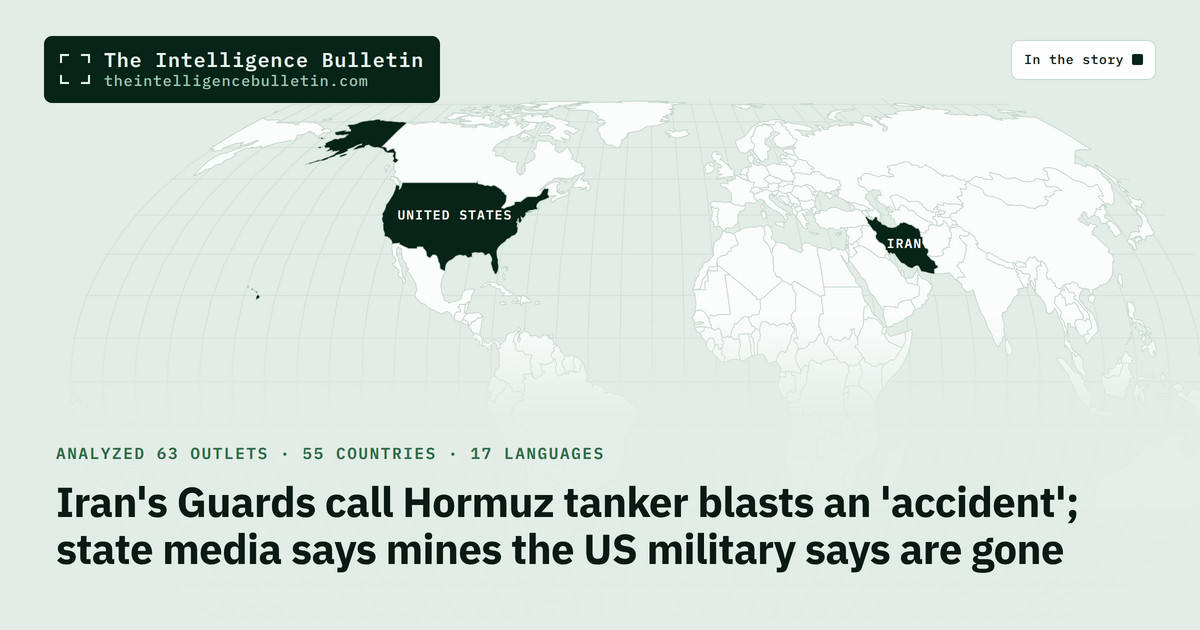
See the 55 countries
Argentina, Armenia, Australia, Austria, Azerbaijan, Bangladesh, Belgium, Brazil, Canada, China, Croatia, Cuba, Cyprus, Czech Republic, Denmark, France, Germany, Greece, Hungary, India, Indonesia, Iran, Ireland, Israel, Jamaica, Japan, Jordan, Kuwait, Lebanon, Libya, Luxembourg, Malaysia, Morocco, Netherlands, Nigeria, Norway, Pakistan, Poland, Qatar, Russia, Saudi Arabia, Senegal, Sierra Leone, Singapore, Slovenia, South Africa, Sweden, Syria, Tunisia, Turkey, Tuvalu, Ukraine, United Arab Emirates, United Kingdom, United States
Iran’s Revolutionary Guards say two supertankers carrying over four million barrels are burning after explosions on a Hormuz route they had banned. The Guards called it an ‘accident’; Iranian state media said mines; the US military says the strait’s mines were cleared.
Across the press: Only Reuters’ dispatch reports Iranian state media blaming mines for these two tankers; AFP’s, reprinted in Indonesia and Greece, cites only the IRGC’s unexplained ‘accident.’
Source base: 5 outlets quoted (Jordan, Indonesia, Pakistan, Greece, Japan), selected from 63 analyzed. 3 read in full, 2 by their headlines only.
- DisputedIranian state media said the tankers exploded after hitting naval mines, while the US military has recently said all mines in the strait were cleared.Source: Mine claim: Iranian state media via Reuters (Ammon News); cleared-mines claim: US military via AFP (CNN Indonesia, Hellenic Shipping News)
- 1 of 5 · Ammon News onlyBritain’s UK Maritime Trade Operations has, in many comparable incidents, said the tankers involved were struck by unidentified projectiles.Reuters, via Ammon News
- 4 of 5 · reported separatelyThe IRGC navy says two tankers were immobilized by explosions overnight while using a southern route through Hormuz that it had declared unauthorized, after ignoring repeated warnings.IRGC statement, carried by Reuters (via Ammon News), AFP (via CNN Indonesia and Hellenic Shipping News) and Dunya News
- 3 of 5 · reported separatelyThe two supertankers were carrying more than four million barrels of oil combined, which the IRGC says are now on fire.IRGC statement, carried by AFP (via CNN Indonesia and Hellenic Shipping News) and Dunya News
- 3 of 5 · reported separatelyThe IRGC blamed the tankers’ reliance on the US military and warned that other ships crossing the southern route with US help would meet the same fate.IRGC statement; the ‘blind trust’ line via AFP (CNN Indonesia, Hellenic Shipping News), the forward warning via Dunya News alone
- When the two vessels are identifiedOwners, flag states or insurers naming the ships would give the first account of the incident that does not come from Iran.
- Still openDid Trump actually pull Vance off the Iran file on Thursday, as only Gooya reports, and if so who now holds the channel to Tehran: Witkoff and Kushner, Rubio, or no one? · Has Rezaei or the Supreme National Security Council answered Vance s October letter, given Araghchi s statement that no meeting is planned and Rezaei s dismissal of imaginary talks ?
- 13 Nov · WSJ: Trump empowered Vance to court Iran s Rezaei; Gooya reports Trump pulled him a day later
- 07 Nov · Trump confirms minor US strikes on Qeshm as a Qatari bridge deal splits AP and Al Jazeera reporting
- 10 Nov · Trump, after Qatar talks, says new Iran strikes quite unlikely — but only Doha hears effectively over
- 09 Nov · Trump meets Qatar s PM; Iran s two-day proposal still on table while Rubio calls demands unacceptable
Full analysis
What happened Why it matters How each country tells it Where accounts conflict Room for disagreement Our assessment Sources and evidence
What happened
Two supertankers were burning in the Strait of Hormuz on Thursday, November 12, according to Iran’s Islamic Revolutionary Guard Corps. Its navy called the cause an "accident" that happened overnight on a shipping lane it had declared off-limits. In a statement quoted by AFP, the IRGC said the two vessels were "acting in violation of regulations and despite repeated warnings" about "the unauthorized and dangerous nature of the southern maritime route." It said they were hit by a "violent explosion" that left them immobilized. The statement put their combined cargo at over four million barrels of oil, "which are now ablaze," and called the loss "a consequence of the blind trust placed in the aggressive American military."
The statement did not say what exploded. A second Iranian account later that day did. Reuters, in a dispatch carried in Arabic by Jordan’s Ammon News, reported that Iranian state media said the tankers "exploded after hitting naval mines" and broadcast what it described as video of both incidents. Pakistan’s Dunya News, writing under a Tehran dateline with no wire credit, carried one more line from the Guards that does not appear in the AFP or Reuters text we read. According to Dunya, the IRGC warned that other vessels attempting the southern route with US assistance would face the same fate.
Everything specific about these two ships comes from Iran. None of the reports we could read names them, gives their flags, owners, destinations or crews, or says whether anyone was hurt. No shipowner appears in the readable reporting, and neither does any statement on this incident from Britain’s UK Maritime Trade Operations or from the US military. Japan Today ran the story under a headline saying Iran reported four tankers struck by explosions. Its text could not be retrieved, so it cannot be determined here whether Iran later raised its count or the headline differs from the article beneath it.
The route matters because of how the strait has been run since war between the United States and Iran broke out in late February, as AFP describes it. Tehran has restricted traffic and insisted that ships use routes it approves. Washington answered with a naval blockade of Iranian ports and by helping tankers through the strait. That help is the support the IRGC now says these two ships relied on. AFP adds that Iranian forces have announced several ships catching fire on routes Tehran considers forbidden in recent weeks.
The fires come in a diplomatic week TIB has followed. TIB reported on November 7 that President Trump confirmed US strikes on an Iranian air-defense system on Qeshm Island, inside the strait, while Qatari mediators pressed a two-day bridge deal that would lift the blockade. On November 10, after meeting Qatar’s prime minister, Trump called renewed US military action "quite unlikely." On November 13, TIB reported The Wall Street Journal’s account that Vice President JD Vance was weighing a meeting with Mohsen Rezaei, secretary of Iran’s Supreme National Security Council. Dunya placed the tanker fires beside Rezaei’s latest position, which it reported as a refusal to let any of Iran’s enriched uranium leave the country.
Why it matters
AFP’s copy notes that the strait normally carries about one-fifth of the world’s oil. The IRGC statement turns a shipping incident into a verdict on American protection. By blaming the fires on reliance on the US military and promising a repeat, the Guards are speaking past Washington to the shipowners and insurers who decide whether to use the southern route at all. If those owners conclude that US assistance makes a ship a target, the southern lane empties without another explosion. Traffic would then shift onto the routes Tehran approves, and Iran would win control of the strait by announcement.
The cause carries its own stakes. A mine is a passive hazard that Tehran can describe as the fault of ships that ignored warnings. An unexplained projectile would be an active attack, and much harder to square with the de-escalation Trump has been signaling. The fires also raise the cost of the blockade-and-escort policy just as Qatar’s bridge deal offers Washington a way out of it. The editor flagged a possible Israeli strike on Iran as the backdrop to this incident, but the reporting we could read makes no connection to Israel. It frames the fires entirely within the confrontation between the United States and Iran.
How each country tells it
- Ammon News · Jordan · wire copyCarries the Reuters account: the IRGC navy said two supertankers were disabled by huge explosions after ignoring warnings against an ‘unauthorized route,’ and Iranian state media later said they hit naval mines and aired video.
- CNN Indonesia · Indonesia · carries AFPRenders the AFP dispatch in Indonesian: the IRGC statement calling the fires an ‘accident’ on a prohibited southern route, four million barrels ablaze, and blame on ‘blind trust’ in the US military.
- Dunya News · Pakistan · original reportingReports the IRGC claim under an ‘Iran claims’ headline and adds the IRGC’s warning that other vessels crossing the southern route with US assistance ‘would face the same fate.’
- Hellenic Shipping News · Greece · wire copyReprints the AFP dispatch via Al Arabiya English: the IRGC statement, four million barrels ablaze, and the context that Hormuz normally carries about a fifth of global oil.
- Japan Today · Japan · wire copyOnly the headline could be read; it says Iran reports four tankers struck by explosions in the Strait of Hormuz.
Where accounts conflict
The central dispute is over mines. Iranian state media, as reported by Reuters, says the tankers hit naval mines. AFP reports that the US military recently said all mines in the strait had been cleared. Both cannot be fully right: if the clearance claim holds, the mine explanation fails, and if the ships did hit mines, the clearance claim is wrong. Neither side’s evidence is described in the reporting. State media aired video it said showed the incidents, but no outlet says what that video shows. The US claim is a general one about the strait, not a finding about these two ships.
Iran’s own accounts also do not match. The Guards’ statement called the event an accident and named no cause, while state media named one. A third account sits behind both. Reuters notes that UKMTO has, in many comparable incidents, said the tankers involved were struck by unidentified projectiles. That is Reuters’ summary of UKMTO’s past record, not a UKMTO statement about this incident. The number of ships is also unsettled: AFP, Reuters and Dunya all say two, against Japan Today’s unread headline saying four.
Room for disagreement
The strongest case against expecting more incidents is that the threat may work too well to need repeating. If the warning carried by Dunya persuades owners to stop sailing the southern route, there will be no further ships to burn. Diplomacy also points the other way. Trump called new strikes "quite unlikely" after his Qatari meeting, the bridge deal to lift the blockade remains on the table, and Dunya’s page links to a report on hopes for de-escalation. A deal that ends the blockade would remove the US-assisted transits the Guards are targeting. There is also a case that this incident is smaller than claimed. With no named vessels and no outside confirmation, the four million barrels and the fires rest on the word of a party that wants the route to look deadly.
Our assessment
Further incidents involving tankers on the southern route are likely in the coming weeks unless the Qatari track ends the blockade. The warrant is a pattern plus an on-record threat. AFP reports repeated Iranian announcements of burning ships on forbidden routes in recent weeks, and the Guards have publicly promised the same fate to ships that cross with US help. The US policy of assisting transits, as AFP describes it, has not changed. Both governments have an interest in how the cause is read. The Guards’ "accident" and state media’s mines both cast Iran as enforcing a warning rather than attacking. The US clearance claim protects the credibility of the escorts Washington offers. That Tehran gave two explanations in one day suggests the cause will stay contested while the deterrent message stays fixed.
What would change this: an agreement through Qatar that lifts the blockade, or a halt to US-assisted transits of the southern route, would remove the target the Guards have named.
Sources and evidence
Press quoted
- Which tankers were hit, under what flags and owners, and were they moving under US escort or assistance as the IRGC implies?
- What actually struck them: mines, as Iranian state media says despite the US claim the strait was cleared, or projectiles, as UKMTO has described in earlier cases?
- Did the toll rise to four tankers, as Japan Today’s headline says, or is that a discrepancy in a text no one could read?
That’s how the world told the story.
Get our daily open-source intelligence on world events in your inbox — one email a day, up to six stories.
Subscribe freeNo spam. One-click unsubscribe. See the latest email →