 AI-generated analysis published under the editorial responsibility of Rohit Sinnas. How it works →
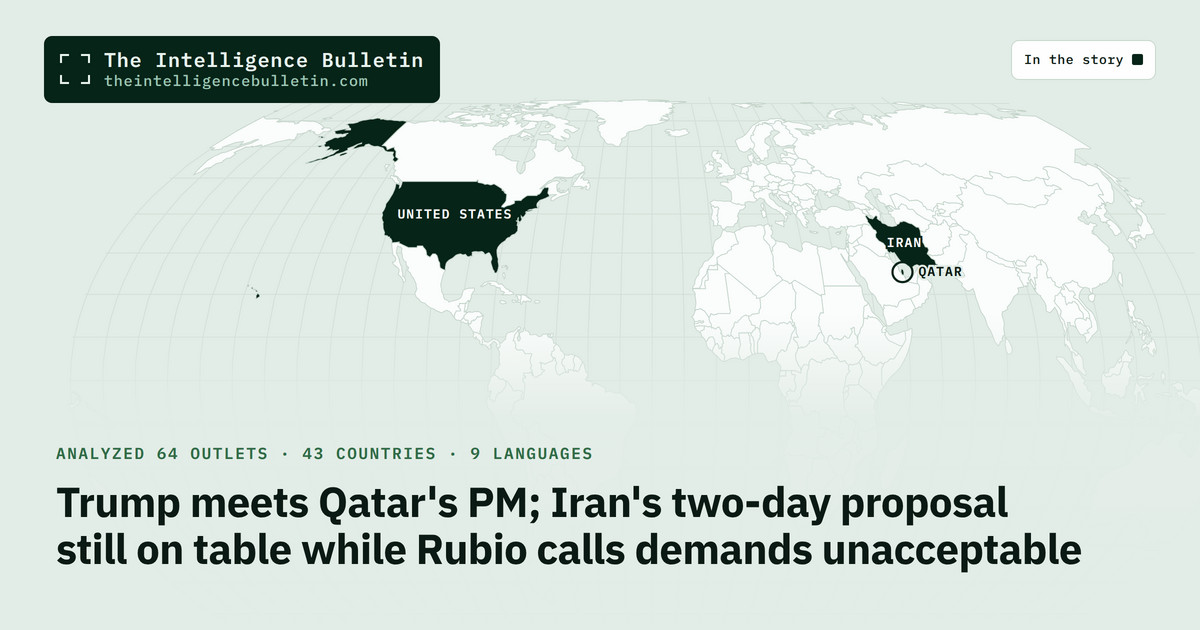
See the 43 countries
Afghanistan, Australia, Azerbaijan, Belgium, Canada, China, Croatia, Cuba, Cyprus, Denmark, Egypt, France, Germany, Greece, Hungary, India, Indonesia, Iran, Iraq, Ireland, Israel, Italy, Japan, Jordan, Kenya, Lebanon, Luxembourg, New Zealand, Pakistan, Poland, Qatar, Singapore, Somalia, South Africa, South Korea, Spain, Switzerland, Syria, Turkey, United Arab Emirates, United Kingdom, United States, Uzbekistan
President Trump is meeting Qatar’s prime minister on Monday as diplomacy over Iran stalls: Rubio says talks made little progress and calls Tehran’s demands unacceptable, while Iran says its two-day proposal stands and Trump says new strikes are highly unlikely if a strong deal emerges.
Across the press: Only International Business Times, citing Israel Hayom, prints the proposal’s terms; Al Jazeera Arabic and Al-Manar keep it “on the table”.
Source base: 5 outlets read in full (Qatar, United States, Israel, Lebanon), selected from 64 analyzed.
- 1 of 5 · International Business Times onlyAccording to Israel Hayom, relayed only by International Business Times, the Iran-approved proposal Al Thani would present would lift the U.S. naval and economic blockade in exchange for Iran reopening the Strait of Hormuz without controlling it or charging tolls, and would unfreeze $8 billion of Iranian funds held in Qatar.International Business Times citing Israeli outlet Israel Hayom.
- 4 of 5 · reported separatelyPresident Donald Trump is scheduled to meet Qatari Prime Minister and Foreign Minister Sheikh Mohammed bin Abdulrahman Al Thani in a closed-door White House meeting on Monday, with Vice-President JD Vance holding a separate meeting.Al Jazeera Arabic, International Business Times, The Jerusalem Post carrying Reuters, and Al-Manar all report the meeting from the White House schedule or a U.S. official.
- 4 of 5 · reported separatelySecretary of State Marco Rubio said on Sunday that Iran talks had made only limited progress and he saw no imminent breakthrough, describing Iranian demands as unacceptable and sometimes outrageous, ridiculous and unrealistic.Reported by Al Jazeera Arabic, International Business Times, The Jerusalem Post carrying Reuters, and Al-Manar from Rubio’s Florida remarks before the G7 foreign ministers meeting.
- 3 of 5 · reported separatelyTrump said Sunday that renewed strikes on Iran are highly unlikely if negotiations make progress and produce a strong agreement, while warning the U.S. has identified additional infrastructure targets, including bridges, should strikes resume.Al Jazeera Arabic, International Business Times citing Trump’s CNN interview, and The Jerusalem Post carrying Reuters report the remarks; Al-Manar separately reports Trump saying he sees no reason to renew escalation and claiming the U.S. already won.
- 2 of 5 · reported separatelyIranian officials maintain that the two-day proposal remains on the table and is the most logical roadmap, with Foreign Minister Abbas Araghchi saying ‘our 2-day proposal stands.’International Business Times reports Araghchi’s post on X; Al-Manar reports Foreign Ministry spokesman Esmail Baghaei saying the plan is still on the table.
- AnsweredThe 48-hour framing now appears as a two-day proposal: International Business Times, relaying Israel Hayom, reports it would lift the U.S. naval and economic blockade in exchange for Iran reopening the Strait of Hormuz without charging tolls, and would unfreeze $8 billion of Iranian funds held in Qatar.
- Still openWhat exactly did Friday s strikes hit on Qeshm, and can CENTCOM s relatively calm account be reconciled with the two explosions and Iran s claim to have brought down a US MQ-9, given that no independent reporting establishes the target or the exchange? · Did Qatar actually present the detailed two-day bridge deal the anonymous officials describe to AP, given that Al Jazeera — the mediator s own outlet — reports only that mediation continues and denies it failed, without the specifics?
- 07 Nov · Trump confirms minor US strikes on Qeshm as a Qatari bridge deal splits AP and Al Jazeera reporting
- 03 Nov · Trump says Iran deal could happen as strikes continue; the 48-hour Hormuz offer rests on one Indian headline
- 06 Nov · Putin offered to help end the war, Rezaei says; only The National reports Iran s nuclear proposal via Qatar
Full analysis
What happened Why it matters How each country tells it Room for disagreement Our assessment Sources and evidence
What happened
President Donald Trump is set to meet Qatari Prime Minister and Foreign Minister Sheikh Mohammed bin Abdulrahman Al Thani at the White House on Monday, November 9, in a closed-door session at noon Washington time, according to the White House schedule carried by Al Jazeera Arabic, The Jerusalem Post’s Reuters dispatch, International Business Times and Al-Manar. A US official added that Vice-President JD Vance would hold a separate meeting with the Qatari premier. The visit is Qatar’s latest attempt to keep the eight-month US-Iran conflict on a diplomatic track: Al Jazeera Arabic, citing Axios, says the Qatari foreign minister wants to persuade Trump to give diplomacy more time, and that Vance has participated directly in indirect talks with Tehran over the past two weeks, holding near-daily calls with Al Thani.
Secretary of State Marco Rubio, speaking Sunday in Florida before departing for the G7 foreign ministers’ meeting in Paris, said negotiations had made only limited progress and saw no imminent breakthrough. Rubio said Trump preferred a diplomatic solution, but called Iran’s demands unacceptable and, in some cases, “outrageous and ridiculous, and really not realistic.” The same remarks are reported by Al Jazeera Arabic, International Business Times, The Jerusalem Post carrying Reuters, and Al-Manar.
Trump said in a CNN interview on Sunday that renewed attacks on Iran are “highly unlikely” if the negotiations make progress and produce “a very strong agreement.” International Business Times reports he added that the US has three aircraft carriers in the region “fully locked and loaded” and has 38 bridges in its sights that could be knocked down “in literally one hour.” Al-Manar separately reported that Trump told CBS in his first major interview since his party lost its House majority that he sees no reason to renew escalation now, claims the US already won and prevented Iran from acquiring a nuclear weapon, and would take the same decision to attack again without hesitation.
On the Iranian side, Foreign Minister Abbas Araghchi wrote on X on Sunday, as cited by International Business Times, “Our 2-day proposal stands: meet the requirements, including end to war on all fronts, and you will see results. Or choose war, and see our alert and battle-hardened Warriors rain down hell.” Foreign Ministry spokesman Esmail Baghaei, quoted by Al-Manar, said the two-day plan remains “the most logical, practical and organized roadmap” and that restoring security in global energy arteries requires real political will from the other side. He also said all naval vessels and passing ships must coordinate with Iranian authorities for their security.
Among the accounts gathered here, only International Business Times prints the alleged contents of that proposal, and it does so by relaying the Israeli outlet Israel Hayom: the US naval and economic blockade would be lifted in exchange for Iran reopening the Strait of Hormuz without controlling it or charging tolls, and $8 billion in Iranian funds held in Qatar would be unfrozen. Qatar’s own Al Jazeera Arabic and the Iran-aligned Al-Manar do not describe those terms; both keep the proposal at the level of “still on the table.”
The only source in this set carrying an explanation attributed to Tehran’s foreign minister for the stalling is the US-based Persian-language diaspora portal Gooya News, which carried an Asriran report in which Araghchi told the state broadcaster IRIB that the US midterm results “shocked” mediator traffic and froze movement for days. “We need to be patient a little,” he said, adding that time is needed for the atmosphere to calm and for mediators’ shuttling to become possible again.
Al-Manar also reported that Chinese special envoy Zhai Jun met Iran’s Ali Bagheri and said the widening Middle East conflict cannot be solved by force, and that UAE diplomatic adviser Anwar Gargash warned of a possible long period of ambiguity. It further relayed the Israeli daily Ma’ariv’s report that Israel’s security establishment fears Iran could, in the roughly 50 days before the new US Congress is seated, defeat the option of a US military decision, leaving Israel alone.
Why it matters
Monday’s closed-door meeting is the point where several pressures converge. The two-day proposal, if its single-sourced terms are accurate, would be a concrete de-escalation trade: lift the US blockade, unfreeze $8 billion in Qatari-held funds, and Iran reopens Hormuz without tolls or control. That would address the oil-shipping chokepoint at the center of the crisis. But Rubio’s on-record dismissal of Iranian demands as “unacceptable” and sometimes “outrageous and ridiculous, and really not realistic” shows the US administration is not close to accepting those terms. Trump’s own condition — attacks are highly unlikely only “if” negotiations make progress and produce a strong agreement — leaves the military option alive, with 38 bridges named as infrastructure targets. For Qatar, the meeting is a credibility test after weeks of near-daily Vance conversations; for Iran, it is a chance to convert the post-midterm shock in Washington into a ceasefire on its terms; for the United States, it is an attempt to decide whether a president who has just lost his House majority wants to end the war or widen it.
How each country tells it
- Al Jazeera Arabic · Qatar · original reportingThe mediator’s own Arabic newsroom leads with the White House meeting as Qatari mediation in motion, pairing Trump with Vice-President Vance and emphasizing Qatari efforts to buy diplomacy more time.
- Gooya News · United States · carries AsriranThe only source in this set carrying Tehran’s own explanation for the stall: that the U.S. midterm results shocked the mediators’ shuttle and froze movement for days.
- International Business Times · United States · original reportingThe host-country sceptical read: it leads on the gap between Trump’s ‘highly unlikely’ line on renewed strikes and Rubio’s public doubt that an agreement with Iran is reachable.
- The Jerusalem Post · Israel · wire copyUnder an Israeli masthead, the Reuters dispatch leads on negotiations stalling and keeps the Israeli question of whether the Iran campaign is over in the foreground.
- Al-Manar · Lebanon · original reportingThe Iran-aligned Lebanese channel pairs Tehran’s foreign ministry spokesman insisting the two-day proposal is still on the table with the Qatari premier’s White House visit, reading the hold-up as sitting in Washington.
Room for disagreement
The strongest case against reading the meeting as mere time-buying is that the proposal’s terms, as relayed by Israel Hayom via International Business Times, give both sides something they can present as victory. Iran would reopen Hormuz without controlling the waterway or charging tolls, while Washington would lift its naval and economic blockade and release $8 billion held in Qatar. Trump himself said Sunday that renewed strikes are “highly unlikely” if there is a strong agreement, and Al-Manar reports he told CBS he sees no reason to renew escalation now. The only obstacle named by Iran’s foreign minister in the Gooya News account is the US election shock, not the terms; once Washington digests the midterms, mediators can move again. On this view, the closed-door meeting could be the moment Qatar’s shuttle diplomacy converts two weeks of near-daily Vance contacts into a framework acceptable to both sides, with a public announcement soon after — provided the Israel Hayom terms are accurate.
Our assessment
The Monday meeting is very likely to end without a breakthrough, serving to buy Qatar’s mediation more time rather than close the gap Rubio described. That judgment rests on what several independent reporting chains agree on: Rubio’s Sunday statement of limited progress and “unacceptable” Iranian demands appears in Al Jazeera Arabic, International Business Times, The Jerusalem Post carrying Reuters and Al-Manar, and no source reports Washington accepting the two-day proposal’s terms. The proposal itself remains attributed to a single chain — Israel Hayom through International Business Times — while the mediator’s own outlet frames the day as seeking more time, not announcing a deal. Al Jazeera Arabic has an interest in presenting Qatar’s mediation as constructive, but even it does not claim the proposal’s terms are agreed; Al-Manar has an interest in keeping the Iranian plan alive, but its account stops at “still on the table.” Trump’s conditional language and Rubio’s dismissal both point the same way.
What would change this: a joint or Qatari-brokered statement after the closed-door meeting in which Washington accepts lifting the blockade in principle, or Rubio publicly softens his characterization of the Iranian demands.
Sources and evidence
Press quoted
- What exactly are the terms of Iran’s two-day proposal — the blockade-for-Hormuz exchange detailed only by International Business Times via Israel Hayom, or something else — and has Qatar actually presented it, given Al Jazeera Arabic and Al-Manar do not spell out the contents?
- Is the mediation shuttle actually stalled, paused or merely slowed? Rubio says little progress and no imminent breakthrough, while Al Jazeera Arabic via Axios reports near-daily Vance contacts with the Qatari PM, and Gooya News relays Araghchi’s claim that the U.S. midterms stopped the shuttle for days.
- Does Trump’s ‘highly unlikely’ comment signal a durable shift toward diplomacy or only a pause conditioned on an agreement, and what happens to the identified bridge targets if talks fail?
That’s how the world told the story.
Get our daily open-source intelligence on world events in your inbox — one email a day, up to six stories.
Subscribe freeNo spam. One-click unsubscribe. See the latest email →