 AI-generated analysis published under the editorial responsibility of Rohit Sinnas. How it works →
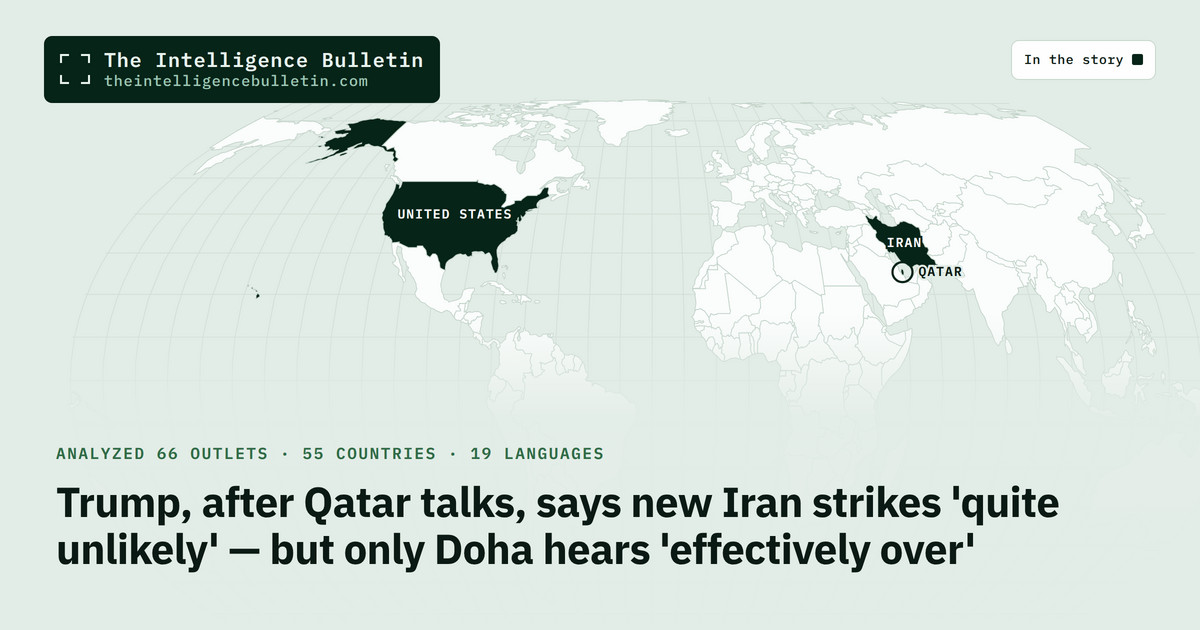
See the 55 countries
Armenia, Australia, Austria, Azerbaijan, Bangladesh, Belgium, Bosnia and Herzegovina, Brazil, Bulgaria, Canada, China, Colombia, Croatia, Cuba, Denmark, Egypt, France, Germany, Guatemala, Guyana, Hungary, India, Indonesia, Iran, Ireland, Israel, Italy, Jamaica, Lebanon, Luxembourg, Malaysia, Mexico, Netherlands, Nigeria, Norway, Philippines, Poland, Qatar, Romania, Senegal, Serbia, Singapore, Slovakia, Spain, Sweden, Switzerland, Syria, Turkey, Tuvalu, Ukraine, United Arab Emirates, United Kingdom, United States, Uzbekistan, Vietnam
Trump met Qatar’s PM Monday and called renewed Iran strikes ‘quite unlikely’ while staying ‘locked and loaded’; one Qatari outlet reported him declaring the war ‘effectively over.’ Rubio saw no breakthrough, and oil slid on an unconfirmed Israeli report.
Across the press: Qatar Tribune publishes Trump’s ‘militarily effectively over’ line; The National, Fox News and Világgazdaság report only hedged versions like ‘quite unlikely’ and ‘good chance.’
Source base: 5 outlets read in full (United States, Qatar, United Arab Emirates, Hungary), selected from 66 analyzed.
- 1 of 5 · Világgazdaság onlyBrent crude fell more than 3 percent Monday to near $95, extending last week’s historic slide, after Israel Hayom’s unconfirmed report that Iran had dropped its demand to control the Strait of Hormuz and collect transit fees.Világgazdaság, citing Bloomberg for the price action and Israel Hayom for the Iranian claim, says the concession report is unconfirmed and Bloomberg could not verify it.
- 5 of 5 · reported separatelyPresident Donald Trump met Qatari Prime Minister Sheikh Mohammed bin Abdulrahman Al Thani at the White House on Monday for Iran-focused talks, reported as closed-door and lasting around 45 minutes.All five outlets report the meeting; Gooya News gives the 45-minute, no-reporters detail and The National says it was held behind closed doors.
- 4 of 5 · reported separatelyAfter the meeting, Trump said renewed US military action against Iran was ‘quite unlikely’ for now while the US remained ‘locked and loaded’ if the situation changed.Qatar Tribune and The National quote Trump’s Truth Social post directly; Világgazdaság reports the same signal via Bloomberg, and Fox News reports he saw no reason to intensify the war.
- 2 of 5 · reported separatelyTrump claimed Qatar, Saudi Arabia, the UAE, Bahrain, Kuwait and others would prefer the status quo — continuation of the US naval blockade and Operation Iron Gate — and that Iran obtaining a nuclear weapon is non-negotiable.Qatar Tribune carries the full Truth Social quote; The National paraphrases the same points.
- 3 of 5 · reported separatelySecretary of State Marco Rubio said the Iran talks had made little progress and were not close to a breakthrough, describing Tehran’s demands as unrealistic.Fox News and Gooya News report Rubio’s Sunday remarks; Világgazdaság notes his cautious stance on the talks’ prospects.
- Tuesday, November 10The US Energy Information Administration releases its oil market report, which could show whether the price slide is sustained.
- Wednesday, November 11OPEC publishes its monthly oil market report, its first since the price drop and the unconfirmed Israel Hayom claim.
- Friday, November 13The International Energy Agency releases its report, offering a third independent read on whether the slide reflects fundamentals or sentiment.
- In the coming daysAny confirmation or denial of Israel Hayom’s claim that Iran dropped its Hormuz control and transit fee demands would move the market sharply.
- 09 Nov · Trump meets Qatar s PM; Iran s two-day proposal still on table while Rubio calls demands unacceptable
- 07 Nov · Trump confirms minor US strikes on Qeshm as a Qatari bridge deal splits AP and Al Jazeera reporting
- 03 Nov · Trump says Iran deal could happen as strikes continue; the 48-hour Hormuz offer rests on one Indian headline
Full analysis
What happened Why it matters How each country tells it Where accounts conflict Room for disagreement Our assessment Sources and evidence
What happened
President Donald Trump met Qatari Prime Minister Sheikh Mohammed bin Abdulrahman Al Thani at the White House on Monday for talks focused on Iran. The meeting lasted about 45 minutes, was held behind closed doors, and no reporters were present, according to Gooya News, a Persian-language diaspora outlet published outside Iran. The same report says no agreement or concrete result had been announced by the time the reviewed reports were published. Before meeting Trump, Sheikh Mohammed met separately with Vice President JD Vance, who has personally participated in indirect talks with Tehran over the past two weeks and has been in nearly daily contact with the Qatari prime minister.
After the meeting, Sheikh Mohammed posted on X that the discussions were positive. "We discussed the situation in the region and ways to progress the US-Iran talks," he wrote, according to Qatar Tribune. "Grateful for the positive discussions on reaching a deal and bringing peace to the region."
Trump’s own account came in a Truth Social post that Qatar Tribune and The National both quote directly. He described "an excellent conversation" with Sheikh Mohammed and said that "Qatar, Saudi Arabia, UAE, Bahrain, Kuwait, and others, would prefer the status quo, in other words, a continuation of the Greatest Naval Blockade in History, and the new Operation Iron Gate." He added: "All have agreed that Iran cannot have a Nuclear Weapon — That is non-negotiable! Should there be any change with respect to developments in the Middle East, the United States of America is ‘locked and loaded’ and ready to go. At this point, however, that seems to be quite unlikely."
That hedge is the key phrase, and it is the one most outlets carried. The National led with Trump calling renewed military action "quite unlikely" while keeping the "locked and loaded" warning. Fox News reported that Trump said in a CBS "60 Minutes" interview on Sunday that he saw no reason to intensify the war with Iran while maintaining that the Strait of Hormuz was open. Világgazdaság, citing Bloomberg, reported Trump called comprehensive strikes "extremely unlikely" but made clear the condition was that Tehran reaches a very strong agreement with Washington.
Only Qatar Tribune carried the stronger formulation. Its account says Trump told reporters he believes the war with Iran is militarily "effectively over" and that taking military action against Iran "doesn’t seem to be a very necessary thing." The National, which also read Trump’s Truth Social post, does not include those phrases. In a later appearance in the White House briefing room on Monday, The National reports, Trump said there was "a good chance" the conflict with Iran could end: "We’ll see what happens. I don’t guarantee anything, but if we do have to go back in, we are locked and loaded and ready to go."
Against Trump’s optimism sits Marco Rubio. Speaking to reporters Sunday before leaving for a G7 foreign ministers meeting in Paris, the secretary of state said there had been little progress in negotiations and rejected the terms Tehran put forward. "I wouldn’t say we’re on the verge of a breakthrough," Rubio said, as reported by Fox News. He described Iran’s demands as unrealistic, according to Gooya News. Fox noted that Trump prefers a diplomatic settlement, and the same report records Iranian President Masoud Pezeshkian saying Monday that Tehran was prepared to negotiate an end to what he described as a prolonged state of neither war nor peace. Pezeshkian said, "We can negotiate with dignity and resolve the issue with dignity," but insisted Iran would not surrender to coercion.
The mediators’ proposal, as described by Axios on November 9 and reported by Fox News, is a two-day bridge deal: the United States would lift its naval blockade and release some frozen Iranian funds; Tehran would take steps toward renewed nuclear inspections and reopen the Strait of Hormuz before broader negotiations resumed. The proposal has not been accepted by Washington, and significant differences remain.
The oil market moved Monday on a different trigger. Brent crude fell more than 3 percent to near $95 a barrel, extending last week’s historic slide, which Világgazdaság, citing Bloomberg, describes as the largest weekly fall since April 2020. The fresh drop came after Israel Hayom reported that Iran had dropped its demand to control the Strait of Hormuz and collect transit fees from passing ships. The Hungarian outlet is clear that the information has not been independently confirmed, and Bloomberg could not verify it. The report adds that OPEC production in October reached 88 percent of prewar levels, while Iranian output fell under the US naval blockade.
Fox News, meanwhile, covered the meeting as a Washington political story, leading with Rubio’s warning and pairing Trump’s de-escalation language with the continuing possibility of strikes. Its energy reporting from the ADIPEC conference in Abu Dhabi includes a direct challenge to Trump’s claim that the strait is open. Amos Hochstein, a former senior adviser to Joe Biden, told Fox that "there has been a hot conflict in the Strait of Hormuz on almost a nightly basis. Tankers are getting fired on, tankers are getting hit." His assessment contrasts with CENTCOM, which said in late October that more than 3,000 commercial vessels had transited the strait with American military support over the preceding six months. The UAE energy minister told Fox that his country’s oil exports had risen from about 3.1 to 3.2 million barrels a day before the war to almost 4.4 million now, in part through the Fujairah pipeline that bypasses the strait.
Why it matters
The meeting’s outcome bears directly on what happens to global fuel prices. The Strait of Hormuz carried roughly one-fifth of global petroleum liquids consumption and more than one-fifth of global liquefied natural gas trade before the war began in February, according to the US Energy Information Administration, cited by Fox News. Since then, Iranian attacks, shipping restrictions and US military operations have severely disrupted commercial traffic. Brent crude, even after Monday’s fall, remains more than 50 percent higher than at the start of the year, according to Világgazdaság. The unconfirmed Israel Hayom claim that Iran dropped its Hormuz demands is the kind of development that, if confirmed, would change the entire market picture.
For the United States, the meeting lands after the Republican Party’s bruising defeat in the midterm elections, with voters naming the economy as a major concern. The National reports Trump called the results "ridiculous." Világgazdaság notes that investors read the Democratic gains as a sign Washington may become more interested in ending the conflict. Fox News frames the story around Rubio’s warning that talks are not close, foregrounding dissent inside the administration and interviewing market figures who dispute the idea that Hormuz has reopened.
For Qatar, the meeting is a validation of its mediation role. Qatar Tribune leads with the prime minister’s own statement calling the talks positive, and the paper is the only outlet in the set that carries Trump’s full claim that the war is "effectively over." For the Gulf states named by Trump — Saudi Arabia, the UAE, Bahrain, Kuwait — the operative question is what "quite unlikely" means for security and exports. The National, an Abu Dhabi daily, treats the story as a regional security matter, keeping Trump’s "locked and loaded" warning alongside his hedge.
How each country tells it
- Fox News · United States · original reportingFrames the White House meeting as a Washington political story, leading with Marco Rubio’s warning that talks are not close to a breakthrough and pairing Trump’s de-escalation language with the continuing possibility of strikes.
- Qatar Tribune · Qatar · original reportingReports the meeting through the Qatari prime minister’s own statement, which called the talks with Trump and Vance ‘positive’ and framed Qatar as the mediator advancing peace.
- Gooya News · United StatesFrames the event from a Persian-speaking diaspora vantage as ’45 minutes behind closed doors’, stressing that no agreement or concrete result had been announced by the time the reviewed reports were published.
- The National · United Arab Emirates · original reportingTreats the meeting as a Gulf security story, foregrounding Trump’s ‘quite unlikely’ hedge on renewed military action while keeping his ‘locked and loaded’ warning and the named Gulf states’ preference for the blockade.
- Világgazdaság · Hungary · carries BloombergReads Trump’s remark as a market event: Brent crude slid more than 3 percent to near $95, extending a historic weekly fall, with the Middle East now the decisive variable for prices.
Where accounts conflict
The central dispute is whether Trump declared the war effectively over or merely said new strikes are unlikely. Qatar Tribune has him telling reporters the conflict is militarily "effectively over" and that military action "doesn’t seem to be a very necessary thing." The National, quoting the same Truth Social post, has him writing "that seems to be quite unlikely" and later saying "a good chance" the conflict ends. Fox News has him saying he sees no reason to intensify. Világgazdaság, via Bloomberg, has him calling comprehensive strikes "extremely unlikely" but conditioned on a strong deal. These are not the same claim, and the distinction matters to anyone pricing risk.
A second conflict runs through the oil market story. The price slide on Monday was driven by the Israel Hayom report that Iran dropped its Hormuz demands — but Világgazdaság is the only outlet in the set that reports it, and it is careful to say the claim is unconfirmed and that Bloomberg could not verify it. The political accounts do not mention it. Trump’s repeated claim that the strait is open is directly challenged by Hochstein in Fox News, who argues that needing a heavy US military presence to escort tankers is "the definition of not open." The Qatari prime minister’s "positive" framing also sits uneasily with Rubio’s Sunday assessment of little progress, and Gooya News notes the meeting ended with no concrete result announced.
Room for disagreement
The strongest case that this war is not ending soon rests on the record itself. Rubio, the secretary of state, said Sunday the talks are not close to a breakthrough and called Iranian demands unrealistic. Pezeshkian, the Iranian president, said Iran will negotiate "with dignity" but insisted it "would not surrender to coercion." The two-day bridge proposal, as described by Axios and reported by Fox News, has not been accepted by Washington, and significant differences remain. Iran’s state media, as reported by Világgazdaság, claimed the US again struck Qeshm Island overnight, meaning military action continues even as diplomacy advances. The oil price slide is built in part on an unconfirmed Israeli newspaper report that no independent source has verified. "There has been a hot conflict in the Strait of Hormuz on almost a nightly basis," Hochstein told Fox News, a description that sits awkwardly with any declaration that the war is over.
Our assessment
Roughly even chance that the Iran conflict ends in a negotiated settlement within the next few weeks. The evidence cuts both ways. Trump’s hedged language — "quite unlikely," "a good chance," "extremely unlikely" but conditioned on a strong deal — appears in four independent accounts and is the settled spine of the day’s reporting. The Qatari prime minister called the talks positive, and Trump wrote of "positive momentum toward an end to this Conflict." But the actual declaration that the war is "effectively over" is a single Qatari chain, and the strongest counterweights are on the record: Rubio’s "I wouldn’t say we’re on the verge of a breakthrough," Pezeshkian’s refusal to surrender to coercion, the unconfirmed nature of the Israel Hayom claim driving the oil slide, and the fact that no agreement was announced. The market’s price action reflects investors betting on diplomacy, but as Világgazdaság quotes Helge Andre Martinsen of DNB Carnegie saying, the oil market is in a calm before the storm in which either a diplomatic breakthrough or renewed military clashes will determine prices.
What would change this: a confirmed Iranian concession on the Strait of Hormuz, verified by a source beyond the Israeli newspaper, or a signed framework agreement announced by both Washington and Doha.
Sources and evidence
Press quoted
- Does Trump’s ‘militarily effectively over’ declaration, carried directly only by Qatar Tribune, reflect a substantive US commitment to stop strikes when The National quotes only ‘quite unlikely’ and ‘good chance’ and Fox News reports no intensification but keeps strikes on the table?
- Is the unconfirmed Israel Hayom claim that Iran dropped its demand to control Hormuz and collect transit fees real, and has it been presented to Qatar or Washington?
- Can the Qatari prime minister’s ‘positive’ characterization be squared with Rubio’s ‘not close to breakthrough’ warning, and what actually changed in the US-Iran terms?
That’s how the world told the story.
Get our daily open-source intelligence on world events in your inbox — one email a day, up to six stories.
Subscribe freeNo spam. One-click unsubscribe. See the latest email →