 AI-generated analysis published under the editorial responsibility of Rohit Sinnas. How it works →
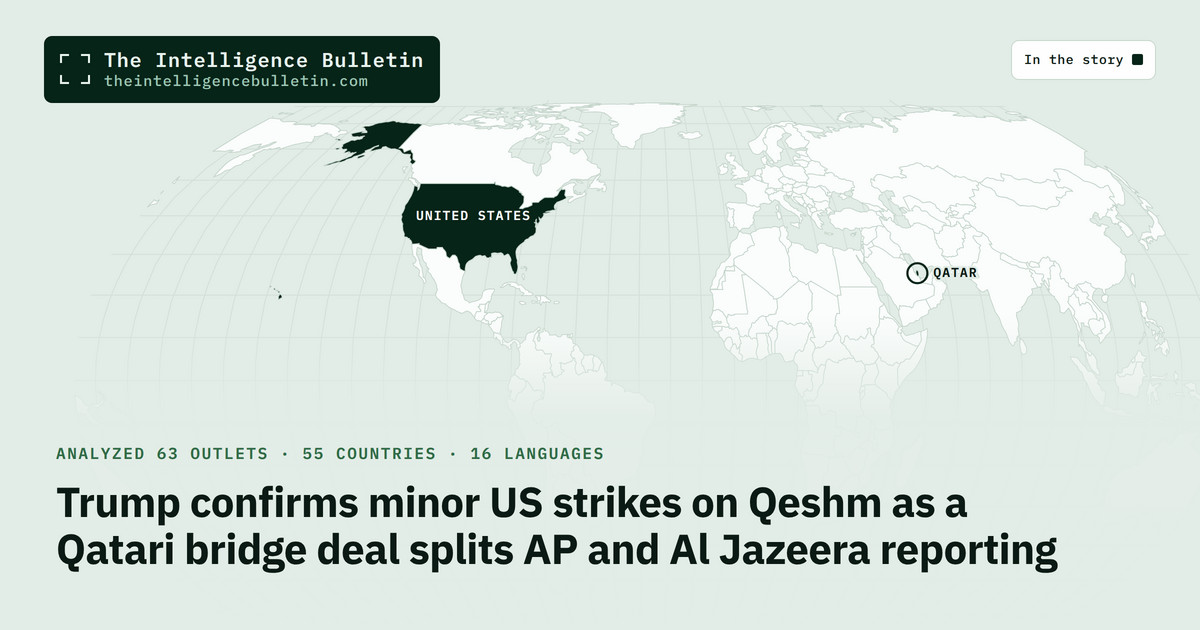
See the 55 countries
Afghanistan, Armenia, Australia, Azerbaijan, Bangladesh, Belgium, Bosnia and Herzegovina, Canada, China, Colombia, Croatia, Denmark, Egypt, Estonia, Georgia, Germany, Greece, Guyana, Hungary, India, Indonesia, Iran, Ireland, Israel, Japan, Latvia, Lebanon, Malaysia, Moldova, Nepal, Netherlands, New Zealand, Oman, Poland, Qatar, Romania, Russia, Saudi Arabia, Serbia, Slovakia, Slovenia, South Africa, South Korea, Spain, Sri Lanka, Sweden, Syria, Taiwan, Trinidad and Tobago, Turkey, Ukraine, United Arab Emirates, United Kingdom, United States, Zimbabwe
Trump confirmed Friday’s limited U.S. strikes on Qeshm Island’s air defenses, the first since the midterms; Iran claims, unverified, it downed a U.S. drone. Qatar’s two-day bridge deal is on the table, but Tehran’s preconditions and the fresh strike keep it stalled.
Across the press: The AP dispatch alone carries the anonymous two-day bridge-deal plan, while Qatar’s Al Jazeera runs only Doha’s on-record denial that talks failed.
Source base: 5 outlets read in full (United States, Israel, Qatar, India, Argentina), selected from 63 analyzed.
- 2 of 5 · one shared reportIran’s military says its air defenses intercepted and destroyed an American MQ-9 drone over Qeshm island following Friday’s explosions.An Iranian army statement via state broadcaster IRIB, reported by Al Jazeera, and an Iranian media claim carried by Ynetnews; the claim is not independently verified.
- 3 of 5 · one shared reportIran is reviewing Qatari proposals but says nuclear talks cannot start until the U.S. ends its port blockade, lifts sanctions, unfreezes assets, pays war-damage compensation and ends regional hostilities including Israeli operations in Lebanon.Two anonymous Middle East government officials, via the AP dispatch (carried by WISH-TV, Ynetnews and Daily Excelsior).
- 3 of 5 · one shared reportA proposed two-day bridge deal would lift the blockade and release frozen funds in exchange for IAEA inspector access to bombed sites, then on day two reopen the Strait of Hormuz under a temporary Iran-Oman modified mechanism, followed by extensive talks on Iran’s uranium stockpile.Regional officials, via the AP dispatch (carried by WISH-TV, Ynetnews and Daily Excelsior).
- 5 of 5 · reported separatelyThe U.S. military carried out fresh limited strikes on Iran on Friday, targeting an Iranian air-defense system.Trump confirmed it to reporters in West Palm Beach; reported by the AP dispatch (carried by WISH-TV, Ynetnews and Daily Excelsior, with Itón Gadol’s Spanish rendering) and by Al Jazeera’s own reporting.
- 5 of 5 · reported separatelyThe strikes were ‘minor’ — Trump said they knocked out ‘a little bit of an anti-aircraft device’ in ‘about 15 minutes, maybe five.’Trump to reporters after arriving in West Palm Beach; carried by both the AP chain and Al Jazeera.
- Coming daysIran’s answer on the Qatari proposals: whether Tehran accepts any day-one exchange of blockade relief and frozen funds for IAEA access will show if the bridge deal is real.
- Next weekU.S. strike tempo: whether Trump orders more strikes on Qeshm or elsewhere, with thousands of forces poised for major combat per The New York Times.
- ImmediateThe MQ-9 claim: whether Washington confirms or denies that Iran downed a U.S. drone over Qeshm; the response sets the next escalation step.
- If day one holdsHormuz reopening: whether Iran actually reopens the strait under the temporary Iran-Oman mechanism, the first tangible de-escalation in the oil chokepoint.
- AnsweredYes — Trump has now confirmed Friday’s limited strikes on an Iranian air-defense system, which he called ‘minor’ and which are the first since Tuesday’s midterms.
- AnsweredThe U.S. has resumed strikes after the midterms — Friday’s limited strike on Qeshm — but not yet on a larger scale, though Al Jazeera reports unnamed Pentagon officials telling The New York Times that thousands of U.S. air and naval forces are poised to resume major combat operations if Trump orders it.
- Still openWhat exactly did the US strike on Qeshm, and how many sites were hit? The US official line names a SAM launcher and radar/launch platforms, while Iranian sources report five explosions inside the island with no official confirmation of targets. · Did Iran actually offer to reopen the Strait of Hormuz within 48 hours, and on what terms, given that only Moneycontrol s headline carries the figure and its body could not be read, while Gulf News reports talks focused on stopping Hormuz attacks in exchange for lifting the blockade with no 48-hour figure?
- 03 Nov · US strikes Iran s Qeshm Island on midterm eve — Washington says defensive, Tehran s media report unexplained explosions
- 03 Nov · Trump says Iran deal could happen as strikes continue; the 48-hour Hormuz offer rests on one Indian headline
- 06 Nov · Putin offered to help end the war, Rezaei says; only The National reports Iran s nuclear proposal via Qatar
- 01 Nov · Daily Sabah, EA WorldView and Vesti carry Trump s one or two sites threat; Al Jazeera alone reports the NPT push
Full analysis
What happened Why it matters How each country tells it Room for disagreement Our assessment Sources and evidence
What happened
On Friday evening, November 6, President Donald Trump confirmed from West Palm Beach, Florida, that the U.S. military had carried out new limited strikes on Iran, targeting an Iranian air-defense system — the first American strikes since Tuesday’s midterm elections handed Republicans the loss of both chambers of Congress. Iranian state media had reported the sound of two explosions in the Suza area of Qeshm Island, in the Strait of Hormuz, the crucial waterway for oil shipments. Trump called the action "minor": "They knocked out — they built a little bit of an anti-aircraft device and we knocked it out in about 15 minutes, maybe five." Both reporting chains in this story — the Associated Press dispatch carried by four outlets, and Al Jazeera’s own reporting — carry those words and the basic facts.
Qeshm is an island Washington has hit before in this more than eight-month-old war. The U.S. military described Monday’s strikes on Qeshm and nearby Hengam, plus the mainland area of Bandar Abbas, as defensive; TIB reported on 3 November that those strikes came on November 2, one day before the midterms, with U.S. officials calling them limited and Iranian state media reporting five explosions of unknown nature.
Iran’s account adds a claimed response. Al Jazeera carried an Iranian army statement via state broadcaster IRIB saying the country’s air defenses intercepted and destroyed an American MQ-9 drone over Qeshm following Friday’s explosions. Ynetnews also carried the claim through Iranian media, and both outlets noted it could not be independently verified. U.S. Central Command said the situation was "relatively calm," and an official told Al Jazeera the command was aware of the reports but had no further comment. Late Friday, CENTCOM announced a reward of up to $20 million and possible relocation for information about Iran’s nuclear program, "including its facilities, equipment, and associated personnel."
The strike landed while a Qatari mediation is the most concrete thing on the table. The AP dispatch, citing two anonymous Middle East government officials, said Iran is reviewing proposals presented by chief mediator Qatar on the nuclear program — but that Tehran remains unwilling to begin negotiations over its atomic activities until the United States ends its port blockade, lifts sanctions, unfreezes Iranian assets, pays war-damage compensation and ends regional hostilities including Israeli operations in Lebanon. Trump, asked earlier Friday, said "We are talking to Iran. We have been," and Al Jazeera quoted him adding: "We’re dealing with them now. They want to make a deal. We’ve made a lot of progress with Iran."
The AP’s regional officials described the proposal’s shape: a two-day bridge deal. On day one, the U.S. would lift the blockade and release some of the billions in frozen Iranian funds, and in return Tehran would allow International Atomic Energy Agency inspectors into sites bombed by the U.S. and Israel. On day two, Iran would reopen the Strait of Hormuz under a modified agreement with Oman that Washington has not approved, temporarily, until a permanent Gulf-wide arrangement. Only after those measures would the two sides move to extensive talks on Iran’s stockpile of highly enriched uranium — 440.9 kilograms (972 pounds) enriched to 60 percent purity, a short technical step from weapons-grade, according to the IAEA.
Qatar’s own government, speaking to its own outlet, told a different part of the same story. Al Jazeera reported that on Saturday Qatar dismissed reports that the negotiations had failed, quoting Foreign Ministry spokesperson Majed al-Ansari: "Promoting such false claims serves only those seeking to prolong the war and destabilise the region." Prime Minister Sheikh Mohammed bin Abdulrahman bin Jassim Al Thani, at an Oxford University event on Friday, said mediation remains active and that "for the past couple of weeks, we have worked with colleagues in the US administration who have very genuine intentions to find a way to contain the situation and de-escalate it," crediting "some wise voices in Tehran."
Iran’s posture hardened over the weekend in reports carried only by Ynetnews. Military spokesman Mohammad Akraminia, via IRNA, said the armed forces are "on higher alert and more powerful than they were at the beginning of the war" and that any response will be "immediate, effective and without geographical limits" on the supreme leader’s orders. Supreme Leader Mojtaba Khamenei warned the conflict would spread if the United States resumed strikes, and dismissed expectations that the midterm result would change U.S. policy as "gravely mistaken."
Around the strike ran a flurry of calls: Defense Secretary Pete Hegseth spoke with Qatar’s Sheikh Saoud bin Abdulrahman Al Thani, following a separate Trump call with Qatar’s emir; Iranian Foreign Minister Abbas Araghchi called his Iraqi and Tunisian counterparts, with Iraq’s news agency saying the Baghdad call covered "Tehran’s vision for resuming negotiations with the U.S."; Egypt’s Badr Abdelatty, after two calls with Araghchi this week, urged "flexibility" and "compromise solutions," then spoke with the UAE’s Abdullah Bin Zayed.
Why it matters
The first American strike after the midterms answers, in one direction, the question the last editions left open: the electoral repudiation did not stop the strikes. Trump, who on Thursday said the U.S. may have to "destroy" the rest of Iran, confirmed this one himself within days. Yet Washington presents it as almost cosmetic — an anti-aircraft device, knocked out in as little as five minutes — while it lands on the exact island whose waterway the Qatari bridge deal is designed to reopen. That is the collision at the center of the story: a mediation asking the U.S. to lift its blockade and Iran to open Hormuz, running simultaneous with a strike on Hormuz island, with both parties claiming progress and neither moving first.
The stakes are global energy and the difference between a war that grinds on and one that widens. The Strait of Hormuz is described by every account here as the crucial route for oil shipments; elevated fuel prices were, in the AP’s telling, part of what cost Trump’s party Congress. Unnamed Pentagon officials told The New York Times, via Al Jazeera, that thousands of U.S. air and naval forces on more than a dozen ships are poised to resume major combat operations on Trump’s orders. The bridge deal is the first concrete mechanism reported for de-escalation, and it requires both sides to give something at the same time — exactly the trust-building the strikes erode.
How each country tells it
- WISH-TV · United States · wire copyA regional US newsroom carrying the AP dispatch verbatim: the strike as an accomplished military fact, Trump’s ‘minor’ framing, the two Qeshm explosions, and Iran’s five preconditions for nuclear talks.
- Ynetnews · Israel · wire copyRuns the same AP base but augments it with Iranian state-media material: the MQ-9 downing claim, the army’s warning of an immediate and geographically unrestricted response, Akraminia’s Hormuz condition, and Khamenei’s warning that the war would spread if strikes resumed.
- Al Jazeera · Qatar · original reportingLeads with Trump’s confirmation and his claim Washington has made ‘a lot of progress’ with Iran, anchoring the piece in Doha’s own on-record answers: al-Ansari’s denial that the talks failed, the prime minister’s Oxford remarks, and CENTCOM’s ‘relatively calm.’
- Daily Excelsior · India · wire copyWelds both halves into one headline — the fresh targeted strikes AND Tehran weighing mediator proposals — and runs the full AP dispatch including the bridge-deal mechanics and the phone-call flurry among Gulf and regional ministers.
- Itón Gadol · Argentina · carries Agencia AJNOpens with Washington’s minimising characterisation — ‘minor’ attacks aimed at ‘a small anti-aircraft device’ — making the story a dispute over scale rather than geography, for a Spanish-reading diaspora.
Room for disagreement
The strongest case that this turns toward de-escalation rather than escalation is made on the record by Qatar itself, and it deserves full weight. Al Jazeera’s Qatari foreign ministry spokesman says the talks have not failed and that reports saying so "serve only those" who want the war prolonged; the prime minister says his U.S. counterparts have "very genuine intentions" and that "wise voices in Tehran" have prevented the situation from spiralling. Trump says he has made "a lot of progress" and that Iran "wants to make a deal." Under that reading, Friday’s strike is exactly what Trump called it — a minor, five-to-fifteen-minute operation against a rebuilt anti-aircraft device, not a resumption of war — and the two-day bridge deal is live enough that the strike and the mediation can coexist. Tehran’s preconditions are an opening position, not a refusal, and the blockade was always going to be the first thing traded.
Our assessment
It is likely that the bridge deal stalls in its present form and that the cycle of limited strikes continues, with the forces poised for larger action remaining a live option. The warrant is in what the two reporting chains each foreground: the AP’s anonymous officials set Iran’s preconditions — end the blockade, lift sanctions, unfreeze assets, war damages, and an end to regional hostilities including Lebanon — all of which, the AP notes, Trump has declined in the past; and the detailed two-day plan requires Washington to lift the blockade on day one before Iran opens Hormuz on day two, a sequence neither side looks ready to trigger while Friday’s strike is fresh and Tehran’s military says any response will be immediate and without geographical limits. The mediator’s own outlet, Al Jazeera, pointedly does not carry the bridge-deal specifics the AP attributes to regional officials, instead running Doha’s on-record denial that talks have failed — an interest in the reader seeing the mediation as alive, which it is, but not yet agreed. Every party has an incentive to present the talks its way: Qatar to keep its mediation credible, Trump to show progress toward ending a war that cost his party Congress, and Tehran to show it is not negotiating under strikes. The strike on Qeshm, on the waterway the deal would reopen, reads as the stronger signal about what comes first.
What would change this: confirmation by either government that the day-one exchange — lifting the blockade and releasing frozen funds in return for IAEA inspector access — has actually been accepted, or, on the other side, a second strike large enough that Tehran’s promised response without geographical limits follows.
Sources and evidence
Press quoted
- What exactly did Friday’s strikes hit on Qeshm, and can CENTCOM’s ‘relatively calm’ account be reconciled with the two explosions and Iran’s claim to have brought down a US MQ-9, given that no independent reporting establishes the target or the exchange?
- Did Qatar actually present the detailed two-day bridge deal the anonymous officials describe to AP, given that Al Jazeera — the mediator’s own outlet — reports only that mediation continues and denies it failed, without the specifics?
- Will Friday’s strikes derail the mediation, since Iran conditions nuclear talks on an end to hostilities while the US is simultaneously offering $20 million for information on Iran’s nuclear program and Trump claims progress has been made?
That’s how the world told the story.
Get our daily open-source intelligence on world events in your inbox — one email a day, up to six stories.
Subscribe freeNo spam. One-click unsubscribe. See the latest email →