 AI-generated analysis published under the editorial responsibility of Rohit Sinnas. How it works →
See the 52 countries
Argentina, Armenia, Australia, Austria, Bangladesh, Bosnia and Herzegovina, Brazil, Burundi, Chile, China, Colombia, Costa Rica, Croatia, Cuba, Dominican Republic, Ecuador, Egypt, France, Germany, Guatemala, Israel, Italy, Lebanon, Lithuania, Malawi, New Zealand, Nigeria, Pakistan, Panama, Paraguay, Peru, Philippines, Poland, Puerto Rico, Qatar, Romania, Russia, Saudi Arabia, Slovenia, South Africa, South Sudan, Spain, Sri Lanka, Switzerland, Syria, Turkey, Tuvalu, Uganda, United Kingdom, United States, Uruguay, Venezuela
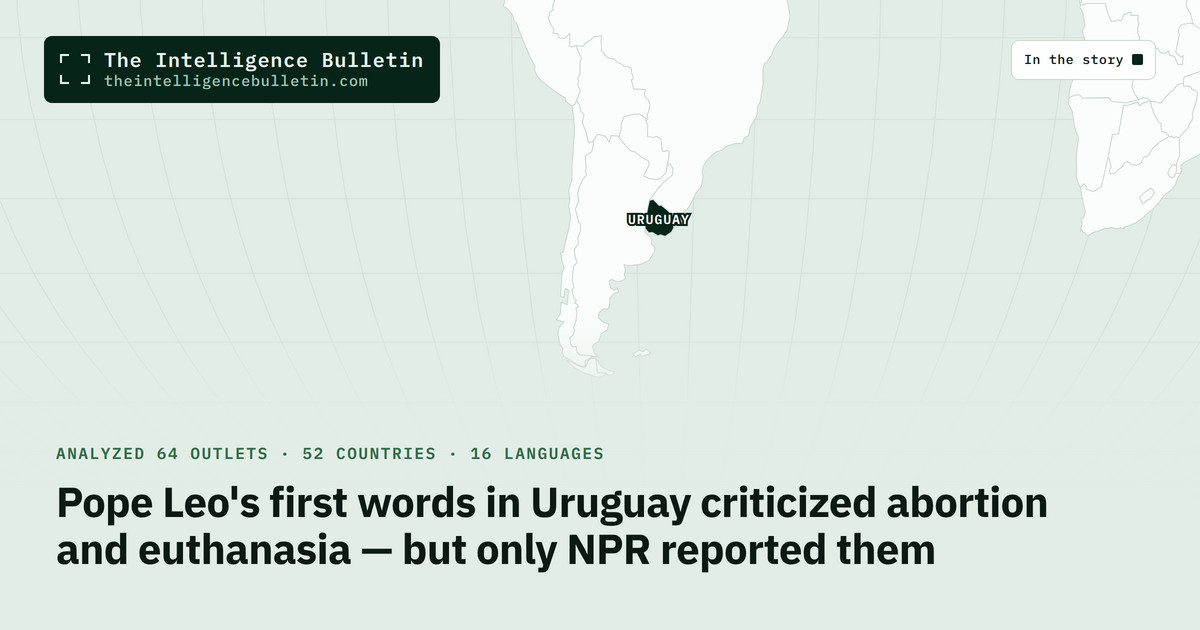
Pope Leo XIV opened a 12-day tour of Uruguay, Argentina and Peru in Montevideo November 6, his first major trip since lung surgery; his first speech criticized Uruguay’s abortion and euthanasia laws, per NPR, while El País and Vatican News accounts carried only his schedule.
Across the press: NPR alone reports Pope Leo used his first Uruguay speech to criticize abortion and euthanasia, absent from El País, Diario Correo, RedeTV!, and PCh24.
Source base: 5 outlets read in full (Uruguay, United States, Peru, Brazil, Poland), selected from 64 analyzed.
- 1 of 5 · NPR onlyPope Leo is making the journey less than a month after surgery to remove the lower lobe of his right lung, with Vatican officials saying he has completed recovery and needs no further treatment.NPR, citing Vatican officials including communications chief Maria Montserrat Alvarado.
- 1 of 5 · NPR onlyIn his first speech in Uruguay, Pope Leo criticized the country’s abortion and euthanasia laws, saying everyone must be accompanied until the natural end of life.NPR, quoting the pope speaking in Spanish.
- 5 of 5 · reported separatelyPope Leo XIV arrived in Montevideo on Friday, November 6, 2026, beginning a South American tour that also takes in Argentina and Peru.El País reports from the Uruguayan bishops’ conference schedule; NPR reports from its own coverage; Diario Correo cites Vatican News; RedeTV! and PCh24/KAI also report the itinerary.
- 3 of 5 · reported separatelyThis is the first papal visit to Uruguay since John Paul II’s 1988 trip.El País states the last visit was 1988; Diario Correo calls Leo the second successor of Peter to visit after John Paul II’s 1987 and 1988 trips; PCh24 says it is 38 years after John Paul II’s last visit.
- 3 of 5 · reported separatelyAfter leaving Uruguay on Sunday, the pope will go to Argentina, where he is to be received by President Javier Milei.El País says he will be received by Milei the same day; NPR says he arrives in Buenos Aires on Sunday evening and frames the visit as an early test with Milei; PCh24 says he will meet Milei.
- Sunday, November 8Pope Leo departs Montevideo for Buenos Aires, where President Javier Milei receives him the same day; the meeting is the first direct test of the Church’s friction with right-wing populist leaders.
- November 8–11The Argentina leg, including Mass at Luján and a prison visit; PCh24 reports organizers expect up to six million people across events, testing the pope’s pull in Francis’s homeland.
- November 11–17The Peru leg, including Cusco at over 11,000 feet and meetings with victims of the Sodalitium abuse scandal, where Leo’s credibility on the Church’s own past is at stake.
- After the tourWhether the Vatican publishes full speech texts, which would confirm or soften the abortion and euthanasia passage reported only by NPR.
Full analysis
What happened Why it matters How each country tells it Room for disagreement Our assessment Sources and evidence
What happened
Pope Leo XIV landed at Montevideo’s Carrasco International Airport at 4:30 p.m. on Friday, November 6, 2026, beginning a 12-day, three-country journey through Uruguay, Argentina and Peru — his longest and most far-reaching trip as pontiff and his first major overseas visit since surgery last month to remove the lower lobe of his right lung. The itinerary, running to November 17, takes in ten cities and twelve flights, including two helicopter rides, with a stop in Cusco, Peru, at more than 11,000 feet above sea level. NPR, citing Vatican officials including communications chief Maria Montserrat Alvarado, reported that Leo completed his two-week recovery and needs no further treatment; Alvarado said doctors are "very confident" and medical care would be on board should something happen.
The visit is Uruguay’s first papal event since John Paul II’s 1988 trip — El País states that directly, Diario Correo calls Leo the second successor of Peter to visit after John Paul II’s 1987 and 1988 trips, and PCh24 places him 38 years after John Paul II’s last visit. From the airport Leo traveled along Montevideo’s rambla to Plaza Independencia for a 5:30 p.m. welcome ceremony led by President Yamandú Orsi, followed by a meeting with national authorities, civil society and the diplomatic corps, where, per El País’s schedule drawn from the Uruguayan bishops’ conference, he was to give his first speech at 5:45 p.m. before a private meeting with Orsi at Torre Ejecutiva and a key-of-the-city ceremony at the Cabildo.
What he actually said in that first address is the sharpest point of divergence in the reporting. NPR alone quotes the pope speaking in Spanish and delivering "a pointed criticism" of Uruguay’s abortion and euthanasia laws — Uruguay being the first Latin American country to legalize euthanasia through legislation, and in 2012 the second in the region to legalize abortion after Cuba. The quoted words: "It is everyone’s responsibility to ensure that each person can live with dignity, receive the care they need, and be accompanied until the natural end of his or her life." That passage does not appear in El País’s minute-by-minute schedule, in Diario Correo’s Vatican News-derived arrival account, in RedeTV!’s decline-of-Catholicism framing, or in PCh24’s KAI translation. El País says only that Leo "pronunciará su primer discurso" at 5:45 p.m.; Diario Correo, following Vatican News, says he would "pronunciará su primer discurso en el país" after meeting authorities. Neither carries its content.
The rest of the three-day Uruguay leg is a pastoral itinerary across Montevideo and the interior. On Saturday, November 7, Leo flies to Paysandú for a Mass honoring Jacinto Vera, visits the Casavalle barrio — a working-class neighborhood about half an hour north of the capital, where NPR’s reporting centers on the Our Lady of Guadalupe Church and its pastor, Father Pablo Coimbra — and then the Universidad Católica before an evening vigil at Estadio Centenario. On Sunday, November 8, he travels to Canelones and Florida, where he is to celebrate an open-air Mass at the National Shrine of Our Lady of the Thirty-Three, an image tied to Uruguay’s 1825 independence struggle against Brazil. After lunch with the bishops — the menu, El País says, is presumed to be asado — he returns to Carrasco for the farewell ceremony and flies to Buenos Aires. El País reports he will be received the same day by Argentine President Javier Milei; NPR puts his arrival in Buenos Aires on Sunday evening and frames the visit as an early test of how Leo will address the Church’s differences with right-wing populist leaders, given Milei’s austerity measures and the pope’s long-standing championing of the poor. PCh24 adds that organizers expect up to six million people across the Argentine events, including at the shrine of Our Lady of Luján. The final leg in Peru, where Leo spent two decades as a missionary and bishop of Chiclayo and became a naturalized Peruvian in 2015, is billed by NPR as a homecoming; he will visit Lima, Chiclayo, Cusco, Pucallpa and other sites, meet with President Keiko Fujimori, and, per PCh24, sit down with victims of the Sodalitium Christianae Vitae abuse scandal, which the Vatican suppressed in 2025 while Leo was involved in investigating it.
Why it matters
The trip’s stakes are measurable in its context. Leo is making the longest journey of a still-new pontificate months after lung-cancer surgery that removed part of his right lung — a fact carried only by NPR, which grounds the itinerary’s endurance demands in numbers, while RedeTV! counts 31,000 kilometers and NPR tallies 36 speeches. Uruguay’s secularism is the terrain of the first leg: NPR notes Christmas is officially "Family Day," Easter week is "Tourism Week," and only about a third of Uruguayans identify as Catholic, with fewer practicing — a figure RedeTV! backs with Pew Research Center data charting the decline of Catholic identification across Latin America. Against that backdrop, whether the pope’s first words attacked the country’s liberal abortion and euthanasia laws, and whether that is reported at all, determines what kind of visit this is: a pastoral pilgrimage or a political intervention. A reader of El País gets times and routes but no speech content; a reader of Diario Correo, the Peruvian outlet carrying Vatican News, gets arrival and ceremony but no criticism; a reader of RedeTV! gets demographics; a reader of PCh24 gets a strategic assessment of the Church’s place in each society. Only an NPR reader learns that the pope’s first substantive act on the continent was to challenge two laws Uruguay pioneered in the region. The Milei meeting on Sunday carries the next stakes: NPR frames it as an early test of Leo’s posture toward right-wing populists who clash with the Church over austerity, and in the U.S. over migration, where Leo has clashed with President Trump. The Peru leg sharpens it further, returning Leo to a Church scarred by the Sodalitium scandal and to a country he knows from the inside.
How each country tells it
- El País · Uruguay · original reportingCovers the papal visit as a domestic schedule, itemizing arrival times, routes, and the pope’s day-by-day movements until he leaves for Argentina.
- NPR · United States · original reportingReads the trip as Pope Leo’s personal South American homecoming, foregrounding his biography, recovery from lung cancer surgery, and the pointed content of his first day in Uruguay.
- Diario Correo · Peru · carries Vatican NewsFrames the visit as the opening stage of an apostolic journey that will end in Peru, reporting the Rome departure and Montevideo arrival from a destination-country vantage.
- RedeTV! · BrazilLeads with the decline of Catholic identification in Latin America, citing Pew Research data, and treats the papal tour as a response to institutional shrinkage.
- PCh24 · Poland · carries KAITreats the tour as a Vatican program to be assessed from inside the Church, asking what the pope plans and examining each country’s challenges to the Church’s place in society.
Room for disagreement
The strongest case that the political reading overstates the visit comes from the Vatican’s own news apparatus. Diario Correo’s account, which follows Vatican News, reports the Montevideo arrival and first-day ceremony without any mention of the abortion and euthanasia criticism; if the Vatican wanted that challenge to dominate the trip’s public framing, its own service would presumably lead with it. PCh24’s KAI analysis, which reads the tour as a deliberate Vatican program, frames the Uruguay leg as the Church "giving witness in a society where Christian references have ceased to be obvious" — a pastoral challenge, not a confrontation — and treats the Argentina leg as an opportunity for Leo to speak about economic justice "without engaging in party confrontation." El País, the host country’s paper of record, presents the visit as a schedule to navigate, not a political moment. On that view, the abortion and euthanasia passage was a single line in a first address that has been permitted to recede, and the trip will be defined by the Masses, the Casavalle visit, the Centenario vigil and the Luján pilgrimage — the pastoral program every other outlet documents. If the speech did not dominate even the host country’s own paper, the argument runs, it may not dominate the visit’s actual meaning.
Our assessment
It is likely that the political content of this trip, not its logistics or demographics, will define how it is remembered. The warrant rests on two reporting chains converging: NPR’s account of the speech’s content is the only one that carries the criticism, but it is not contradicted by any other outlet — El País, Diario Correo, RedeTV! and PCh24 simply do not report the speech’s substance, which is a distinction between what they carried and what they denied. Leo chose Uruguay, the region’s most secular and most liberal state on abortion and euthanasia, as his first stop and, per NPR, used his first address there to challenge both laws directly. He follows that with a meeting with Milei that every outlet expects, and ends in Peru at a Church facing an abuse scandal he helped investigate. The structural direction of the trip is toward the region’s sharpest political and institutional fault lines, not around them. The absence of the speech from the Vatican News-derived and host-country accounts cuts the other way, which is why the call is likely and not certain.
What would change this: if the Vatican publishes the full text of Leo’s Montevideo address and the abortion and euthanasia passage turns out to be a minor element rather than the speech’s center, the pastoral reading would gain at the political one’s expense.
Sources and evidence
Press quoted
- NPR says President Orsi presided over the welcome ceremony outside Montevideo’s main cathedral, while El País and Diario Correo both schedule the official welcome at Plaza Independencia; where did the ceremony actually take place?
- Did Pope Leo’s first speech at Plaza Independencia include the criticism of Uruguay’s abortion and euthanasia laws that only NPR reports, and what have the Vatican, Uruguayan authorities, and other outlets said about it?
- What medical precautions are in place for the pope’s visit to Cusco, at more than 11,000 feet, weeks after lung surgery, given that only NPR raises the altitude risk?
That’s how the world told the story.
Get our daily open-source intelligence on world events in your inbox — one email a day, up to six stories.
Subscribe freeNo spam. One-click unsubscribe. See the latest email →