 AI-generated analysis published under the editorial responsibility of Rohit Sinnas. How it works →
See the 54 countries
Albania, Armenia, Australia, Azerbaijan, Belgium, Bosnia and Herzegovina, Brazil, Canada, China, Colombia, Croatia, Cyprus, Czech Republic, Egypt, Estonia, Finland, Gambia, Georgia, Germany, Greece, India, Ireland, Israel, Italy, Japan, Kazakhstan, Kenya, Lebanon, Luxembourg, Morocco, Nigeria, Oman, Pakistan, Qatar, Romania, Russia, Saudi Arabia, Serbia, Singapore, Slovakia, Slovenia, Somalia, South Africa, South Korea, Sri Lanka, Switzerland, Syria, Turkey, Tuvalu, Uganda, Ukraine, United Arab Emirates, United Kingdom, United States
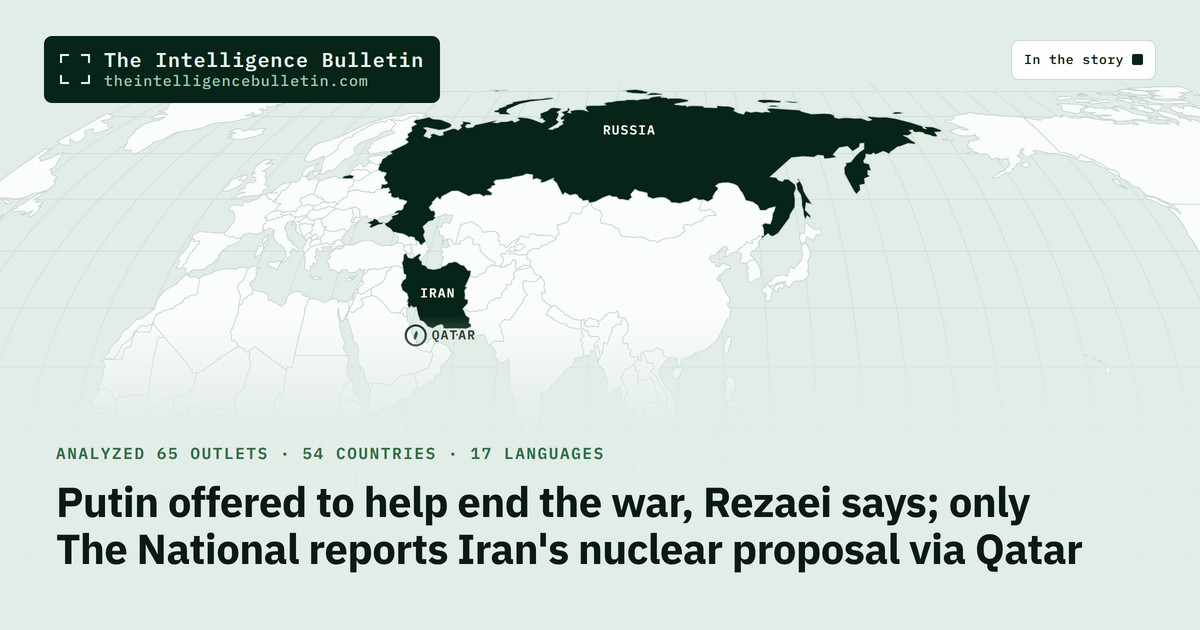
Putin received Rezaei on Thursday and offered to help end the war. The National alone reports, via Reuters, Iran sent a nuclear proposal through Qatar, conditional on Washington meeting seven demands first. Washington is weighing resumed strikes.
Across the press: The nuclear proposal The National reports in one sentence via Reuters is absent from Al Jazeera, the home outlet of the alleged conduit Qatar.
Source base: 5 outlets read in full (Russia, United States, Qatar, Israel, United Arab Emirates), selected from 65 analyzed.
- 1 of 5 · The National onlyIran sent a nuclear proposal to the United States through Qatar, to be discussed only once Washington meets Tehran’s seven demands, and the US is reviewing it.The National, citing ‘a senior Iranian official told Reuters’.
- 4 of 5 · reported separatelyPutin received Iran’s security chief Mohsen Rezaei at the Kremlin on Thursday; Rezaei delivered a message from Supreme Leader Mojtaba Khamenei and said Putin offered to help end the US and Israeli war on Iran.Al Jazeera (citing Press TV and TASS), Headlines & Global News (citing Iranian state television and Russian officials), The Jerusalem Post (citing Iranian state media and Reuters), and The National (reporting the meeting and message directly).
- 3 of 5 · reported separatelyRezaei said Iran will neither reopen the Strait of Hormuz nor negotiate until Washington executes Tehran’s seven conditions.Al Jazeera and The National quote Rezaei directly; Headlines & Global News cites an Iranian source briefed on the talks who spoke to a Lebanese broadcaster.
- 2 of 5 · reported separatelyWashington is weighing resumed strikes: no order has been issued, but preparations continue and Trump says he will decide soon, with one US source reportedly saying ‘He’s planning to bomb Iran.’Headlines & Global News (citing two sources, CENTCOM chief Adm. Brad Cooper’s briefing, and US and Israeli officials) and The National (citing Axios and Fox News).
- 2 of 5 · reported separatelyIran’s conditions include the lifting of US sanctions, the release of frozen Iranian assets, war reparations, and an end to the US naval blockade before the strait reopens.Headlines & Global News (sanctions relief, frozen funds, end of blockade) and The National (lifting sanctions, release of frozen assets, war reparations, ‘among other conditions’).
- Nov 10-11, 2026Trilateral US-Russia-Ukraine talks in Abu Dhabi — whether Russia’s offer to help end the Iran war turns into a concrete proposal there or remains a general commitment.
- Trump’s decision window, no date givenWhether US Central Command’s finalized preparations convert into an order to resume strikes, after Trump said ‘You’ll know soon enough.’
- As Qatar circulates its three-day draftWhether Iran and Washington both back the confidence-building steps that could restart direct US-Iran talks within days.
- Nov 18-19, 2026APEC summit in Shenzhen — whether a Xi-Putin-Trump meeting on the sidelines yields any movement on the Iran channel.
- AnsweredThere is now a new Iranian text — a nuclear proposal sent to the US through Qatar (The National, citing a senior Iranian official via Reuters) — and HNGN reports Iran’s willingness to re-engage ‘suggests that Qatar’s mediation has made some progress,’ though neither source discloses the proposal’s contents.
- AnsweredThe mediation survived the strikes: The National reports Qatari mediators held discussions with the White House and Tehran on Thursday and Iran’s nuclear proposal reached Washington, and HNGN describes the mediation as having ‘made some progress,’ while no order to resume operations was issued.
- Still openDid Iran actually offer to reopen the Strait of Hormuz within 48 hours, and on what terms, given that only Moneycontrol s headline carries the figure and its body could not be read, while Gulf News reports talks focused on stopping Hormuz attacks in exchange for lifting the blockade with no 48-hour figure? · Can the two sides stated conditions be reconciled — Washington s demand for a firm, verifiable commitment that Iran not rebuild its nuclear program against Tehran s demand that the naval blockade be lifted and its conditions met first?
- 03 Nov · Trump says Iran deal could happen as strikes continue; the 48-hour Hormuz offer rests on one Indian headline
- 31 Oct · Barrack says very close via Gulf News; Nile News and three others record Iran s rejection.
- 01 Nov · Al-Araby Al-Jadeed reports a US delegation bound for Doha; Araghchi tells IRNA no talks are planned
- 03 Nov · US strikes Iran s Qeshm Island on midterm eve — Washington says defensive, Tehran s media report unexplained explosions
Full analysis
What happened Why it matters How each country tells it Room for disagreement Our assessment Sources and evidence
What happened
The concrete event of Thursday, November 5 was in Moscow: President Vladimir Putin received Mohsen Rezaei, secretary of Iran’s Supreme National Security Council, at the Kremlin’s Senate Palace, in a meeting confirmed by Kremlin spokesman Dmitry Peskov and reported by Al Jazeera, Headlines & Global News, The Jerusalem Post and The National. Rezaei delivered a written message from Iran’s Supreme Leader Mojtaba Khamenei, which he said Khamenei had wanted conveyed "as soon as possible." He did not disclose its contents, and the Kremlin released no account of its own.
After the meeting, Rezaei told Iranian state television that Putin condemned the US and Israeli attacks on Iran, including the bombing of its nuclear sites, described the war as unjust, and said he "was ready to cooperate in any way we can to help end the war." The two men also discussed postwar regional security arrangements, a four-nation meeting Iran held in late October with Saudi Arabia, Turkey and Pakistan, and Russian-Iranian gas pipeline construction, which Rezaei said would ease Iran’s domestic gas shortages and let Russia sell gas to Iran’s neighbors. Kremlin foreign policy aide Yuri Ushakov and the head of Russia’s military intelligence, Igor Kostyukov, also attended, according to HNGN.
Rezaei then set out Iran’s terms in public. "On the issue of diplomacy, we have announced seven conditions to the Americans. As long as they do not execute our seven conditions, we will neither open the Strait of Hormuz nor have negotiations," he said, in remarks carried by both Al Jazeera and The National. Those conditions, as reported by HNGN and The National, include lifting US sanctions, releasing frozen Iranian assets, war reparations and ending the US naval blockade before the strait reopens. The strait remains effectively closed to commercial traffic — HNGN records two transits on October 25 against a pre-crisis baseline of about 85 a day.
The nuclear proposal at the center of this story is the thinnest thread in the reporting. The National, in a single sentence attributed to Reuters, reports that "Iran sent a nuclear proposal to the US through Qatar, a senior Iranian official told Reuters," and that it would be discussed once Washington met Tehran’s seven demands, with the US reviewing the proposal. No other outlet in the pool carries the claim, and no outlet discloses its contents. Al Jazeera, the home outlet of Qatar — the alleged conduit — reports the Moscow meeting, the seven conditions, and Qatar’s mediation effort in detail but never mentions a nuclear proposal.
Washington’s side of the day ran in parallel. President Donald Trump met his national security team at the White House on Wednesday and Thursday and told reporters in the Oval Office: "Now we will make a decision. Do we want to go further? I would rather not destroy the rest of the country if possible, but maybe I will have to. You’ll know soon enough." Fox News reported that no order to resume military operations was issued but that US Central Command was finalising preparations, and Axios quoted two US officials saying the meeting was the first since the midterm elections. HNGN cites two sources saying Adm. Brad Cooper, CENTCOM’s commander, briefed Trump last week on options to resume operations, and quotes one source as saying, "He’s planning to bomb Iran," with Israeli officials reporting the military has begun preparing for a possible return to war. Trump said Vice President JD Vance’s assessment that the war cost Republicans the midterm elections was "largely true," but that he would "do exactly the same thing" because "Iran must not be allowed to have a nuclear weapon."
The day’s fifth outlet covered a different story altogether. Lenta.ru, the set’s only Russian newsroom, devotes its entire report to Trump’s announcement of a "big, beautiful agreement" on Ukraine, his meeting with Russian special envoy Kirill Dmitriev at the White House, and the next trilateral round of US-Russia-Ukraine talks scheduled for Abu Dhabi on November 10-11. Putin, Rezaei, Iran, the seven conditions, the strait and the nuclear proposal do not appear in Lenta.ru’s article at all.
Why it matters
The stakes are whether the region moves toward resumed war or a negotiated end. This is the first time since the standoff escalated that a concrete Iranian text has reportedly traveled to Washington — TIB’s earlier editions had recorded Tehran rejecting a Qatari draft in late October and Iran’s foreign minister denying on the record that talks were planned. HNGN reports that Iran’s willingness to re-engage on the nuclear issue after weeks of refusing to soften its position suggests Qatar’s mediation "has made some progress," according to five officials familiar with the talks, including US and Iranian officials.
But the conditions attached are maximalist, and the proposal is reported as discussable only after Washington complies with demands it has so far refused. Washington has said nuclear issues must be part of any initial negotiations; Tehran says no talks until the blockade is lifted and sanctions removed. If The National’s single sentence is accurate, the proposal is less an offer than a restatement of Tehran’s position with a document attached. Al Jazeera’s framing is de-escalatory, foregrounding Putin’s offer of help and Russia’s readiness; The Jerusalem Post pairs the Moscow meeting with a deadly Turkey-Iran border shooting and a Russian travel advisory warning that fighting could resume; HNGN and The National both center the pending American decision, quoting Trump’s "You’ll know soon enough."
How each country tells it
- Lenta.ru · Russia · original reportingCarries the day’s Washington events as domestic news about its own envoy: Trump announcing a ‘big, beautiful agreement’ on Ukraine touching all of Europe, his meeting with Kirill Dmitriev, Melania Trump’s message relayed to Putin, and the upcoming Abu Dhabi talks — with no mention of Iran whatsoever.
- Headlines & Global News · United States · original reportingReports the Putin-Rezaei meeting from Washington’s decision angle — Tehran ‘weighing’ nuclear proposals — then layers US strike planning, Trump’s contradictory statements, Vance’s midterm post-mortem, and Russian diplomacy into one account.
- Al Jazeera · Qatar · original reportingFrames the Moscow meeting as intra-regional diplomacy — Khamenei’s message delivered to Putin — and reads it as de-escalation, foregrounding Rezaei’s seven-conditions statement, the gas-pipeline talk, and Russia’s offer to help end the war.
- The Jerusalem Post · IsraelPairs the Putin-Rezaei talks with a deadly Turkey-Iran border shooting, then pivots to Zakharova’s warning that fighting could resume and Dmitriev’s denial that Russian tankers changed course — the Moscow meeting framed as one more threat to monitor.
- The National · United Arab Emirates · original reportingLeads with Trump’s Oval Office deliberation — ‘You’ll know soon enough’ — over whether to resume the war or reach a deal, then reports that Iran sent a nuclear proposal to the US through Qatar, citing Reuters.
Room for disagreement
The strongest case that this is a genuine de-escalation rather than a diplomatic placeholder rests on three on-record elements. Vice President JD Vance and envoy Steve Witkoff have urged Trump to pursue an agreement, according to HNGN, against the counsel of CIA Director John Ratcliffe, Treasury Secretary Scott Bessent and Secretary of State Marco Rubio, who favor keeping the naval blockade in place. The five officials who described the mediators’ texts as "concrete proposals" said Iran’s re-engagement is itself evidence that mediation is moving. And The National reports that Qatari mediators held discussions with the White House and Tehran on Thursday, while the proposal’s arrival in Washington, reported by Reuters and carried only by The National, shows the channel is functioning.
The midterm defeat, in this reading, gives Trump a political incentive to take the deal: HNGN notes one source said renewed fighting could be more likely because Trump has "nothing to lose politically," but the same arithmetic could push toward agreement, since the war’s cost at the pump was, by Trump’s own account, what cost his party Congress. If the proposal is real and the seven conditions are a negotiating position rather than a literal precondition, the next step after Abu Dhabi and the APEC summit could be direct talks.
Our assessment
The nuclear proposal is unlikely to produce negotiations on the terms stated in the near future. The corroborated spine of the reporting — Rezaei’s Moscow visit, Putin’s offer, the seven conditions, the continued US strike planning — points to two sides hardening their positions rather than narrowing the gap. The proposal, as reported, is conditional on Washington meeting demands it has refused for weeks, and the only source for it is a single sentence in The National attributed to Reuters, absent from Al Jazeera, the outlet best positioned to know what Qatar actually ferried. Washington’s preparations continue, Trump’s timeline is his own, and the strait stays closed. The parallel Russia channel, covered exclusively by Lenta.ru, shows Moscow’s public priority is Ukraine, and its offer to help on Iran remains, in HNGN’s words, without "the one thing that would change U.S. planning, a visible Russian stake in Iran’s air defenses."
What would change this: Washington announcing it would meet any of the seven conditions, or Tehran dropping the precondition and allowing the nuclear proposal to be discussed on its own terms.
Sources and evidence
Press quoted
- What does Iran’s nuclear proposal actually contain, and is it a substantive concession or a restatement of the seven conditions, given that the one outlet carrying it — The National, citing Reuters — reports no details?
- What did Mojtaba Khamenei’s message to Putin say, which neither the Kremlin nor Rezaei disclosed, and does it constitute a request for Russian mediation, military support, or something narrower?
- Can Washington’s insistence that nuclear issues must open any talks be reconciled with Tehran’s sequencing of seven conditions executed before any negotiation, when no pool source reports either side yielding?
That’s how the world told the story.
Get our daily open-source intelligence on world events in your inbox — one email a day, up to six stories.
Subscribe freeNo spam. One-click unsubscribe. See the latest email →