 AI-generated analysis published under the editorial responsibility of Rohit Sinnas. How it works →
See the 59 countries
Afghanistan, Argentina, Australia, Austria, Azerbaijan, Belgium, Brazil, Canada, Colombia, Denmark, Dominican Republic, Egypt, Finland, France, Georgia, Ghana, Greece, Guatemala, Guyana, India, Indonesia, Iraq, Ireland, Israel, Italy, Jamaica, Jordan, Lebanon, Lithuania, Luxembourg, Malaysia, Mauritius, Mexico, Moldova, Morocco, Nepal, New Zealand, Norway, Oman, Pakistan, Philippines, Qatar, Romania, Saudi Arabia, Serbia, Singapore, Somalia, Spain, Sri Lanka, Switzerland, Syria, Turkey, Tuvalu, Uganda, United Arab Emirates, United Kingdom, United States, Uruguay, Yemen
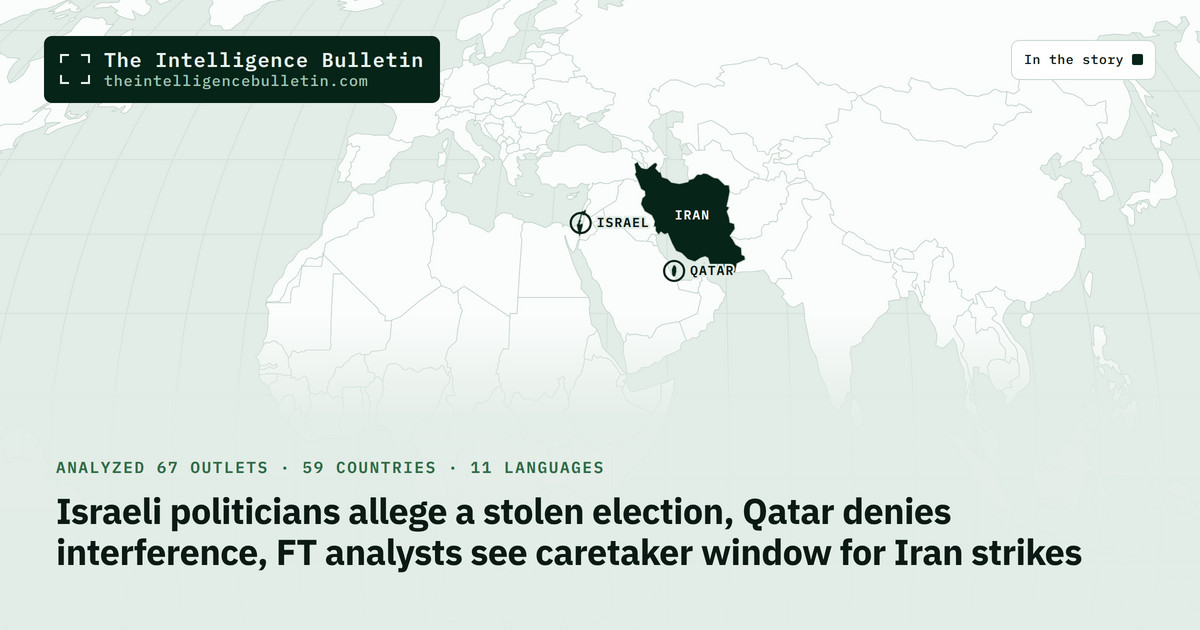
Israel’s election gave no bloc a majority: Netanyahu’s right-wing camp won 53 seats, Eisenkot’s opposition 48, Arab parties 19. Sohlberg ordered a Shin Bet probe into foreign funding that Qatar denies; Eisenkot accused Netanyahu of trying to delegitimize the result.
Across the press: The Jerusalem Post leads with legitimacy; The Irish Times ignores the Qatar row and sees a path to war.
Source base: 5 outlets read in full (Israel, Qatar, Saudi Arabia, Jordan, Ireland), selected from 67 analyzed.
- Denied on the recordQatar interfered in Israel’s election or funded activities intended to influence its outcome.Source: The allegation surfaced from Israeli politicians and media; Qatari Foreign Ministry spokesman Majed al-Ansari categorically denied it on X, calling the accusations a disinformation campaign.
- 1 of 5 · The Irish Times onlyNetanyahu’s caretaker status after the deadlock removes legitimacy constraints and leaves him able to launch a new multi-day bombing campaign against Iran, likely after the November 3 US midterms.The Financial Times, carried by The Irish Times, quotes former Israeli national security adviser Yaakov Amidror, former military intelligence Iran analyst Danny Citrinowicz, former intelligence officer Michael Milshtein and a person familiar with Israeli war planning.
- 3 of 5 · reported separatelyNeither Netanyahu’s right-wing bloc nor Eisenkot’s opposition bloc won a majority: the right-led camp took 53 of 120 Knesset seats, the opposition 48, and Arab-led parties 19.Arab News reports the same seat count as preliminary results; Agence France-Presse via Ammon News reports it as final results; The Financial Times via The Irish Times reports it as initial results after most ballots were counted.
- 3 of 5 · reported separatelyGadi Eisenkot accused Netanyahu and Likud of launching an organized campaign to delegitimize the election results because they lost and lacked a Knesset majority.The Jerusalem Post reports Eisenkot’s direct statement; Agence France-Presse via Ammon News carries the same ‘coordinated and organized campaign’ accusation; The Financial Times via The Irish Times reports Eisenkot said the caretaker premier lacked the mandate or people’s trust for military action.
- 3 of 5 · reported separatelyCentral Elections Committee chairman Supreme Court Justice Noam Sohlberg directed the Shin Bet to investigate suspicions of foreign funding and election bribery, and Shin Bet chief David Zini is briefing party leaders.The Jerusalem Post reports Sohlberg’s directive and the Shin Bet probe; Arab News reports Sohlberg asked Shin Bet to establish whether evidence supported suspicions; Agence France-Presse via Ammon News reports the request to investigate claims that Ra’am received foreign money.
- Within the coming daysThe Shin Bet presents its findings to Justice Noam Sohlberg, determining whether foreign-funding suspicions are substantiated.
- After the November 3 US midtermsWashington decides whether to greenlight the multi-day bombing campaign against Iran that Israeli experts say Netanyahu is preparing.
- Still openWill the official results due on Nov. 4 diverge from the exit polls, and if so, in whose favour? · Whom will President Isaac Herzog task with forming a government, and can either camp reach 61 seats without a deal with Arab parties?
Full analysis
What happened Why it matters How each country tells it Where accounts conflict Room for disagreement Our assessment Sources and evidence
What happened
The Israeli election that ended Tuesday resolved little. On Thursday Central Elections Committee chairman Supreme Court Justice Noam Sohlberg directed the Shin Bet to investigate suspicions of foreign funding and election bribery, according to The Jerusalem Post. Shin Bet chief David Zini is briefing party leaders, and the inquiry, which The Jerusalem Post says began covertly and advanced only after investigators gathered “solid information,” is expected to conclude within days. Arab News reports that Sohlberg described the suspicions as serious but unsubstantiated and asked the domestic security agency to establish whether evidence supported them. The Jerusalem Post names Qatar and Turkey as possible sources of money intended to influence turnout in Arab communities.
No bloc won a majority. Arab News reports preliminary results giving Benjamin Netanyahu’s right-wing camp 53 of the 120 Knesset seats, Gadi Eisenkot’s opposition 48, and Arab-led parties a record 19. Agence France-Presse, carried by Ammon News, reports the same 53-48-19 split as final results on Friday and describes the Arab parties as potential kingmakers. The Financial Times dispatch carried by The Irish Times reports the same seat count as initial results after most ballots were counted, with Likud the largest single party. Netanyahu’s camp intensified pressure on Arab party leaders, Agence France-Presse via Ammon News reports, seeking through unproven accusations of foreign funding to limit their gains.
Gadi Eisenkot said Netanyahu and Likud had prepared statements in advance to delegitimize the election result because they had lost and lacked a Knesset majority. The Jerusalem Post quotes him vowing not to allow the Knesset’s swearing-in to be delayed “by even a single centimeter.” Agence France-Presse via Ammon News carries the same accusation as a “coordinated and organized campaign.” The Irish Times adds that Eisenkot said on election night the caretaker premier had neither the mandate nor the people’s trust for “any military adventure.”
On the foreign-funding claim, Israeli politicians and media alleged Qatari money was used to boost Arab turnout. Qatari Foreign Ministry spokesman Majed al-Ansari categorically denied that Qatar interfered in the election or funded activities intended to influence the outcome, according to The Jerusalem Post, Qatar Tribune and Arab News. He called the accusations a disinformation campaign and, in comments carried by Qatar Tribune and Arab News, said “if these claims were to be believed, Qatar would apparently own all of Israel” and “Qatar should not be used as a scapegoat for the political failures of certain Israeli politicians.” Arab News situates the row in the prior Qatargate investigation, in which two Netanyahu aides were arrested in March 2025; Netanyahu was questioned as a witness and Qatar rejected allegations of improper involvement.
The political stakes were immediate. Agence France-Presse via Ammon News reports Likud called the affair the “Ra’am gate” scandal, a “political earthquake,” and said the election had been stolen in an assault on democracy intended to enable foreign control of the Knesset, Islamize Israel and topple the right. Netanyahu had said on Tuesday that envelopes of cash were found with Arab parties; police arrested three suspects but the elections committee called the incident unusual, the same account reports. Ra’am chairman Mansour Abbas denied involvement and welcomed the probe, according to The Jerusalem Post and Agence France-Presse via Ammon News. President Isaac Herzog called for a thorough investigation and prosecution of those responsible, while warning against tarnishing an entire public that exercised its right to vote. Former prime minister Yair Lapid said after meeting Shin Bet chief Zini that there was no risk to the election results and no obstacle to swearing in the Knesset.
The Financial Times, carried by The Irish Times, reads the same deadlock as removing legitimacy constraints on Netanyahu as caretaker. It reports he had instructed the military to prepare a multi-day bombing campaign against Iran for the weekend of October 10, which did not proceed because President Donald Trump did not greenlight it before the US midterms. Former national security adviser Yaakov Amidror is quoted saying there would be “no problem of legitimacy” for Netanyahu to order such an operation, and former military intelligence Iran analyst Danny Citrinowicz says a caretaker government has no legal constraints and army commanders cannot say no when Trump calls. Michael Milshtein, a former Israeli intelligence officer, says Netanyahu will seriously consider military steps next week or the week after, and a person familiar with Israeli war planning says any new assault would last some three days and target nuclear facilities, regime assets and civilian infrastructure including power plants. Israel and Iran have not exchanged direct fire since the April 8 ceasefire.
Why it matters
The stakes run in three directions. For The Jerusalem Post, the immediate question is domestic legitimacy: whether a sitting prime minister can persuade enough Israelis that a vote he did not win is not a real vote. Its account foregrounds Eisenkot’s warning not to delay the swearing-in and Herzog’s insistence that election integrity is a supreme democratic value, while also carrying a KAN News report that even substantiated foreign interference would not have been extensive enough to alter the result.
For Qatar Tribune and Arab News, the fight is about Doha’s standing as a mediator. Qatar Tribune reports Al Ansari saying the accusations would not distract Qatar from its diplomatic and humanitarian efforts, its support for Palestinians and its commitment to regional stability; Arab News explicitly links the denial to Qatar’s ongoing mediation between Washington and Tehran and its role in Gaza diplomacy. Both present Israel’s internal election row as a threat to that regional role.
For Agence France-Presse via Ammon News, the deadlock matters because it lands at a moment when the region already faces the risk of renewed war with Iran. The Arab parties’ 19 seats could decide government formation, but Netanyahu’s camp is pressuring their leaders. The Irish Times pushes that security logic furthest: if no coalition forms, a caretaker Netanyahu retains authority to order the multi-day Iranian bombing campaign his advisers say he is considering after the November 3 midterms.
How each country tells it
- The Jerusalem Post · Israel · original reportingLeads on Gadi Eisenkot accusing Netanyahu of an organized campaign to delegitimize the election result, then details the Shin Bet investigation opened after Justice Noam Sohlberg’s directive.
- Qatar Tribune · Qatar · original reportingSpeaks in the first person of the accused state, reporting Al Ansari’s categorical denial and casting the allegations as a ‘ridiculous and dangerous’ disinformation campaign meant to drag Doha into Israeli politics.
- Arab News · Saudi Arabia · original reportingReports Qatar’s denial through the lens of Doha’s continued Gaza and US-Iran mediation, while also giving the seat arithmetic and Qatargate background.
- Ammon News · Jordan · wire copyReads the outcome as plain parliamentary arithmetic, with Netanyahu’s camp ahead but short of a majority, the Arab parties as potential kingmakers, and the fraud allegations as a source of uncertainty.
- The Irish Times · Ireland · carries The Financial TimesLooks past the seat count and the Qatar row to the military-strategic consequence: a hung parliament leaves Netanyahu as caretaker with no legitimacy constraint on launching fresh strikes on Iran.
Where accounts conflict
The first conflict is the status of the seat count itself. Agence France-Presse via Ammon News calls the 53-48-19 allocation final results published on Friday; Arab News calls the same numbers preliminary; The Financial Times via The Irish Times reports them as initial results after most ballots were counted. The Jerusalem Post does not print the arithmetic at all, treating the deadlock as established through Eisenkot’s accusation rather than a number.
The second is the central factual claim behind the probe. Israeli politicians and Israeli media report that foreign money, potentially from Qatar and Turkey, was funneled to organizations working to raise Arab turnout, and The Jerusalem Post says the Shin Bet investigation progressed after gathering “solid information.” But Arab News reports Sohlberg said the suspicions were serious yet unsubstantiated and asked Shin Bet to establish whether evidence supported them. Doha’s Foreign Ministry spokesman denies any interference or funding and describes the allegation as a disinformation campaign. No judicial or intelligence finding in the published record settles that disagreement. The Financial Times dispatch is the only selected account that omits the Qatar row entirely; in its telling the deadlock’s significance is military rather than legal.
Room for disagreement
The strongest case against a renewed strike is carried inside the Irish Times account itself. The same former intelligence officers who describe the caretaker green light also record that the IDF was against initiating war now, that Israel would need US backing and depends on US forces to support its defences, and that Iran is expected to mount a ferocious response. The White House has said US forces will not launch such attacks before the November 3 midterms, and the earlier October 10 operation was not greenlit. On the domestic track, The Jerusalem Post reports that a senior Central Elections Committee official said even substantiated interference would not have changed the outcome, and Yair Lapid said there is no risk to the results and no obstacle to the swearing-in; President Herzog is warning against tarnishing the Arab public rather than endorsing a stolen-election claim. If the 19 Arab-led seats enable Gadi Eisenkot to form a government, his election-night statement that the caretaker premier lacks the mandate or the people’s trust for military action becomes a governing position, not just a campaign line. That path has not yet closed.
Our assessment
Roughly even chance that Israel and the United States launch a fresh multi-day bombing campaign against Iran within weeks of the November 3 midterms. The warrant is not any single government’s announcement but the convergence of independent reporting chains: Arab News, Agence France-Presse via Ammon News and The Financial Times via The Irish Times all record the same seat count that leaves Netanyahu as caretaker, while the FT dispatch quotes named Israeli security sources saying that caretaker status imposes no legitimacy or legal constraint and that Netanyahu will seriously consider military action within a week or two. The Jerusalem Post and Agence France-Presse via Ammon News confirm from inside Israel that the foreign-interference fight has not displaced him or altered the result. Those interests matter: the former officials and war-planning source want Washington and Tehran to treat the window as real, while Qatari officials in Qatar Tribune and Arab News have an interest in casting the election row as a distraction from Doha’s mediation.
What would change this: an explicit White House statement that US forces will not join any Israeli attack before a new Israeli government forms, or a Qatari-mediated interim US-Iran deal, would move the call to unlikely.
Sources and evidence
Press quoted
- Will the Shin Bet investigation substantiate the foreign-funding allegations, and would any findings affect the Knesset’s swearing-in or the coalition arithmetic?
- Whom will President Isaac Herzog task with forming a government, and can either bloc reach 61 seats without a deal with Arab parties?
- Will Netanyahu revive a joint US-Israeli bombing campaign against Iran after the November 3 midterms, and will Trump greenlight it?
That’s how the world told the story.
Get our daily open-source intelligence on world events in your inbox — one email a day, up to six stories.
Subscribe freeNo spam. One-click unsubscribe. See the latest email →