 AI-generated analysis published under the editorial responsibility of Rohit Sinnas. How it works →
See the 53 countries
Afghanistan, Albania, Algeria, Australia, Austria, Azerbaijan, Bangladesh, Barbados, Belgium, Brunei, Bulgaria, Canada, China, Cyprus, Egypt, Germany, Greece, Hong Kong, India, Indonesia, Iran, Iraq, Ireland, Italy, Kenya, Lebanon, Mali, New Zealand, Nigeria, Oman, Pakistan, Philippines, Poland, Qatar, Romania, Russia, Saudi Arabia, Serbia, Somalia, South Africa, South Korea, Spain, Sri Lanka, Switzerland, Syria, Taiwan, Tunisia, Ukraine, United Arab Emirates, United Kingdom, United States, Vietnam, Yemen
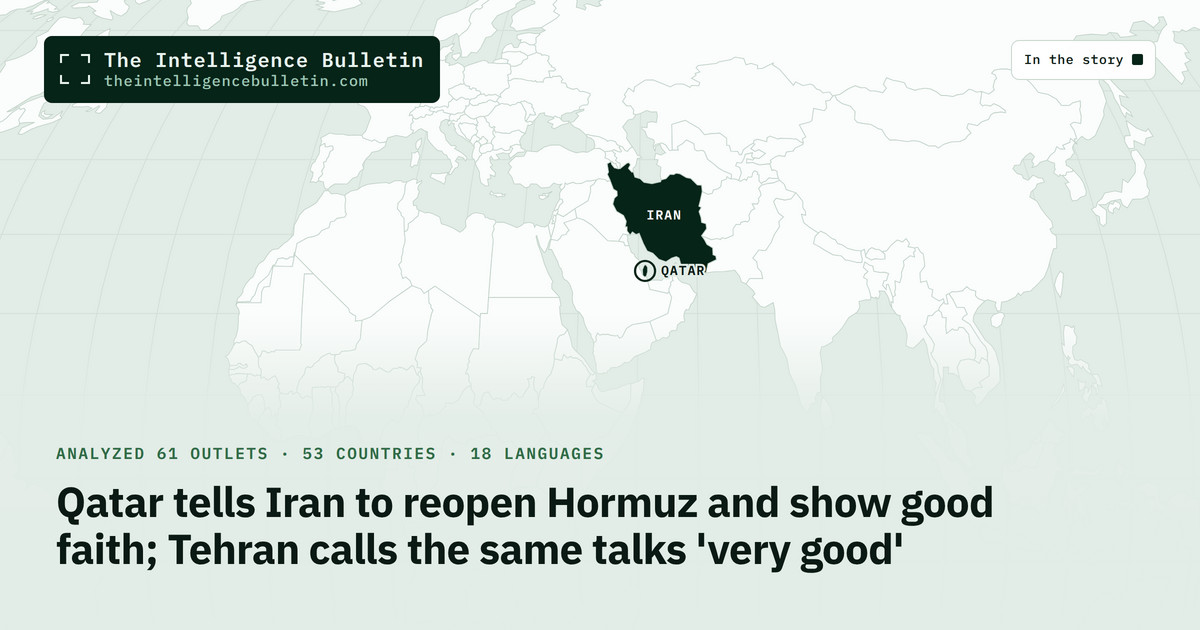
Saudi, Turkish and Pakistani officials met Iran in Tehran on Monday; Qatar’s foreign ministry says Iran must show good faith and reopen the Strait of Hormuz, while Iran’s security chief called the talks ‘very good’ and said regional states should handle their own security. The mediation has produced agreement to keep talking, not a deal.
Across the press: Qatar’s Peninsula and Dubai’s Al Bayan report a Qatari demand that Iran reopen Hormuz, while Pakistan Times relays Iran’s ‘very good’ readout that omits it.
Source base: 5 outlets read in full (Saudi Arabia, France, Qatar, United Arab Emirates, Pakistan), selected from 61 analyzed.
- 1 of 5 · Al Bayan onlyUS President Donald Trump called the short June ceasefire with Iran a ‘waste of time’ and reaffirmed the continuation of the US naval blockade, while CENTCOM denied Iranian claims that US forces had left the Strait of Hormuz.Reported by Al Bayan, which cites Trump’s remarks and CENTCOM’s statement on X denying IRGC naval commander Ali Azmaei’s claim.
- 4 of 5 · reported separatelySenior officials from Saudi Arabia, Turkey and Pakistan met with Iranian officials in Tehran on Monday, October 26, 2026, to discuss regional security and de-escalation.Reported by The Peninsula citing the Qatari foreign ministry spokesman, by Al Bayan in its own reporting, by Pakistan Times citing Iranian state television and Saudi Arabia’s foreign ministry, and by Okaz in its opinion column.
- 4 of 5 · reported separatelyThe meeting included Saudi Defense Minister Prince Khalid bin Salman, Pakistani Army Chief Asim Munir, and Turkish intelligence chief Ibrahim Kalin, who also met Iranian President Masoud Pezeshkian.Reported by The Peninsula, Al Bayan, Pakistan Times, and Okaz, all naming the same three visiting officials and the meeting with Pezeshkian.
- 2 of 5 · reported separatelyQatar’s foreign ministry spokesman Ibrahim bin Sultan Al-Hashmi said Iran must show good faith, stop threatening regional countries, and reopen the Strait of Hormuz.Reported by The Peninsula quoting Al-Hashmi directly, and by Al Bayan quoting the same spokesman in its own Arabic reporting.
- 2 of 5 · reported separatelyIran described the Tehran talks as ‘very good’, with Supreme National Security Council chief Mohsen Rezaei saying participants agreed regional states should take responsibility for their own security and prevent foreign intervention.Reported by Pakistan Times citing Iranian state television and Rezaei’s remarks, and by The Peninsula which notes Iran described the talks as ‘very good’.
- November 1, 2026Iran says all Sinokor South Korean shipping vessels face ‘legal measures’ from this date, a test of whether maritime pressure continues or eases.
- November 3, 2026US midterm elections, after which CNN reported a strike order on Iran is more likely — the date that frames whether diplomacy or military action comes next.
- Next round of Tehran consultationsThe four countries agreed to continue consultations on regional security; the next meeting will show whether the Hormuz reopening demand enters the agenda.
- AnsweredYes — The Peninsula, Al Bayan, Pakistan Times and Okaz all confirm the meeting took place on Monday, October 26, with the three named officials attending and meeting Pezeshkian, and Pakistan Times reports Rezaei’s ‘very good’ characterization of the talks afterward.
- Still openWhat does the pre-agreed immediate deployment of troops and defence capabilities to Saudi Arabia actually consist of — which forces, from which of the three countries, and against what threat — and is it compatible with the de-escalation the Saudis say they are pursuing in Tehran? · Will Trump actually order renewed strikes, on what targets, and would they fall before the November 3 midterms, given that WSJ says no final decision has been made and Trump hints at action as early as Sunday?
- 26 Oct · Tehran hosts Saudi, Pakistani and Turkish officials — Riyadh announces de-escalation, Iranian officials announce an order without the US
- 25 Oct · Pentagon s Iran strike options rest on one WSJ chain; Tehran s Hormuz denial arrives via Tasnim relay
- 27 Oct · US ready to strike Iran in 96 hours—but Netanyahu pushed first, and Trump refused
Full analysis
What happened Why it matters How each country tells it Where accounts conflict Room for disagreement Our assessment Sources and evidence
What happened
Senior officials from Saudi Arabia, Turkey and Pakistan sat down with Iranian leaders in Tehran on Monday, October 26, 2026, in the latest attempt to stop the US-Iran war from reigniting. Saudi Defense Minister Prince Khalid bin Salman, Pakistani Army Chief Field Marshal Asim Munir, and Turkish intelligence chief Ibrahim Kalin met Iranian President Masoud Pezeshkian and Supreme National Security Council chief Mohsen Rezaei, according to The Peninsula, Al Bayan, Pakistan Times and Okaz, all of which name the same three visiting officials and the meeting with Pezeshkian.
The day after, Qatar — which co-leads the mediation with Pakistan — made its position public. Foreign ministry spokesman Ibrahim bin Sultan Al-Hashmi told a press briefing in Doha that the region needs a new security framework, and that "the ball is now in Iran’s court to commit to these principles and demonstrate good faith." He said Iran must "stop threatening countries of the region, and reopen the Strait of Hormuz so that all those efforts can go towards having a safe and prosperous region," as quoted by The Peninsula and Al Bayan. Al-Hashmi added that "messages are ongoing and the exchange of ideas continues through the mediators," and that a Qatari delegation had visited Tehran on Sunday.
Iran’s account of the same meeting was markedly different. Rezaei told Iranian state television the talks had been "very good" and that a more positive atmosphere was developing across the region, Pakistan Times reported. He said participants agreed that security should be achieved through the efforts of countries within the region, and stressed the need to prevent outside intervention — a framing that excludes the United States, whose naval blockade of Iranian ports is a central fact of the crisis. Saudi Arabia’s foreign ministry said the meeting sought to reduce tensions between the parties involved in the current crisis, and Pezeshkian called for stronger regional unity and a coordinated response to emerging security challenges.
The mediation is taking place against a backdrop of active military pressure. Al Bayan reported that US President Donald Trump called the short June ceasefire with Iran a "waste of time" and reaffirmed the continuation of the US naval blockade. CENTCOM denied on X a claim by IRGC naval commander Ali Azmaei that US forces had left the Strait of Hormuz, saying US forces and their partners "are the ones who control the Strait of Hormuz, not Iran." Al Bayan also reported that Iran’s navy announced a fire on an oil tanker after it struck mines east of the strait, and that Iran said all South Korean Sinokor shipping vessels would face "legal measures" from November 1 over alleged violations in the strait.
TIB reported on 26 October that Riyadh framed the quadrilateral as de-escalation in support of Qatari and Pakistani mediation, while Iranian officials presented Iran’s defense of its interests. TIB also reported on 27 October that CNN said US forces could launch major attacks on Iran within 96 hours of a Trump order, with an attack order likely after the November 3 midterms, though Trump has not decided.
Why it matters
The Strait of Hormuz is the chokepoint through which a substantial share of the world’s seaborne oil passes, and it is the single point where the war’s economic consequences and its military logic converge. Al Bayan, published in the Gulf trading hub of Dubai, puts the waterway in its headline and leads with the demand that Iran reopen it — a framing that reflects the strait’s centrality to the Gulf economies whose shipping and energy exports depend on it. The Peninsula, Qatar’s own English-language daily, frames the pressure as polite process: the spokesman’s demand is delivered as an appeal, and the mediation is described as an ongoing exchange of messages rather than a confrontation.
Okaz, the Saudi domestic Arabic daily, reads the diplomacy through Riyadh’s security interests and the Mecca Agreement for mutual defense, which Saudi Arabia, Pakistan and Turkey signed in August. Its opinion column argues that the three countries are moving with their political and security weight to support de-escalation, and that the power to defend one’s security can also create space for dialogue. The column dwells on Iran’s internal economic fragility — declining purchasing power, pressure on ordinary people — as the lever that might push Tehran toward peace, and frames the entire meeting as a test of whether Iran will "seize the message and choose the future."
The National Council of Resistance of Iran, the Paris-based exile opposition group, barely treats the Hormuz mediation as a story at all. Its October 27 roundup uses the moment to document what it calls the regime’s internal factional warfare, economic decay and repression: 2,271 trucks stranded at the Dogharoun border crossing to Afghanistan, Isfahan Steel Company’s net loss of 93 trillion rials over six months, and protests against Pezeshkian in Mashhad. For the NCRI, the Tehran talks are evidence of a system struggling to contain its internal contradictions, not a diplomatic opening.
How each country tells it
- Okaz · Saudi Arabia · opinionA Saudi opinion column framing the Tehran quadrilateral as a test of whether Iran will finally ‘seize the message’ and choose peace, with the outcome placed squarely on Tehran’s answer.
- National Council of Resistance of Iran (NCRI) · France · original reportingAn exile opposition roundup that reads the Tehran talks through the clerical regime’s internal factional warfare, economic decay, and repression rather than as Gulf diplomacy or a shipping crisis.
- The Peninsula · Qatar · original reportingQatar’s own daily reporting the mediation in Doha’s own words, with the foreign ministry spokesman urging Iran to show ‘good faith’ and reopen the Strait of Hormuz while describing messages as ‘ongoing’.
- Al Bayan · United Arab Emirates · original reportingA Dubai Arabic daily that puts the waterway itself in the headline — mediators demand Iran open Hormuz — and pairs that with Trump’s dismissal of ceasefire and CENTCOM’s denial of Iranian claims of US withdrawal.
- Pakistan Times · Pakistan · original reportingIslamabad’s press relaying Iran’s readout of the talks as ‘positive’ and naming Pakistan first among the visiting delegations, treating the meeting as a successful security-format consultation.
Where accounts conflict
The central conflict is not over what happened in the room but over what the meeting means. Qatar’s Peninsula and Dubai’s Al Bayan both report the Qatari foreign ministry spokesman’s demand that Iran show good faith and reopen the Strait of Hormuz, and both present the demand as having been delivered. Pakistan Times relays Iran’s readout of the talks as "very good," with Rezaei’s framing that regional states should take responsibility for their own security and prevent foreign intervention — an account that does not mention the Hormuz reopening demand at all. Okaz, the only Saudi voice, does not report an outcome; it asks whether Tehran has even received the message, framing the entire meeting as an open question.
A second conflict concerns the strait itself. Al Bayan carries Trump’s dismissal of the June ceasefire as a "waste of time" and CENTCOM’s denial that US forces left the strait, quoting CENTCOM as saying US forces and their partners control the waterway. Iran, through IRGC naval commander Ali Azmaei, claimed US forces had left the strait by moving hundreds of kilometers away. CENTCOM called that claim "not true." The two accounts cannot both be right, and the disagreement bears directly on whether Iran’s reopening of the strait is even a meaningful concession while a US naval blockade remains in place.
Room for disagreement
The strongest case that this mediation will produce a deal is the one Iran itself is making. Rezaei told Iranian state television the talks were "very good" and that a more positive atmosphere was developing, and Pakistan Times reports that the four countries agreed to continue consultations on regional security. Pakistan proposed the meeting, and its army chief has now visited Tehran three times since August, most recently on October 20, when he met Pezeshkian, Parliament Speaker Mohammad Bagher Ghalibaf, Foreign Minister Abbas Araghchi and Rezaei. The Peninsula quotes Al-Hashmi saying "we have heard positive statements from the Iranian side." If Iran is genuinely prepared to translate those statements into steps — reopening the strait, stopping threats to regional countries — the mediation has a path. Okaz’s column makes the case that Iran’s internal economic pressures give it a powerful incentive to choose peace, and that engagement could open trade and investment opportunities that the current confrontation forecloses.
Our assessment
It is very unlikely that this mediation produces a reopening of the Strait of Hormuz or a broader de-escalation in the near term. The accounts converge on one fact: the meeting produced agreement to keep talking and nothing else. Qatar’s spokesman said "messages are ongoing," and no source reports a concrete commitment from Iran on the strait, on its seven conditions, or on the nuclear file. The demand that Iran reopen Hormuz sits alongside a US naval blockade that Trump reaffirmed and CENTCOM insists remains in place, and no account reconciles the two. Iran’s own readout — that regional states should handle their own security and prevent foreign intervention — is a direct rejection of the US role, not a step toward accommodation. The NCRI’s reporting on Iran’s internal factional struggle over whether to continue maritime pressure or turn it into leverage for an agreement suggests the decision is not yet made in Tehran.
What would change this: a public Iranian commitment to reopen the strait or a US signal that the naval blockade would be lifted in return, neither of which any source reports.
Sources and evidence
Press quoted
- Did the Tehran meeting produce any concrete commitment from Iran on reopening the Strait of Hormuz, or only an agreement to continue consultations?
- What are the seven conditions Iran has tied to reopening the strait and returning to negotiations, and do the mediators consider any of them acceptable?
- Is the five-day Hormuz plan mentioned in the editor’s framing actually on the table, and if so, what is its status given that none of the selected sources names it?
That’s how the world told the story.
Get our daily open-source intelligence on world events in your inbox — one email a day, up to six stories.
Subscribe freeNo spam. One-click unsubscribe. See the latest email →