 AI-generated analysis published under the editorial responsibility of Rohit Sinnas. How it works →
See the 51 countries
Albania, Argentina, Australia, Austria, Azerbaijan, Bangladesh, Barbados, Bosnia and Herzegovina, Brazil, Bulgaria, Canada, Croatia, Cuba, Cyprus, Czech Republic, Estonia, Georgia, Germany, Greece, Hungary, India, Indonesia, Iran, Ireland, Israel, Italy, Japan, Kenya, Kosovo, Lebanon, Luxembourg, New Zealand, Nigeria, Norway, Poland, Portugal, Qatar, Romania, Russia, Saudi Arabia, Serbia, Somalia, Spain, Syria, Taiwan, Turkey, Tuvalu, Ukraine, United Kingdom, United States, Vietnam
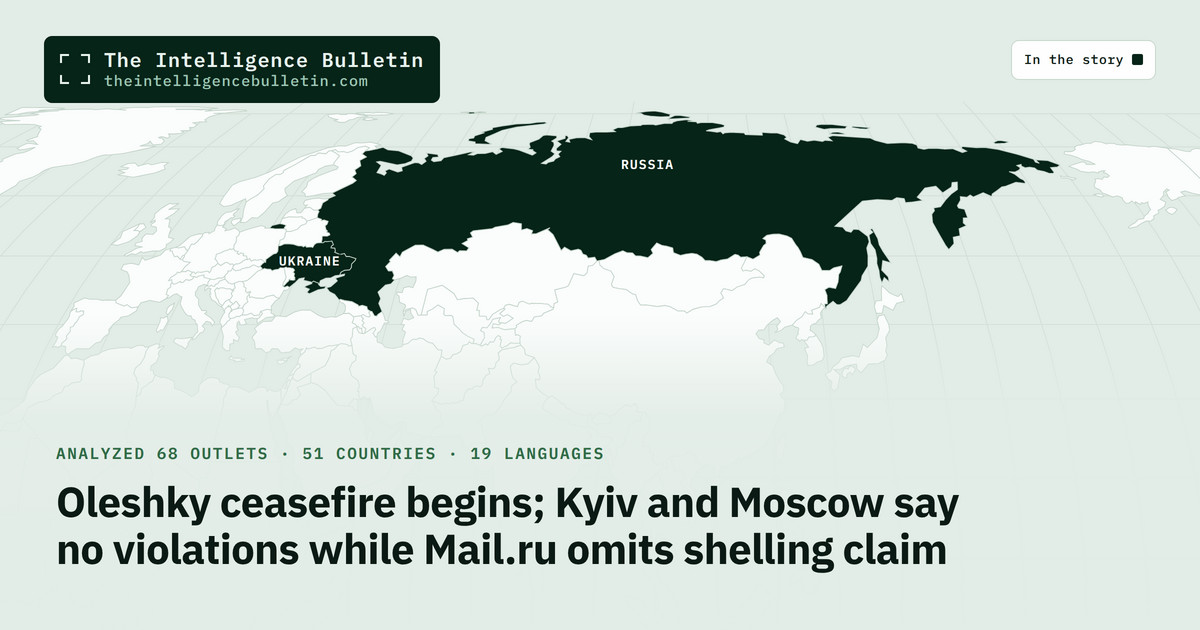
A Melania Trump-mediated ceasefire began October 27 in Russian-occupied Oleshky to deliver aid and evacuate civilians; both ombudsmen reported no violations by 17:30, while Russia’s military, via Politika, claims Ukraine shelled the town 18 times beforehand, unverified by Reuters.
Across the press: Russia’s Mail.ru covers the Oleshky truce as a humane, Musk-endorsed operation and omits Moscow’s own pre-truce shelling accusation carried by Serbia’s Politika.
Source base: 5 outlets read in full (Ukraine, Russia, Romania, Serbia, Indonesia), selected from 68 analyzed.
- 1 of 5 · Politika onlyRussia’s Defense Ministry accused Ukrainian forces of shelling Oleshky 18 times and launching more than 120 drone attacks since October 19, impeding food and medicine delivery and preventing residents from leaving.Politika relays the Russian Defense Ministry’s account and Reuters’s caveat that it could not independently confirm the claims, adding that the Ukrainian side had not responded by publication.
- 5 of 5 · reported separatelyThe local ceasefire in Oleshky began on October 27 at 03:00 Kyiv time, or 04:00 Moscow time.24 Kanal cites Lubinets, Mail.ru News cites KP.RU, Digi24 and Liputan6 relay the Russian Defense Ministry’s Telegram statement via BBC, and Politika reports Russia and Ukraine announced the deal on October 23 for an October 27 start.
- 5 of 5 · reported separatelyThe truce is limited to Oleshky and associated territory, and is a humanitarian operation for aid delivery and civilian evacuation rather than a wider end to the war.All five sources describe the operation as humanitarian; 24 Kanal cites Lubinets on staged delivery, demining and evacuation, while Politika notes Peskov sees it as a possible precedent for similar local truces.
- 2 of 5 · reported separatelyAs of 17:30 on October 27, no violations of the ceasefire had been recorded by either side, and both countries’ ombudsmen said the agreements were being implemented in full.24 Kanal quotes Lubinets’s 17:30 update, and Mail.ru News reports that Russian ombudsman Lantratova and Ukrainian ombudsman Lubinets both stated the agreements are fully observed by both parties.
- 5 of 5 · reported separatelyMelania Trump mediated and coordinated the Oleshky ceasefire with US, Russian and Ukrainian representatives.All five sources report her role: 24 Kanal calls her the mediator and coordinator, Mail.ru News calls her initiator and coordinator, Digi24 and Liputan6 say she secured the deal, and Politika says the agreement was mediated by the US first lady.
- November 1, 22:59 Kyiv timeThe ceasefire’s scheduled end; whether aid delivery, demining and evacuation were completed and whether either side reports a violation.
- Within days of October 27Whether Ukraine responds to the Russian Defense Ministry’s unverified accusation of 18 artillery attacks and more than 120 drone strikes since October 19.
- As the humanitarian mission proceedsWhether the staged delivery, demining and civilian departure plan announced by Lubinets holds and residents actually begin leaving.
- AnsweredThe two militaries’ October 27 date governs: 24 Kanal and Mail.ru News both give 03:00 Kyiv time and 04:00 Moscow time, while Digi24 and Liputan6 relay the Russian Defense Ministry’s stop-firing time at 04:00 Moscow, and no source reports a White House-governed October 29 start in effect.
- Still openDid Kyiv formally accept the White House s preferred destination clause allowing evacuees to choose Russia, and what safe-passage or de-mining guarantees did Moscow give? · Will the truce hold given Russia s record of breaking past ceasefires, and who beyond Newsmax will monitor or verify it?
Full analysis
What happened Why it matters How each country tells it Where accounts conflict Room for disagreement Our assessment Sources and evidence
What happened
The ceasefire that took effect in Oleshky at 03:00 Kyiv time on October 27 is the first concrete pause on Ukrainian territory to follow recent diplomatic appeals by Melania Trump and Pope Leo XIV. Ukrainian human rights ombudsman Dmytro Lubinets confirmed the start to 24 Kanal and said the silence regime is to run until 22:59 on November 1. The Russian Defense Ministry announced on Telegram that its forces stopped firing toward Ukrainian-held Kherson, across the Dnipro, from 04:00 Moscow time, which Digi24 and Liputan6, relaying the BBC, put at 01:00 GMT. Politika notes that Russia and Ukraine announced the deal on October 23 for an October 27 start.
The operation is explicitly local and humanitarian. Oleshky, on the Dnipro’s occupied east bank, fell to Russian troops in the first days of the February 2022 full-scale invasion. Before the war it had about 24,000 residents; Ukrainian estimates carried by Digi24 and Liputan6 now put the remaining population at about 6,000, including 200 children, with severe shortages of food and other essentials. The joint mission run by Lubinets and Russian ombudsman Yana Lantratova is to deliver humanitarian cargo, carry out technical demining and create conditions for civilians to leave, Lubinets told 24 Kanal. He said the operation will be staged and residents will decide for themselves whether to evacuate.
Melania Trump mediated and coordinated the truce with American, Russian and Ukrainian representatives, all five sources report. Mail.ru News, carrying KP.RU, adds that she said the ceasefire zone had been extended beyond the city and that Elon Musk responded to her announcement on X with a one-word endorsement. Politika reports that Pope Leo XIV also urged the two sides to cooperate so the population could receive food and medicine.
As of 17:30 on October 27, Lubinets said that no violations had been recorded by either side and that the agreements were being implemented in full, 24 Kanal reported. Mail.ru News said Lantratova and Lubinets both stated that the agreements were being fully observed by both parties. TIB reported on October 24 that the White House had announced an October 29 start while the two armies said October 27; the October 27 time is the one now in effect.
The only note of discord in the sources concerns the period before the truce. Serbia’s Politika leads with the Russian Defense Ministry’s accusation that Ukrainian forces shelled Oleshky 18 times and carried out more than 120 drone attacks since October 19, disrupting the delivery of food and medicine and preventing residents from leaving. It notes Reuters could not independently confirm the claim and that Ukraine had not responded by publication. Russia’s own domestic account in the pool, Mail.ru News, does not mention that accusation, and Kyiv’s 24 Kanal reports no ceasefire violations since the truce began without taking up the charge.
Why it matters
The stakes are measured in a few thousand people. Oleshky’s remaining residents have been trapped between Ukrainian positions on the Dnipro’s far bank and Russian forces to the east since 2022. Digi24 and Liputan6 stress that roughly 6,000 civilians, including 200 children, may now receive aid or leave. The operation’s narrow scope is itself the point: Peskov told Politika that the Oleshky deal could serve as a precedent for similar local truces if humanitarian access is needed elsewhere, while being careful that it is not a ceasefire for the whole war. For Kyiv, the staged delivery and demining plan described by Lubinets is a way to reach civilians without conceding anything about the occupied status of the town; for Moscow, the operation offers a humanitarian image, reinforced by Musk’s endorsement in Mail.ru News, without addressing the front line.
The first lady’s involvement builds on her August 2025 letter to Putin, noted by Digi24 and Liputan6, in which she said it was time to protect children and future generations. The unresolved question TIB flagged on October 24, whether Kyiv accepted the White House’s preferred clause allowing evacuees to choose Russia and what safe-passage guarantees Moscow gave, is not answered by any of the five reports. That gap will affect the evacuation itself if residents begin to move. The truce also tests the two armies’ ability to hold fire around a negotiated corridor after months in which both sides have accused each other of blocking aid, and after the single-source Russian claim of pre-truce shelling that remains unverified.
How each country tells it
- 24 Kanal · Ukraine · original reportingTreats the Oleshky ‘silence regime’ as a domestic safety and logistics story, relaying Ukrainian ombudsman Dmytro Lubinets’s timetable, the no-violations status, and the staged evacuation and demining plan.
- Mail.ru News · Russia · carries KP.RULeads with Elon Musk’s one-word endorsement of Melania Trump’s announcement and presents the silence regime as a humane, celebrity-approved operation coordinated by the US first lady.
- Digi24 · Romania · carries BBCReads the ceasefire as a neighboring Black Sea region’s aid and refugee story, stressing that Oleshky is Russian-occupied and that roughly 6,000 civilians, including 200 children, still await food and possible evacuation.
- Politika · Serbia · carries ReutersLeads with the Russian Defense Ministry’s claim that Ukraine launched 18 artillery attacks and more than 120 drone attacks on Oleshky since October 19, disrupting aid and evacuation, before noting Reuters could not verify it.
- Liputan6 · Indonesia · carries BBCPresents the ceasefire as a distant wire event in which Melania Trump is the primary actor, watched from outside Europe without a claimed stake in the outcome.
Where accounts conflict
The clearest divergence is not over the ceasefire itself, which all five accounts corroborate, but over what happened in Oleshky in the days before it. Serbia’s Politika leads with the Russian Defense Ministry’s accusation that Ukrainian forces shelled Oleshky 18 times and launched more than 120 drone attacks since October 19, impeding aid and evacuation; it notes Reuters could not independently confirm and Ukraine had not responded. Russia’s own domestic pick, Mail.ru News carrying KP.RU, does not mention the accusation at all, instead reporting Musk’s endorsement and both ombudsmen’s statements that the truce agreements are being fully implemented. Kyiv’s 24 Kanal also does not take up the shelling claim; it reports that as of 17:30 no violations had been recorded by either side since the truce began. A reader depending on Mail.ru would not know Moscow’s military had made the charge; a reader depending on 24 Kanal would not know it existed; only Politika surfaces it, with the verification caveat attached.
Room for disagreement
The strongest case against reading the first day as a durable pause comes from the Russian military’s own pre-truce account. If Ukrainian forces were shelling Oleshky and flying drones as recently as October 19, the front-line conditions that made aid impossible are still present; the truce is an agreement between civilian ombudsmen and a first lady, with no independent monitor described in any source. Reuters could not verify the Russian shelling claim, but nor has Ukraine responded publicly in this set. Peskov’s statement that Oleshky could be a precedent implies no wider military disengagement, and Russia’s record of broken ceasefires, noted in TIB’s earlier edition, cuts against confidence. A single day without recorded violations is not yet evidence of a stable corridor.
Our assessment
The Oleshky ceasefire is likely to hold through its scheduled end on November 1 as a narrow humanitarian exception, not a turn toward wider negotiations. The call rests on the convergence of independent reporting chains on October 27: Ukraine’s ombudsman Lubinets in 24 Kanal gives 17:30 no violations; Russia’s Lantratova and Lubinets in Mail.ru News and KP.RU say agreements fully observed; the Russian Defense Ministry’s Telegram via BBC says fire stopped; Politika and Reuters note both countries announced on October 23. That is corroboration across Ukrainian, Russian, Western and Southeast Asian conduits. The main parties and the mediator have an interest in presenting the operation as successful, but the specific on-record statements about no violations are checkable, and a public collapse would embarrass all of them. Moscow’s unverified shelling accusation is the unresolved risk; it concerns the pre-truce period, so it does not by itself invalidate the ceasefire, but it shows the military side that will keep firing if it judges the operation compromised.
What would change this: independently confirmed shelling or a drone attack inside the ceasefire zone after 03:00 Kyiv time on October 27, or an ombudsman from either side reporting a violation, would move the judgment to unlikely.
Sources and evidence
Press quoted
- Did Ukrainian forces actually carry out the 18 artillery and 120-plus drone attacks Russia’s Defense Ministry alleges against Oleshky between October 19 and the truce, and has Kyiv answered that specific claim beyond its earlier accusation that Russia blocks aid?
- What does the reported extension of the ceasefire zone beyond Oleshky cover in operational terms, and how are evacuation destinations being determined for the roughly 6,000 remaining civilians?
- Who beyond the two countries’ own ombudsmen and Melania Trump’s coordination will independently monitor or verify the truce, and what role did Pope Leo XIV actually play, given only Politika reports his appeal?
That’s how the world told the story.
Get our daily open-source intelligence on world events in your inbox — one email a day, up to six stories.
Subscribe freeNo spam. One-click unsubscribe. See the latest email →