 AI-generated analysis published under the editorial responsibility of Rohit Sinnas. How it works →
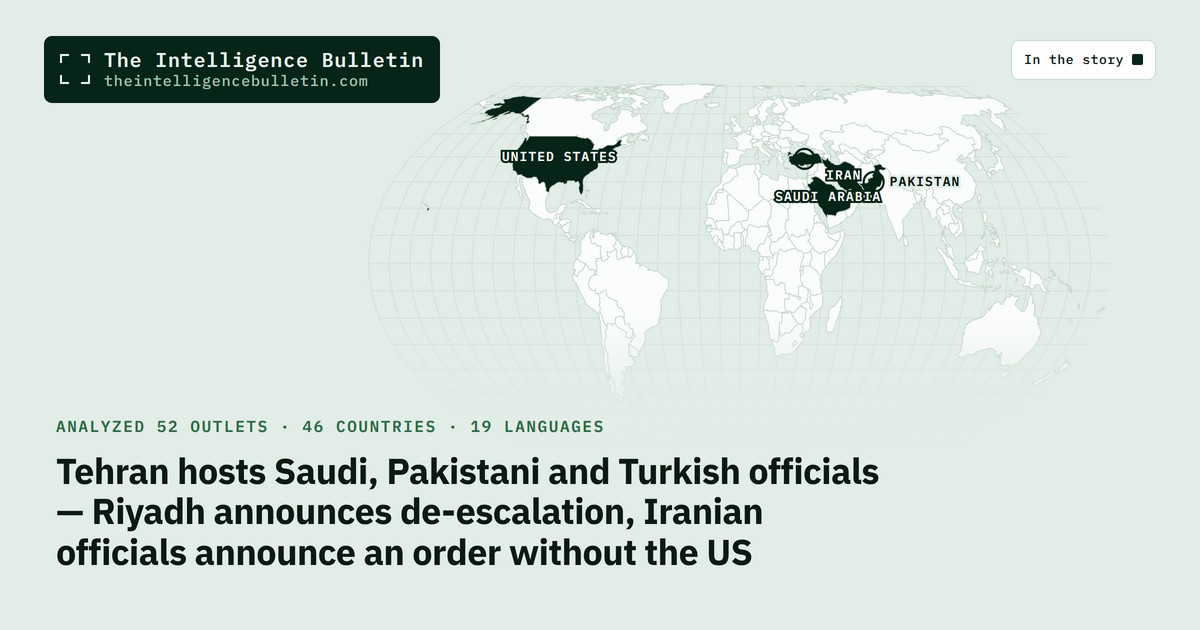
See the 46 countries
Albania, Algeria, Armenia, Australia, Azerbaijan, Belarus, Benin, Bosnia and Herzegovina, Brazil, Canada, China, Cuba, Cyprus, Egypt, France, Greece, Indonesia, Iran, Iraq, Israel, Kuwait, Kyrgyzstan, Lebanon, Malaysia, Mexico, Oman, Pakistan, Poland, Portugal, Qatar, Romania, Russia, Saudi Arabia, Serbia, Singapore, South Korea, Sri Lanka, Sudan, Syria, Taiwan, Turkey, Tuvalu, United Arab Emirates, United Kingdom, United States, Vietnam
Saudi, Pakistani and Turkish officials met Iranian security chiefs in Tehran on Monday. Riyadh says the goal is de-escalation and support for Qatari-Pakistani mediation; Iranian officials say it is a security order without the US or Israel.
Across the press: Riyadh’s announcement in Okaz and Al Jazeera says de-escalation; Iran’s Press TV and Al-Manar never use the word, selling an order excluding America.
Source base: 5 outlets read in full (Iran, Saudi Arabia, Pakistan, Qatar, Lebanon), selected from 52 analyzed.
- 2 of 5 · one shared reportRiyadh casts the trip as part of the Mecca Agreement countries’ efforts to reduce escalation between the parties to the current crisis and support the mediation led by Qatar and the Islamic Republic of Pakistan.The Saudi official line, carried in near-identical wording by Okaz and in Al Jazeera’s quotation of Deputy Foreign Minister Raed Qarmali; Press TV and Al-Manar never use this framing.
- 4 of 5 · one shared reportThe meeting was proposed during Pakistani Army chief Munir’s visit to Tehran last week, when he informed Rezaei of the decision by senior Saudi, Turkish and Pakistani officials to travel to Iran for a joint session.Iranian officials: SNSC Deputy Secretary Ali Bagheri Kani (Press TV, AAJ via IRIB, Al-Manar) and the Iranian Foreign Ministry (Al Jazeera).
- 1 of 5 · AAJ TV onlySaudi Arabia, Pakistan and Turkey signed the Mecca Joint Defense Agreement in August this year, including a clause treating an armed attack on one member as an attack on all members.AAJ TV’s background account of the pact; the other four outlets mention the ‘Mecca Agreement for Joint Defense’ but state neither the August signing nor the collective-defence clause.
- 1 of 5 · AAJ TV onlyThe three pact members agreed this month to ensure the immediate deployment of troops and defence capabilities to Saudi Arabia.AAJ TV, attributed to ‘the news agency’ (Reuters); none of the other four outlets carries it.
- 5 of 5 · reported separatelySaudi Defense Minister Prince Khalid bin Salman, Pakistani Army chief Asim Munir and Turkish intelligence chief Ibrahim Kalin meet Iranian officials in Tehran on Monday, including SNSC Secretary Mohsen Rezaei.Reported independently by Iranian SNSC officials (Press TV and Al-Manar), by the Saudi official announcement (Okaz and Al Jazeera) and via Reuters (AAJ).
- Monday, after the Tehran meeting closesAny joint statement, or its absence, will show whether the Mecca signatories and Iran agreed on shared language or papered over the split.
- Within daysQatar and Pakistan, named by Riyadh as mediators, may announce the next step of their track, including whether US-Iran message exchanges produce a new round.
- In the coming daysAny confirmation or denial of the reported pact decision on immediate troop deployment to Saudi Arabia — carried only by AAJ — would test whether the military track is real.
- Still openWill Trump actually order renewed strikes, on what targets, and would they fall before the November 3 midterms, given that WSJ says no final decision has been made and Trump hints at action as early as Sunday?
- 20 Oct · Turkey submits the Mecca pact to parliament; Sega calls it Islamic NATO, SANA relays Mecca Alliance
- 21 Oct · Arab News calls Sisi s defense-only pledge reassuring; Annabaa sees Cairo hanging its war decision on Riyadh
- 25 Oct · Saudi coalition says Taif and Yanbu; its civil defense says Mecca and Medina; Houthis call that a lie
- 25 Oct · Pentagon s Iran strike options rest on one WSJ chain; Tehran s Hormuz denial arrives via Tasnim relay
Full analysis
What happened Why it matters How each country tells it Room for disagreement Our assessment Sources and evidence
What happened
Saudi Defense Minister Prince Khalid bin Salman, Pakistani army chief Field Marshal Asim Munir and Turkish intelligence chief Ibrahim Kalin were due in Tehran on Monday for a quadrilateral meeting with Iran’s Supreme National Security Council secretary, Major General Mohsen Rezaei. Iran’s deputy SNSC secretary, Ali Bagheri Kani, announced the visit in terms carried by Press TV, Al-Manar and AAJ TV; the Saudi announcement in Okaz and Deputy Foreign Minister Raed Qarmali’s statement quoted by Al Jazeera said the visiting representatives were also expected to meet Iranian President Masoud Bezhakian.
The two sets of announcements gave the meeting different purposes. Qarmali said the visit came "in the framework of continuing efforts of the countries of the Mecca Agreement for Joint Defense to reduce escalation between the parties to the current crisis, encourage dialogue and diplomatic solutions, and support the mediation efforts undertaken by the State of Qatar and the Islamic Republic of Pakistan." Okaz used almost identical wording and said the meetings also aimed to affirm the Mecca Agreement countries’ "pivotal role" in regional security. The Iranian account did not use the word de-escalation. Bagheri Kani said the meeting would advance "the idea of ensuring security by regional countries" and draw on Iran’s experience during what he called the 40-day US-Israeli war, which began on February 28. He described Iran’s indigenous defense model as "a successful model for ensuring national security" and said any foreign interference, "particularly by the US regime," and any role for "the illegitimate Zionist regime" disrupt regional security.
Bagheri Kani said the meeting was proposed during Munir’s visit to Tehran last week, when the Pakistani army chief informed Rezaei of the decision by senior Saudi, Turkish and Pakistani officials to travel to Iran and hold the joint session. Iran’s Foreign Ministry, in Al Jazeera’s account, said the initiative had been proposed during that visit and approved by Iran.
The gathering is the first high-level joint contact between the three pact countries and Iranian leadership since intensified Houthi attacks on Saudi Arabia, according to AAJ TV’s report relaying Reuters. It lands days after Houthi ballistic missiles and drones struck at Saudi Arabia and Aden on October 24, and as the Pentagon has given President Trump options for renewed strikes on Iran without a final order, as TIB reported earlier. In this cycle, AAJ alone among the five accounts read adds two pact details: that Saudi Arabia, Pakistan and Turkey signed the Mecca agreement in August with a clause treating an armed attack on one member as an attack on all three, and that the three members agreed this month to ensure the immediate deployment of troops and defense capabilities to Saudi Arabia. TIB reported on October 20 that the pact, signed August 7, includes a NATO-style mutual defense clause and has been submitted to Turkey’s parliament. The other four accounts name the Mecca Agreement for Joint Defense but do not state the August signing, the collective-defense clause or the deployment decision.
Why it matters
The meeting is a live test of whether the Mecca pact’s military hardening and diplomacy can move in the same direction. Riyadh’s official language describes the Tehran visit as part of a de-escalation track alongside Qatari and Pakistani mediation; the news agency account carried by AAJ says the pact members agreed this month to ensure immediate deployment to Saudi Arabia. That makes the meeting’s actual agenda important beyond any communique: either the four governments find a shared description of the crisis, or the pact continues to prepare for one while talking to Iran about another. Tehran’s framing matters equally, because it presents Iran not as a side to be de-escalated but as the author of a regionally owned security order from which the United States and Israel are excluded. President Bezhakian’s expected meeting with the visiting delegation, noted by Okaz and Al Jazeera, would give that Iranian proposal a head-of-state platform.
How each country tells it
- Press TV · Iran · original reportingTehran’s official line that the visit promotes a regionally-owned security framework built on Iran’s ‘successful defense model’ from the 40-day US-Israeli war that began February 28.
- Okaz · Saudi Arabia · original reportingRiyadh’s self-presentation: Prince Khalid bin Salman heads the Kingdom’s delegation to talks pre-labelled as de-escalation efforts supporting Qatari and Pakistani mediation.
- AAJ TV · Pakistan · carries ReutersThe trip as the Mecca defence pact’s first live test: pact officials meeting ‘the Iranian leadership’ amid Houthi attacks, with the collective-defence clause as the backdrop.
- Al Jazeera · Qatar · original reportingThe cautious, mediation-centred account: the meeting is still ‘anticipated’, the peg is Saudi Deputy Foreign Minister Raed Qarmali’s announcement, and Iranian grievances about US refusal of ‘legitimate demands’ are folded in.
- Al-Manar · Lebanon · original reportingThe axis reading: a ‘four-way meeting to strengthen regional security’ in which the Mecca Pact members’ arrival validates Tehran rather than pressures it.
Room for disagreement
The strongest case that this is a genuine de-escalation track is on the record from both Riyadh and Tehran. Qarmali’s statement explicitly commits the Mecca Agreement countries to reducing escalation and supporting Qatari and Pakistani mediation, and Okaz repeats that the meetings aim at containing the current crisis and its repercussions. On the Iranian side, Al Jazeera reports that Foreign Ministry spokesman Esmaeil Baghaei said Tehran is still exchanging messages with Washington through intermediaries and has not left the negotiating table; an Iranian official called the mediation efforts positive, while saying they "always collide with the American administration’s evasion of its commitments." A Qatari delegation visited Tehran on Sunday, in what the Iranian Foreign Ministry described as continuing communication amid rising regional tension. Under this reading, the arrival of the Saudi defense minister and Pakistani army chief is itself the de-escalation step: the military leaders are in the room, the mediator is Qatar, and the meeting gives both sides a way to lower the temperature without abandoning their public positions.
Our assessment
It is likely that the Tehran meeting remains a parallel track rather than a single de-escalation mechanism. The reporting supplies the reason: the Saudi announcement and Qarmali identify the meeting’s purpose as reducing escalation in the current crisis and supporting Qatari and Pakistani mediation, while Iranian officials quoted by Press TV and Al-Manar never use the word de-escalation and describe a regional security order built on Iran’s defense model, with any US or Israeli role named as a source of instability. Those are not two descriptions of the same diplomatic track; they are two tracks occupying the same room. The only account carrying the pact’s military commitments, AAJ via Reuters, reports that the three signatories agreed this month to ensure immediate deployment of troops and defense capabilities to Saudi Arabia, which points to preparation rather than conciliation. Al Jazeera’s mediation-centered reporting shows Qatar trying to hold both vocabularies together, but the Iranian official it quotes says the obstacle is Washington’s refusal of Iran’s "legitimate demands," not the absence of a forum. A joint statement vague enough to satisfy both sides is likelier than a concrete mechanism.
What would change this: a written, jointly announced agreement between Saudi and Iranian officials that names the current crisis, commits the Mecca signatories to defined de-escalation steps, and is mirrored by a public Iranian acceptance of Qatar and Pakistan’s mediation on those specific terms.
Sources and evidence
Press quoted
- Did the meeting take place as scheduled today, and did Khalid bin Salman, Munir and Kalin actually sit with Rezaei as every article was written before the meeting and none reports an outcome?
- Does Iran accept Riyadh’s de-escalation framing, or is Tehran using the session to pull Mecca Pact members into an ‘indigenous’ regional security order that excludes the United States — and if both readings are in play, which one governs the follow-up?
- What does the pre-agreed ‘immediate deployment of troops and defence capabilities to Saudi Arabia’ actually consist of — which forces, from which of the three countries, and against what threat — and is it compatible with the de-escalation the Saudis say they are pursuing in Tehran?
That’s how the world told the story.
Get our daily open-source intelligence on world events in your inbox — one email a day, up to six stories.
Subscribe freeNo spam. One-click unsubscribe. See the latest email →