 AI-generated analysis published under the editorial responsibility of Rohit Sinnas. How it works →
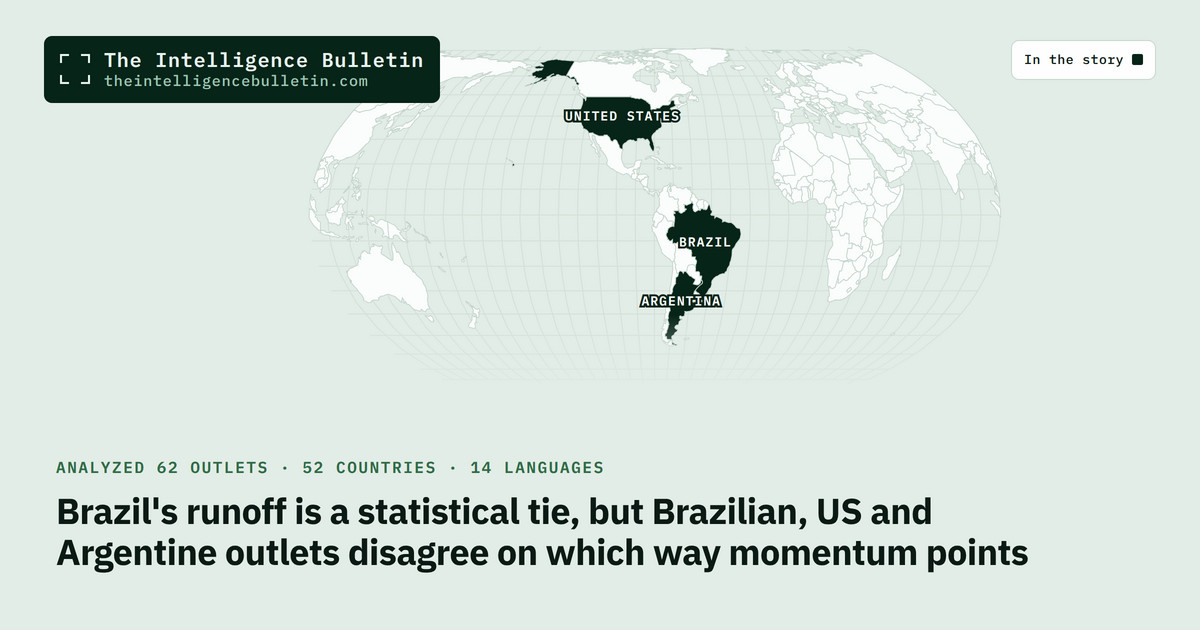
See the 52 countries
Argentina, Azerbaijan, Bangladesh, Belgium, Benin, Bolivia, Brazil, Canada, Cape Verde, Chile, China, Costa Rica, Cuba, Denmark, Dominican Republic, Ecuador, Egypt, Estonia, France, Germany, Guatemala, India, Israel, Japan, Kenya, Lithuania, Luxembourg, Malaysia, Mali, Mexico, Nigeria, Norway, Panama, Paraguay, Peru, Poland, Portugal, Qatar, Romania, Serbia, Singapore, Sweden, Switzerland, Taiwan, Tunisia, Turkey, Tuvalu, United Kingdom, United States, Uruguay, Venezuela, Vietnam
Brazilians voted Sunday in a runoff between President Lula and Senator Flávio Bolsonaro after a first round Bolsonaro led 47%-45%. Final polls are statistically tied; a close result could trigger a disputed aftermath, given both camps’ pre-positioned narratives and the US alignment stakes.
Across the press: Revista Fórum’s headline says Lula ‘turned’ ahead while Newsweek’s says Bolsonaro’s lead ‘shrunk’ to a tie, though both polls are within the margin of error.
Source base: 5 outlets read in full (Brazil, United States, Argentina, India), selected from 62 analyzed.
- 2 of 5 · one shared reportBrazilians went to the polls on Sunday, Oct. 25, 2026 for a second-round runoff between President Lula and Senator Flávio Bolsonaro, and both candidates cast ballots in the morning.G1 reports from polling places in Rio and São Bernardo do Campo, with Reuters and AFP photos; Minuto Uno repeats the voting updates via G1.
- 2 of 5 · one shared reportAfter voting, Flávio Bolsonaro declared it was time for change and Lula said he had never seen comparable popular mobilization in 50 years of politics.G1 quotes both candidates from their polling places; Minuto Uno repeats the G1 updates and headline excerpts.
- 4 of 5 · reported separatelyPreelection surveys showed a statistically indistinguishable race, with different polls placing either candidate a point or less ahead.Revista Fórum cites a Colectta/Brazil Economy poll (Lula 50.3%-49.7% of valid votes, margin ±2 points); Newsweek cites Datafolha (50%-50% valid); Minuto Uno cites an Oct. 17-20 study (Bolsonaro 45%-44%); The Times of India summarizes polls as neck-and-neck.
- 3 of 5 · reported separatelyFlávio Bolsonaro led the first-round vote on Oct. 4, finishing with roughly 47% to Lula’s 45%.Newsweek reports exact first-round figures (47.03% to 45.16%); Minuto Uno gives 47% to 45%; The Times of India reports Bolsonaro won more than 2.2 million more votes.
- 2 of 5 · reported separatelyFlávio Bolsonaro has aligned himself with Donald Trump and pledged a foreign-policy shift toward the US, Israel and Argentina, while Trump has remained publicly restrained about the race.Newsweek reports his Oval Office meeting with Trump, JD Vance and Marco Rubio and his pledge to join the Shield of the Americas; The Times of India reports he has courted Trump and promised a shift in foreign policy.
- Within days after the resultWhether Flávio Bolsonaro recognizes a narrow Lula victory, as Newsweek analysts split on the likelihood of fraud claims.
- If Bolsonaro winsWhether Lula supporters accept the result, given the Meta AI controversy over campaign image generation and US groups’ calls for oversight.
Full analysis
What happened Why it matters How each country tells it Where accounts conflict Room for disagreement Our assessment Sources and evidence
What happened
On Sunday, October 25, 2026, Brazilians voted in the second round of a presidential runoff between incumbent Luiz Inácio Lula da Silva of the Workers’ Party and Senator Flávio Bolsonaro of the Liberal Party, son of former president Jair Bolsonaro. Both candidates cast ballots in the morning: Flávio in Rio de Janeiro around 8:20, accompanied by his wife Fernanda and the state’s governor-elect Douglas Ruas; Lula in São Bernardo do Campo around 9:30, the city where he is registered to vote. G1 reported both voting events, and Minuto Uno relayed the same updates for Spanish-speaking readers.
After voting, Flávio told reporters it was time for change, saying Brazil cannot withstand four more years as things are, that life had worsened and hope had turned to fear of street crime, empty refrigerators and unpaid bills, and urged supporters to turn out regardless of weather. Lula, who is 80 and says he has spent five decades in politics, said he had never seen such popular mobilization in any previous campaign, and that he was voting grateful to the Brazilian people.
The vote followed a first round on October 4 in which Flávio Bolsonaro finished first with 47.03% to Lula’s 45.16%, a margin of roughly 2.2 million votes according to The Times of India. Pre-election surveys released in the final days showed a statistically indistinguishable race. Revista Fórum cited a Brazil Economy/Colectta poll conducted Friday with 3,000 voters across all 27 federal units, putting Lula at 50.3% of valid votes to Bolsonaro’s 49.7%, within the two-point margin of error. Newsweek cited a Datafolha poll released Thursday showing the two tied at 50% of valid votes, down from a 52-48 Bolsonaro advantage two weeks earlier. Minuto Uno repeated an October 17-20 study of 2,154 people that gave Bolsonaro 45% to Lula’s 44%, also within the margin. The Times of India summarized the race as neck-and-neck.
Flávio Bolsonaro has aligned himself closely with US President Donald Trump. In May he met Trump in the Oval Office, then Vice President JD Vance and Secretary of State Marco Rubio, and pledged to bring Brazil into Trump’s Shield of the Americas security initiative. Newsweek reported that Trump has remained publicly restrained about the race, a deliberate strategy that analysts said likely helps Bolsonaro because Brazilians resent foreign meddling. Washington has nonetheless leaned on Brazil: the Trump administration imposed 50% tariffs on Brazilian goods in 2025, sanctioned Supreme Court Justice Alexandre de Moraes before later removing the sanctions, and opened a trade investigation targeting the country’s payment system. Democrats in Washington pushed back, with a State Department response affirming Brazilians’ right to free and fair elections after a letter from Senator Bernie Sanders and 30 House Democrats.
Why it matters
The runoff will set the direction of Latin America’s largest economy and its alignment with the United States, China and the rest of the region. A Bolsonaro victory would give Trump an aligned government in the hemisphere’s biggest country, what Newsweek called the biggest prize yet for an administration pursuing a "Donroe Doctrine." Flávio has pledged to shift foreign policy toward the US, Israel and Argentina, to move Brazil’s embassy in Israel to Jerusalem, to oppose United Nations language on gender and to reverse climate policy. Lula, by contrast, has advocated multilateralism and stronger ties with Mercosur and the BRICS group, and has criticized Trump’s trade measures. Yet analysts told Newsweek that even a Bolsonaro administration would not reduce China’s presence in Brazil’s economy: Brazil now exports more to China than to the United States and Europe combined, and Brazilian agribusiness depends on access to the Chinese market.
Domestically, the campaign centered on rising living costs, crime, corruption and public finances. Brazil’s public debt rose to 82.9% of GDP during Lula’s term, inflation remains above the central bank’s 3% target, and both candidates face scrutiny over corruption allegations involving people close to them. The immediate stakes are also institutional: Newsweek reported that analysts are divided over whether a close result could trigger another crisis, recalling the January 8, 2023, storming of government buildings by Jair Bolsonaro supporters after the last election. Some analysts said a narrow Lula victory would almost certainly draw false claims of fraud from Flávio; others said both candidates would probably concede. The controversy over Meta’s AI tools generating campaign images for Bolsonaro but refusing identical prompts about Lula has added a new layer of distrust about Big Tech’s role.
How each country tells it
- G1 (Globo) · Brazil · original reportingCovers voting day as a domestic civic event, reporting where Lula and Flávio Bolsonaro cast ballots, who accompanied them, and their first remarks.
- Revista Fórum · Brazil · carries Brazil Economy/ColecttaLeads on a Brazil Economy/Colectta poll showing Lula marginally ahead of Flávio Bolsonaro on the eve of the second round.
- Newsweek · United States · original reportingFrames the runoff around Washington’s calculated silence: Bolsonaro’s once-clear lead has narrowed to a statistical tie while Trump stays on the sideline.
- Minuto Uno · Argentina · carries G1A liveblog for Spanish-speaking readers that follows TSE timing, candidate voting, celebrity Lula endorsements and recent polls minute by minute.
- The Times of India · India · opinionA thematic explainer for Indian readers: five issues — cost of living, crime, corruption, foreign policy and Trump ties, and democratic institutions — shaping the race.
Where accounts conflict
The most visible conflict is not over the facts of the vote but over the direction of the race, and it arises entirely from which poll each outlet chose to lead with. Revista Fórum’s headline announced that Lula had "turned" ahead of Flávio Bolsonaro on the eve of the runoff, citing the Brazil Economy/Colectta poll’s 50.3%-49.7% split among valid votes. Newsweek’s headline said Bolsonaro’s lead over Lula had "shrunk" to a statistical tie, citing Datafolha’s 50%-50% result. Minuto Uno, relaying an October 17-20 study, put Bolsonaro at 45% and Lula at 44%. All three polls carry a two-point margin of error, so none shows a lead outside statistical noise. The Colectta poll itself added to the ambiguity: while it showed Lula marginally ahead in vote intention, 50.3% of respondents said they believed Bolsonaro would win, against 39.7% who expected Lula to win, and the poll’s CEO estimated that around six million voters could still change their minds. The disagreement, then, is in the narrative each publication attaches to numbers that are statistically identical.
Room for disagreement
The strongest case against the expectation of a disputed aftermath comes from Michael Shifter of the Inter-American Dialogue, who told Newsweek he expects both candidates to concede. Lula, he said, can be expected to accept the result if he loses. And Flávio, he argued, has promised to respect the result, is not his father, and the moment is different, so a reprise of January 8 is unlikely. Patricio Navia of New York University made a related point: Flávio has largely steered clear of his father’s fraud rhetoric, so if he starts denouncing fraud after a loss, that claim would be weakened by the fact that fraud accusations were not central to his campaign. On this view, the election will produce a clear winner and a normal transfer of power, however narrow the margin, because neither candidate has built his identity on election denial.
Our assessment
Very likely, the next development after polls close is not a clean concession but a contested aftermath, because every credible poll places the candidates within a statistical tie and both camps have already constructed narratives to explain a narrow loss as illegitimate. Newsweek’s reporting carries the strongest warrant: Benjamin Gedan, a former White House National Security Council director for South America, said false claims of fraud from Flávio are "almost guaranteed" if Lula wins narrowly; Oliver Stuenkel of the Getulio Vargas Foundation said it is "practically guaranteed" that Flávio will not recognize a narrow defeat and that Trump could not either; Gimena Sánchez of WOLA said it is unclear whether the US will accept a Lula result. On the other side, Stuenkel noted that some Lula voters may argue a Bolsonaro win was potentially rigged due to Big Tech’s role. Both campaigns have an interest in keeping a thin margin in play, and the Colectta poll’s estimate of six million persuadable voters suggests the official count is unlikely to produce a comfortable margin.
What would change this: a margin of more than two percentage points in the official result, which would leave the loser without a statistically plausible basis to dispute the outcome.
Sources and evidence
Press quoted
- Which candidate actually won the runoff, and by what margin?
- Will the loser accept a narrow result, especially Flávio Bolsonaro given analysts’ warnings, and will Trump recognize the outcome?
- What role, if any, did reported issues such as Meta platform bias, crime fears or foreign interference play in the final vote?
That’s how the world told the story.
Get our daily open-source intelligence on world events in your inbox — one email a day, up to six stories.
Subscribe freeNo spam. One-click unsubscribe. See the latest email →