 AI-generated analysis published under the editorial responsibility of Rohit Sinnas. How it works →
See the 28 countries
Argentina, Bolivia, Brazil, Canada, Chile, Colombia, Costa Rica, Cuba, Dominican Republic, Ecuador, El Salvador, France, Germany, Guatemala, Haiti, Italy, Japan, Lebanon, Mexico, Nicaragua, Nigeria, Panama, Qatar, Romania, Spain, Turkey, United Kingdom, United States
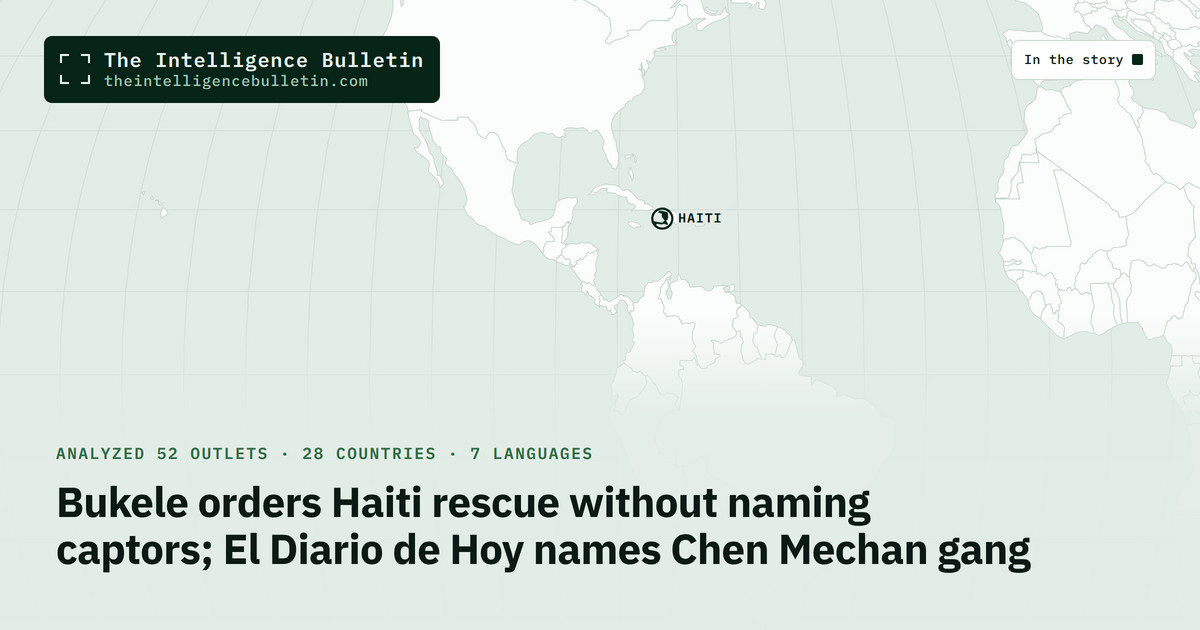
Four Salvadoran aviation technicians kidnapped after a Sunday ambush near Port-au-Prince are the object of a military rescue Bukele announced Wednesday, threatening escalation unless they are freed alive. El Diario de Hoy names the captors as the Chen Mechan gang; CBC says Bukele did not.
Across the press: El Diario de Hoy names the gang holding the four as Chen Mechan, while CBC reports Bukele announced the operation without identifying the captors.
Source base: 5 outlets read in full (El Salvador, Haiti, Dominican Republic, Canada, Brazil), selected from 52 analyzed.
- 1 of 5 · Brasil 247 onlyAt the UN Security Council, El Salvador’s ambassador demanded urgent recovery of the four, and US envoy Mike Waltz said Washington believes they survived and is providing logistical support.Only Brasil 247, relaying teleSUR, reports this exchange; no other selected source mentions a Security Council session.
- 5 of 5 · reported separatelyFour Salvadoran members of the international force in Haiti have been missing since an ambush on their armoured vehicle on Sunday 18 October near Croix-des-Bouquets and Santo, outside Port-au-Prince.Reported independently by El Diario de Hoy citing the Gang Suppression Force, Le Nouvelliste, El Día, CBC News citing security officials, and Brasil 247 relaying teleSUR.
- 5 of 5 · reported separatelyBukele publicly announced that El Salvador had launched a military operation in Haiti to rescue the four and demanded their return alive and unharmed.Bukele’s post on X, quoted or reported by El Diario de Hoy, El Día, CBC News and Brasil 247; Le Nouvelliste presents it as an ultimatum in its headline and opening.
- 3 of 5 · reported separatelyBukele warned the gangs that the attacks so far are nothing compared with what El Salvador will do if the four are not released alive.Bukele’s X message, quoted by El Diario de Hoy, El Día and Brasil 247; CBC’s article does not carry the explicit warning, and Le Nouvelliste’s visible portion stops before it.
- 4 of 5 · reported separatelyThe four are non-combatant aviation technicians or pilots whose unit carries out medical evacuations, not combat.Bukele’s X post, carried by El Diario de Hoy, El Día, CBC News and Brasil 247; Le Nouvelliste’s visible text calls them soldiers.
- In the coming daysThe Gang Suppression Force said it will issue further verified updates through official channels on the search in Santo, which will show whether the four have been recovered.
- In the coming weeksWhether the UN Security Council returns to the matter, after El Salvador’s ambassador demanded urgent recovery and US envoy Mike Waltz said Washington believes the men survived, as reported only by Brasil 247 relaying teleSUR.
Full analysis
What happened Why it matters How each country tells it Where accounts conflict Room for disagreement Our assessment Sources and evidence
What happened
Four Salvadoran aviation technicians disappeared on Sunday 18 October when their armoured vehicle was ambushed by armed gangs near Croix-des-Bouquets and Santo, on the Cul-de-Sac plain outside Port-au-Prince, as they returned from buying food at a local market. The event and the rescue run through one document: a post by President Nayib Bukele on X, published Wednesday 21 October in Spanish and Haitian Creole, which announced a military operation and delivered an ultimatum. "Return our four compatriots to us alive, without any harm, and everything will return to how it was before the kidnapping," Bukele wrote, addressing the gang leaders directly.
The four are members of an international force, named by CBC News as the UN Gang Suppression Force and by Brasil 247, relaying teleSUR, as Força-Tarefa Libertad II. El Diario de Hoy reports they are aviation technicians in a mission dedicated to medical evacuations, and that they were intercepted by the Chen Mechan gang, known as Perro Feroz. CBC News reports that Bukele announced the operation without identifying the group holding the Salvadorans hostage. El Salvador’s armed forces, as relayed by Brasil 247, say the armoured vehicle was ambushed and burned by explosives in Santo; CBC reports, citing security officials, that the four leapt from the burning vehicle. Contact with them has been lost since the attack.
The Gang Suppression Force said in a statement on 20 October that its troops had been operating in the area since Sunday, facing armed gang members with helicopter support. The force reported that several gang members were killed or wounded, without giving numbers, and that four of its own personnel had been injured and were receiving medical care. It asked residents of Santo and nearby communities to stay indoors and avoid the operation areas, and thanked the Salvadoran government for its coordination and support. Le Nouvelliste, Haiti’s newspaper of record, reports the operation in Santo has mobilised helicopters, armoured vehicles and explosive drones. El Día, from the Dominican Republic, reports that Bukele initiated the combat mission on Monday.
Bukele’s message insisted the four are not combatants. "Our men are non-combatants," he wrote, in the translation carried by El Diario de Hoy, El Día and CBC News. "They are technicians in the field of aviation who are part of our mission in Haiti, within an international mission. Our mission consists only of pilots and technical personnel, whose primary job is to carry out medical evacuations and save lives, not to wage war. But you kidnapped them in a cowardly way while they were returning after buying food at a market in the area." Le Nouvelliste, in its visible portion, refers to the four as soldiers.
The president’s warning was explicit. "Today’s attack is nothing compared to what is coming if you do not return all four hostages alive," he told the gang leaders. "Do not take our words for an empty threat. We have already finished with the gangs in El Salvador, and we can finish with yours too. We still have time to avoid this. Return our four compatriots alive, without any harm, and everything will return to how it was before the kidnapping. The decision is in your hands." El Día reports that Bukele used the same message to warn that the attack gang members witnessed on Monday does not compare to what would follow, and that Haiti’s gangs could end the way El Salvador’s did.
Haiti’s government issued a statement Wednesday evening calling the abduction of the aviation technicians an "absolute priority," and noting a meeting at the prime minister’s office to assess the ongoing interventions and strengthen operations with the Gang Repression Force. The force itself, CBC reports, has reached just over a third of its planned size a year into its mandate, with limited impact on Haiti’s security, despite deployments from nations including Chad and Sri Lanka. Brasil 247, relaying teleSUR, reports that on Monday El Salvador’s UN ambassador, Egriselda López, spoke at the Security Council, condemning the ambush and demanding "the rapid and safe recovery of our personnel." During the same session, the report says, US envoy Mike Waltz stated that Washington believes the four technicians survived and is providing logistical support for the rescue. No other selected source mentions the Security Council session.
Why it matters
The rescue places a new foreign military operation inside an already severe crisis in Haiti, and each outlet reads that fact through its own position. El Diario de Hoy casts the story as the president’s demand that Haitian gangs free four kidnapped Salvadoran nationals, foregrounding the safety of its citizens and the state’s resolve; it is the actor’s own domestic account, inheriting the government’s rescue-of-nationals framing. Le Nouvelliste, the only source physically reporting from Haiti, frames Bukele’s message as a foreign president’s ultimatum to Haitian criminal groups within an armed operation on its soil, built on sovereignty. El Día, from a country that shares Hispaniola with Haiti and has a direct stake in any escalation or displacement across the border, treats the episode as immediate island-neighbourhood security news, supplying the most precise account of the four’s non-combatant role. CBC News, from Canada, a principal backer of the Haiti security effort, foregrounds the institutional rules and limits of the UN-backed mission, its missing personnel, its third-strength deployment and its limited impact, as well as the Haitian government’s stated commitment to retrieval. Brasil 247, relaying teleSUR, reads the operation as geopolitical tension in the Caribbean, drawing out the debate over intervention versus national sovereignty, and adds the UN Security Council exchange absent from the other four sources.
There is a second consequence running through several of the accounts: the model Bukele is invoking. His message holds up El Salvador’s gang crackdown as a precedent, "we have already finished with the gangs in El Salvador," and threatens to extend it to Haiti. That is a statement about the scope of the operation as much as about the fate of four men. If the threat is carried out, it would change the shape of foreign military involvement in Haiti, where the authorized force is already under-strength and underwhelming in effect, as CBC reports.
How each country tells it
- El Diario de Hoy · El Salvador · original reportingCasts the operation as Bukele’s demand that Haitian gangs free four kidnapped Salvadoran aviation technicians, and as an ongoing military search to bring them home alive, with casualties among gang members.
- Le Nouvelliste · Haiti · original reportingReports Bukele’s message as a foreign president’s ultimatum to Haitian criminal groups responsible for the disappearance of four of his soldiers, amid a heavy operation in Santo.
- El Día · Dominican Republic · original reportingTreats Bukele’s warning and demand as immediate island-neighbourhood security news, identifying the four as aeronautical technicians or pilots seized while buying food.
- CBC News · Canada · original reportingFrames the four as members of the UN-backed Gang Suppression Force, making the story one about the mission’s missing personnel and the Haitian government’s commitment to retrieving them.
- Brasil 247 · Brazil · carries teleSURReads the deployment as geopolitical tension in the Caribbean, highlighting the ethics of intervention and Latin American sovereignty while relaying teleSUR’s account of the ambush and UN Security Council session.
Where accounts conflict
The captors’ identity, central to the rescue, is asserted by one reporting chain and explicitly unstated by another. El Diario de Hoy reports, citing disclosed information, that the four were intercepted by the Chen Mechan gang, known as Perro Feroz. CBC News reports that Bukele announced the operation "without identifying the group holding the Salvadorans hostage." The two cannot both be the operative picture of who holds the men, and the difference bears directly on how a rescue proceeds and how a negotiation might be structured.
A second disagreement concerns the four’s status. Le Nouvelliste’s visible text refers to them as soldiers, militaires, while Bukele’s message, carried by El Diario de Hoy, El Día, CBC News and Brasil 247, insists they are non-combatant aviation technicians whose primary job is medical evacuations. The distinction matters in law and in the field: Bukele wants the four treated as civilians in a humanitarian outpost, not as combatants in a gang war.
There is also a timing discrepancy. El Día reports that Bukele initiated the combat mission on Monday 19 October, while Le Nouvelliste and CBC News report the announcement as Wednesday 21 October, and Bukele’s own message says "today."
Room for disagreement
The strongest case against expecting a major Salvadoran escalation is that the threat is a negotiation opening, not a military plan. Bukele’s message is explicit that the door remains open, "return our four compatriots alive, without any harm, and everything will return to how it was before," and the kidnap is of non-combatants who raise no military value as hostages. Le Nouvelliste’s framing, from within Haiti, refuses the premise that an ultimatum from a foreign president is the event. Haiti’s own government has called the abduction an "absolute priority," and the existing force, despite its limits, is already conducting the search. If the four are recovered through the ongoing operation, the ultimatum stands down before it is tested.
Our assessment
Likely the operation expands, and hard, if the four Salvadorans are not returned within days. The warrant is in the reporting: Bukele has stated publicly, in Creole, that he will escalate, and the operation is already underway with helicopters and explosive drones, per Le Nouvelliste, and with confirmed gang casualties, per the Gang Suppression Force. He has a demonstrated domestic model of mass gang detention in El Salvador to hold up as proof of capacity, and the message is addressed not to negotiators but to gang leaders. The Haitian government’s statement that the abduction is an absolute priority works in the same direction; it means the political cover for an expanded role is being prepared. Who has an interest in the reader seeing it this way: the Salvadoran government, which needs its ultimatum to be credible; the gangs, which gain leverage by being seen as able to hold the men; and the Haitian government, which has reason to keep the operation within its own frame. The UN Security Council exchange reported only by Brasil 247, if it stands, signals Washington’s logistical involvement and makes escalation more constrained but more resourced.
What would change this: the release of the four alive and unharmed through negotiation, which would stand down the threat before it is tested.
Sources and evidence
Press quoted
- Which gang or armed group holds the four Salvadorans, and has it made any demand or offered proof of life?
- Is the rescue operation being conducted under the UN Gang Suppression Force mandate or as a separate Salvadoran national operation, and has the UN or the Haitian government accepted Bukele’s escalation?
- Are the four men alive, and what is their current condition, beyond Waltz’s belief reported only by Brasil 247?
That’s how the world told the story.
Get our daily open-source intelligence on world events in your inbox — one email a day, up to six stories.
Subscribe freeNo spam. One-click unsubscribe. See the latest email →