 AI-generated analysis published under the editorial responsibility of Rohit Sinnas. How it works →
See the 53 countries
Afghanistan, Algeria, Armenia, Austria, Bangladesh, Brazil, China, Czech Republic, Egypt, France, Germany, Greece, India, Indonesia, Iran, Iraq, Israel, Italy, Japan, Jordan, Kenya, Kuwait, Lebanon, Libya, Lithuania, Macao, Malaysia, Montenegro, Morocco, Nigeria, Pakistan, Philippines, Qatar, Romania, Russia, Saudi Arabia, Senegal, Singapore, South Korea, Spain, Sudan, Switzerland, Syria, Thailand, Turkey, Tuvalu, Uganda, Ukraine, United Arab Emirates, United Kingdom, United States, Vietnam, Yemen
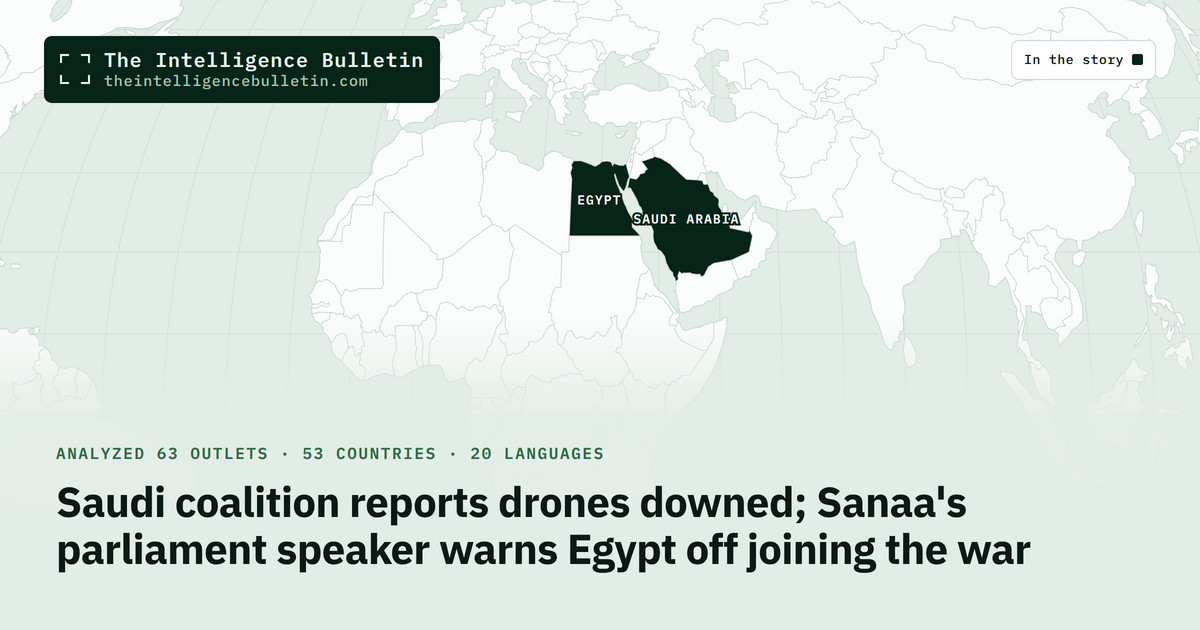
Saudi coalition officials say air defenses intercepted overnight drone and missile attacks without reported casualties. Egypt’s parliament meets Sunday on authorizing defensive support for Riyadh, while Sanaa’s parliament speaker warns any Egyptian entry makes Egypt a target.
Across the press: Arab News reports the interceptions as defensive success; The Hindu alone carries Houthi claims that Saudi strikes killed twelve civilians.
Source base: 5 outlets read in full (Saudi Arabia, Yemen, Iran, Egypt, India), selected from 63 analyzed.
- DisputedOver the previous day, Saudi airstrikes killed numerous people, including 12 civilians in Dhamar and Taiz, according to Houthi sources.Source: The Hindu, citing Houthi military spokesman Yahya Saree and a Houthi-affiliated agency; Arab News describes coalition strikes as targeting Houthi facilities only.
- 1 of 5 · Arab News onlyEarly Sunday, Saudi air defenses intercepted two ballistic missiles aimed at Khamis Mushayt and destroyed a drone over the Riyadh region.Arab News, citing Saudi-led coalition officials.
- 1 of 5 · Al Alam onlySanaa’s parliament speaker Yahya Ali al-Ra’i warned Egypt that joining Saudi against Yemen would pose a grave danger to Egypt’s national security and stability.Al Alam, reporting the speaker’s statement.
- 2 of 5 · reported separatelyOn Saturday the Saudi-led coalition intercepted and destroyed four drones over Riyadh, the Eastern Province and southern regions.Saudi coalition spokesman Turki al-Maliki, as reported by Arab News and The Hindu.
- 4 of 5 · reported separatelyEgypt’s parliament prepared to hold an emergency session Sunday to authorize President Sisi to take defensive measures in support of Saudi Arabia if requested.Al-Montasaf, The Hindu, Al Alam and FJ-P all report the session or Sisi’s request; Al-Montasaf cites the session announcement.
- Sunday, October 18, 2026Egypt’s House of Representatives votes on Sisi’s requested mandate; the result determines whether Cairo commits forces and on what terms.
- Within days of any voteSanaa’s warning that Egyptian bases, airports and the Suez Canal would become targets will be tested by any deployment or by further Houthi statements.
- Ongoing, through the coming daysSaudi Civil Defense alerts and coalition interceptions will show whether the overnight barrage was a one-off or a new sustained phase.
- Still openHas Saudi Arabia actually requested Egyptian defence measures, and for what specific threat — airport and oil-facility strikes, or a wider Houthi campaign? · Will Egypt s parliament grant the mandate unconditionally, and would any Egyptian deployment stay inside Saudi territory or reach Yemen?
- 18 Oct · Cairo s Sisi seeks parliament mandate to defend Saudi Arabia; Yemen s Al-Montasaf reads intervention , Okaz directives
- 15 Oct · Houthis target Aramco and Riyadh airport; Saudi accounts say intercepted, oil markets count a hit
- 12 Oct · Second Houthi strike on Riyadh airport kills one as Saudi and Yemeni outlets clash on war crime vs interception
- 13 Oct · Iran offers mediation after Houthi strikes force Riyadh airport closure
Full analysis
What happened Why it matters How each country tells it Where accounts conflict Room for disagreement Our assessment Sources and evidence
What happened
In the small hours of Sunday, October 18, civil-defense alerts told residents of Riyadh and Khamis Mushayt to shelter from a "hostile aerial threat"; minutes later the all-clear came and Saudi-led coalition officials announced that air defenses had intercepted two ballistic missiles aimed at Khamis Mushayt and destroyed a drone over the Riyadh region. Arab News alone carries that Sunday account, citing coalition officials and attaching no casualty figure. It was the second wave in twenty-four hours. On Saturday, coalition spokesman Maj. Gen. Turki al-Maliki said forces had "intercepted and destroyed four drones over the past few hours in the regions of Riyadh, the Eastern Province, and the South" — a tally both Arab News and The Hindu report — and added the destruction of two ballistic-missile launchers in Saada governorate.
Cairo moved while the alerts lifted. President Abdel Fattah el-Sisi asked parliament Saturday to convene an emergency session the next day empowering him to take the measures Saudi Arabia requests for its defense, insisting this meant "defence" and that he was "not talking about fighting anyone or attacking anyone." Four of the five outlets — Al-Montasaf, The Hindu, Al Alam and FJ-P — carry the session or the request; none says Riyadh has in fact asked.
Sanaa answered before the vote. Al Alam published the formal warning from Sanaa parliament speaker Yahya Ali al-Ra’i: joining Saudi "against the Yemeni republic" would pose a "grave danger" to Egypt’s "national security and internal stability," and he rejected "dragging Egypt of Arabism and history into a battle that does not resemble its values," accusing the Saudi "regime" of waging "aggression and siege" for more than twelve years and ending the de-escalation by striking Sanaa airport in July. A harsher version came through FJ-P, whose contributor relayed what he called a Sanaa military official’s statement that Egyptian airports, military bases and ports would be hit and the Suez Canal closed "if a single Egyptian plane takes off or a single Egyptian soldier moves or an Egyptian shell is fired at us," and that Egyptian personnel already inside Saudi territory had become "a legitimate target."
The exchange cuts both ways. The Hindu carries Houthi military spokesman Yahya Saree’s claim that Saudi Arabia conducted 53 strikes in 24 hours across Sanaa and six provinces, causing "numerous dead and wounded," and a Houthi-affiliated agency’s allegation that Saudi warplanes hit "civilian residences" in Dhamar and Taiz with cluster bombs, killing 12 people and wounding more than 30. Arab News describes the same campaign as airstrikes on "Houthi facilities and installations" aimed at stopping the militia from threatening government-held Yemen, the kingdom and shipping; it reports no civilian toll.
The barrage sits inside an escalation that reignited in July. A strike on Riyadh’s airport last week killed 13 people; the Education Ministry has extended remote learning in Riyadh and neighboring Diriyah, and foreign embassies are urging citizens to avoid Saudi airports. Arab News adds one defense-side element: Greek Defense Minister Nikos Dendias published a photo of himself at Greek Patriot batteries in Yanbu, the first public acknowledgment, Arab News says, that the Hellenic contingent protects the kingdom’s energy infrastructure. Iran renewed an offer to mediate; Yemen’s government rejected it, with Foreign Minister Afrah al-Zouba saying Tehran "is a party to the war against Yemenis, not a mediator."
Why it matters
Parliament’s Sunday vote concerns the largest Arab army weighing entry into a war that now reaches a G20 capital. FJ-P’s analysts attach the bill: Suez Canal revenues of $10.25 billion in 2023, tourism receipts of $16.7 billion in 2024-25, and $161.2 billion in external debt as of September 2025 — all exposed if the Suez threat is ever tested. Arab News presents the weekend as containment working: alerts lifted, interceptions announced, support arriving in Sisi’s offer and the now-public Greek Patriots. Al Alam, Iran’s Arabic channel, makes Egypt’s risk the story and casts Saudi Arabia as the side that broke the de-escalation. FJ-P frames the mandate as a transaction — "#Sisi_drags_Egypt_into_Yemen" — with contributors reaching for Nasser’s 1960s Yemen intervention and the 1967 defeat. The Hindu, the set’s only outside observer, holds the four-drone interception and the Houthi civilian-death claims in one dispatch. Al-Montasaf carries Egyptian MP Mustafa Bakri telling RT that any move is defensive and "not a prelude to a war inside Yemen." What the set never contains is Cairo’s own official voice: Sisi’s case reaches the reader through critics and a television parliamentarian.
How each country tells it
- Arab News · Saudi Arabia · original reportingLeads with the Saudi-led coalition’s official air-defense successes against missiles and drones, framing the overnight attack as contained.
- Al-Montasaf · Yemen · carries RTReports Egypt’s mandate through Egyptian MP Mustafa Bakri’s RT comments that any move is purely defensive and not a war inside Yemen.
- Al Alam · Iran · original reportingCarries Sanaa parliament speaker Yahya Ali al-Ra’i’s warning that Egypt should not join Saudi against Yemen and that doing so endangers Egypt’s security.
- FJ-P · Egypt · opinionUses the hashtag #Sisi_drags_Egypt_into_Yemen and social-media commentary to attack the mandate as selling Egypt for Saudi money and risking another war.
- The Hindu · India · wire copyGives a detached foreign-page summary pairing Saudi interceptions with Egypt’s mandate and including both Iranian mediation and Houthi civilian-casualty claims.
Where accounts conflict
The sharpest conflict is the weekend’s cost inside Yemen. The Hindu, citing Saree, reports a day of Saudi strikes leaving "numerous dead and wounded" and relays the Houthi-affiliated agency’s accusation that 12 civilians died and more than 30 were wounded by cluster bombs in Dhamar and Taiz. Arab News, citing the coalition, describes the same operations as hitting Houthi facilities only, with no civilian figure at all. Both cannot be complete: either Saudi aircraft killed civilians with banned munitions, as Houthi-linked sources say, or the strikes hit only Houthi targets and the toll is Sanaa’s invention. One version rests on a belligerent’s spokesmen and its agency; the other on the coalition’s statements issued after the fact.
Room for disagreement
The strongest case that this will not stay contained is that Sanaa has announced the rules and shown the will to follow them. Al Alam’s reporting has Sanaa holding that the July strike on its airport ended the de-escalation, and the Sanaa foreign ministry pledging "siege for siege and escalation for escalation" — a formula for answering each round with a larger one. The relayed military warning’s threshold is any Egyptian move at all, and the cluster-bomb allegation, if partly true, means each Saudi strike manufactures the escalation Cairo would be asked to defend against. On Riyadh’s side, the defenses Arab News describes as holding were breached with mass casualties as recently as last week, so the containment is a knife’s-edge, not a settled fact. Egypt’s opposition concedes the vote is decided, which shifts the question to execution: TIB’s October 18 edition reported that Sisi said Egypt would act "according to the directives of King Salman," a commitment that makes a future Saudi request hard to decline.
Our assessment
It is likely that the overnight barrage was not a one-off but part of a sustained phase in which the Houthis probe Riyadh’s defenses and the kingdom absorbs while trading strikes, a phase that will keep arriving until something forces a stop. The warrant is the convergence of independent reporting chains: the Saturday four-drone interception appears in both Arab News and The Hindu, Al Alam carries Sanaa’s own claim that it chose to end the de-escalation, and The Hindu’s inclusion of a cumulative-strike figure shows two sides trading blows at a tempo. Every party has an interest in its version — Riyadh in a shield that holds, Sanaa in a capital within reach and an Egypt deterred, Cairo’s opposition in a bill the country cannot pay — and simultaneous independent accounts of an ongoing exchange outweigh any single frame. Egypt’s parliament will grant the mandate, as even FJ-P’s commentators concede the outcome is decided, but nothing in this set points to forces about to move; the likelier path is a Cairo waiting on a Saudi request that has not come, the Suez threat doing its deterrent work.
What would change this: a new barrage that again breaks through and kills civilians, or a Saudi request that Cairo then honors with troops.
Sources and evidence
Press quoted
- Has Riyadh actually requested Egyptian defense measures, and against what specific threat?
- Will Egypt’s parliament grant the mandate unconditionally, and would any deployment stay inside Saudi territory or reach Yemen?
- Did Sunday’s interceptions result in debris falling in populated areas, and were there any casualties or damage?
That’s how the world told the story.
Get our daily open-source intelligence on world events in your inbox — one email a day, up to six stories.
Subscribe freeNo spam. One-click unsubscribe. See the latest email →