 AI-generated analysis published under the editorial responsibility of Rohit Sinnas. How it works →
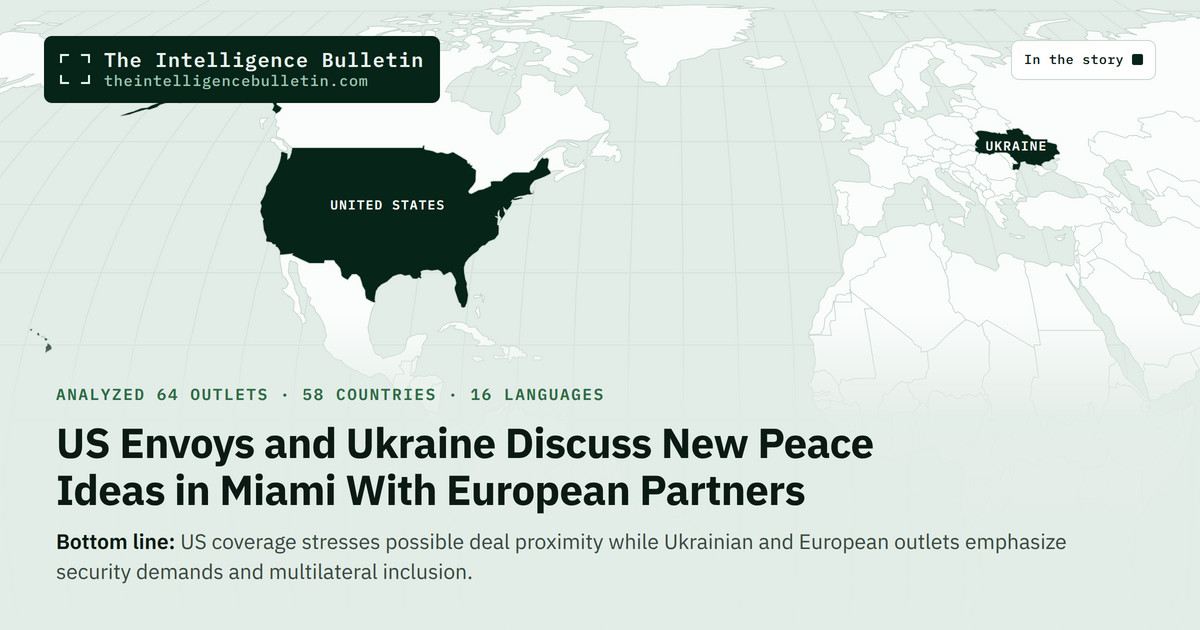
| Press analyzed | 64 outlets · 58 countries · 16 languages |
| Press quoted | 5 sources, each independently reported |
See the 58 countries
Algeria, Argentina, Armenia, Australia, Azerbaijan, Belarus, Belgium, Benin, Bosnia and Herzegovina, Brazil, Brunei, Bulgaria, Canada, China, Croatia, Cuba, Czech Republic, Egypt, Estonia, Finland, France, Germany, Ghana, Greece, Hungary, India, Ireland, Israel, Italy, Jordan, Latvia, Lebanon, Lithuania, Luxembourg, Moldova, New Zealand, Nigeria, Oman, Pakistan, Poland, Qatar, Romania, Russia, Saudi Arabia, Somalia, South Africa, Spain, Switzerland, Syria, Taiwan, Turkey, Tuvalu, Ukraine, United Arab Emirates, United Kingdom, United States, Uruguay, Yemen
US coverage stresses possible deal proximity while Ukrainian and European outlets emphasize security demands and multilateral inclusion.
- Single sourceThe meeting was described as constructive with continued diplomatic efforts planned, though no specific agreements were announced.Source: Witkoff statement via 24 TV and České noviny (Reuters)
- Independently reportedUS envoys Witkoff and Kushner met Ukrainian negotiators and European officials in Miami on October 9 to discuss new ideas for ending the war.Source: Townhall, Kyiv Post, RTÉ, 24 TV, České noviny
- Independently reportedDiscussions covered security guarantees for Ukraine, a post-war prosperity plan, limited ceasefire on energy infrastructure and grain, and winter preparations.Source: Townhall (US source), Kyiv Post (Axios/Reuters), 24 TV (Witkoff)
- Independently reportedNational security advisers from UK, France, Germany plus NATO and EU officials were invited to join.Source: Townhall (US source), Kyiv Post (Axios)
- Will Witkoff and Kushner travel to Moscow later in October with a unified proposal?
- What specific new ideas were presented and how do they differ from prior proposals?
- Did the talks produce any private agreements on limited ceasefires despite public statements?
Press quoted
Full analysis
US Special Envoys Steve Witkoff and Jared Kushner sat down with Ukrainian negotiators in Miami on October 9 for closed talks aimed at breaking the deadlock in efforts to end Russia’s war against Ukraine. The Ukrainian side included Kyrylo Budanov, head of the presidential office, Rustem Umerov of the foreign intelligence service, Davyd Arakhamia of the ruling party parliamentary faction, and Sergiy Kyslytsya. National security advisers from Britain, France and Germany joined, along with officials from NATO and the European Union. The session, held at the Shell Bay Club in Florida, was scheduled to run two days but reports indicated it concluded after one.
The agenda centered on new ideas and proposals the American envoys had developed during earlier visits to Moscow and Kyiv in September. Those ideas included security guarantees for Ukraine, a post-war economic recovery plan, and short-term measures to prepare for winter such as protections for energy infrastructure and grain shipments. A US source told Townhall that European participants voiced frustrations over high energy costs and other financial impacts of the war, noting that all sides were nervous about the coming winter. The same source described the American goal as creating a unified proposal that Washington could then take to Moscow. Witkoff later posted that the discussion on possible paths to de-escalation and ending the war ahead of winter had been constructive, confirming continued diplomatic efforts without announcing concrete agreements.
Ukrainian President Volodymyr Zelensky confirmed the meeting in advance and stated that his team would discuss a possible limited ceasefire covering attacks on energy facilities and grain shipments. He said Ukraine was ready to consider such arrangements but avoided predicting outcomes, noting that Russia had previously acted contrary to expectations. The envoys had briefed President Trump the day before the Miami session, and reports indicated they might travel to Moscow later in October to present whatever unified position emerged. Kremlin spokesman Dmitry Peskov had earlier described the diplomatic process as stalled and rejected temporary or limited ceasefires in favor of a comprehensive settlement.
The Miami gathering followed a pattern of intensified US mediation under the Trump administration. Witkoff and Kushner had conducted separate visits to Russian President Vladimir Putin and Zelensky in early September. Those meetings produced updated proposals that the October 9 session was meant to refine. Trump had spoken with Putin earlier in the week, though that call focused in part on other matters including diesel fuel supplies. Zelensky had previously called for pushing Russia toward diplomacy rather than continued strikes, and recent Russian attacks on Ukrainian cities including Kramatorsk had killed dozens in the days leading up to the talks.
Coverage across the five outlets converged on the core facts of who attended and what topics were on the table. All reported the same Ukrainian delegation members, the invitation of European and NATO officials, and the emphasis on security guarantees alongside winter preparations. The description of the talks as constructive came from Witkoff’s public statement and appeared in both the Ukrainian Russian-language outlet and the Czech report. No outlet claimed a breakthrough or specific new agreement.
The accounts diverged in emphasis. Townhall, drawing on a US source, presented the session as evidence that a deal might be near by stressing envoy momentum and the relief of a prolonged stalemate. It highlighted European anxieties over energy costs as a factor pushing all parties toward progress. In contrast, the Kyiv Post report, citing US and Ukrainian officials, foregrounded Kyiv’s demand for stronger pressure on Russia before any concessions and noted the possibility of a follow-up Moscow trip as the real test of whether the new ideas could bridge differences. RTÉ, relaying AFP, placed particular weight on the enlarged format that brought in Britain, Germany, France, NATO and the EU alongside the US-Ukraine core, presenting the meeting as a deliberate broadening of the diplomatic table. The Czech outlet echoed the constructive tone from Witkoff but gave less detail on European participation and instead noted Zelensky’s timeline for possible trilateral talks by the end of October along with Kremlin comments on prior stalled efforts.
The 24 TV account added specifics on the closed venue and Witkoff’s post-meeting statement about short-term winter measures and long-term security arrangements, while citing a report that the second day of talks had been canceled. These differences in framing track national stakes. The US outlet sees movement toward resolution as the story worth leading with. Ukrainian outlets register the same movement but tie it to Kyiv’s insistence on leverage and guarantees. The Irish report registers the same movement but registers the European role as newly prominent. The Czech report registers the movement but registers the constructive label as the takeaway.
The absence of any direct Russian commentary in these reports leaves the viability of the limited ceasefire ideas untested from Moscow’s perspective. Ukrainian sources in the set stress that stronger pressure on Russia remains a precondition for meaningful progress, which makes the lack of a Russian voice a practical gap rather than a minor omission. All five sources agree that the meeting produced no public agreements, so the next measurable step remains whether Witkoff and Kushner carry a unified proposal to Moscow and whether that proposal survives contact with Russian conditions.
What to Watch
The reporting that best matches the available evidence is the process-oriented accounts from Kyiv Post, RTÉ and 24 TV. They record the same attendee list and agenda items that Townhall and the Czech outlet also carry, yet they avoid framing the session as evidence of imminent closure when no agreements were announced and when the Kremlin has already signaled preference for comprehensive rather than incremental steps. The national interests at play explain the variations: an American outlet has reason to present diplomatic activity as forward motion, while outlets closer to the conflict register the same activity as one more round of testing whether leverage can be increased. The corroborated elements across independent chains—the participants, the topics, the absence of announced results—provide the firmest ground for expecting continued closed diplomacy rather than a sudden shift in the battlefield or a rapid trilateral summit.
That’s how the world told the story.
Get our daily open-source intelligence on world events in your inbox — one email a day, up to six stories.
Subscribe freeNo spam. One-click unsubscribe. See the latest email →